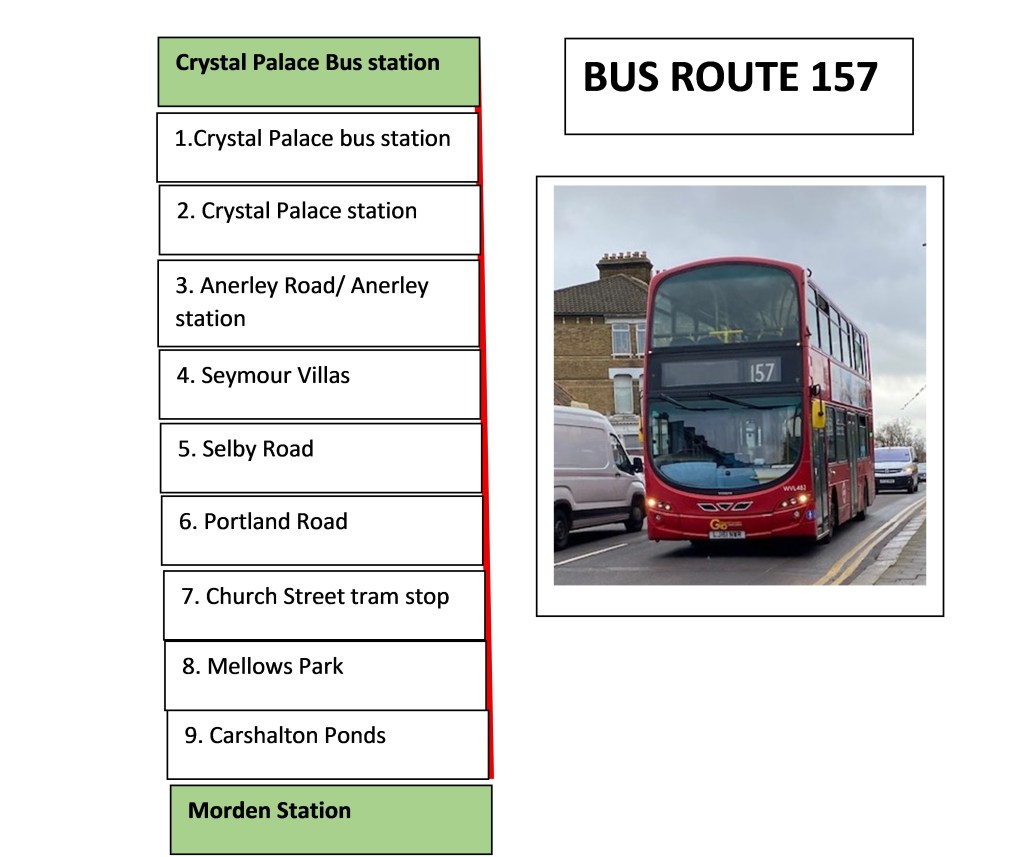
Crystal Palace bus station to Morden station
Highlights:
- Croydon Minster
- Carshalton Ponds and surrounding area
1. Crystal Palace bus station bus stop
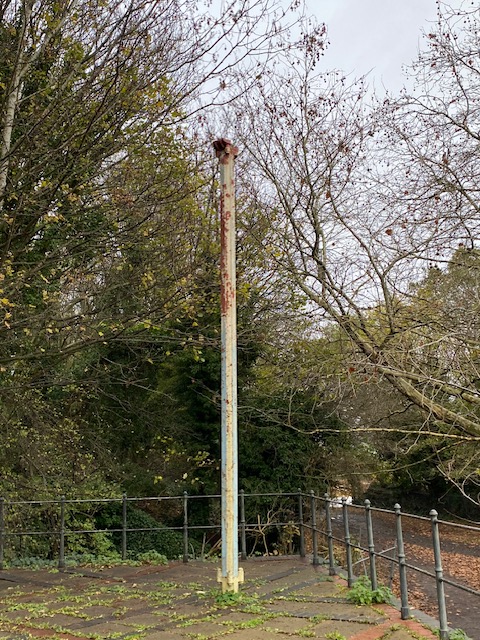
Before getting on the bus, walk round to see a couple of things within the vicinity of Crystal Palace Park. It’s currently (November 2025) undergoing renovation, but it’s still possible to see various places. First of all, head towards the Iron Column that was from the original Great Exhibition Pavilion of 1851. It’s one of the few surviving elements of Joseph Paxton’s pavilion and has been designated grade II. The original pavilion had been in Hyde Park for the Great Exhibition and it was deemed to be too important to just be dismantled and forgotten about and so it was transported to Sydenham Hill, which has since been renamed Crystal Palace. More than 3,000 of these iron columns were used for making the pavilion.
At the same spot as the column is Crystal Palace Museum, which is only open on Sundays (but do check before you go, because the website says it’s temporarily closed due to fire repairs). The museum tells the story of both the Hyde Park and Sydenham Crystal Palaces. It’s the only surviving building constructed by the Crystal Palace Company and had been built around 1880 as a lecture room for the Crystal Palace Company’s School of Practical Engineering. The story of both palaces is told in a series of unique images and large scaled models of the Crystal Palace. There are showcases displaying ceramics and other items associated with the Crystal Palace including remnants from the original building. It definitely would be worth visiting, once open.

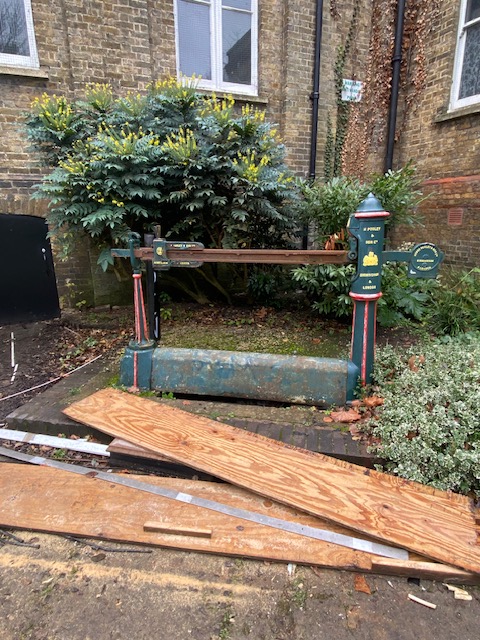
2. Crystal Palace station bus stop
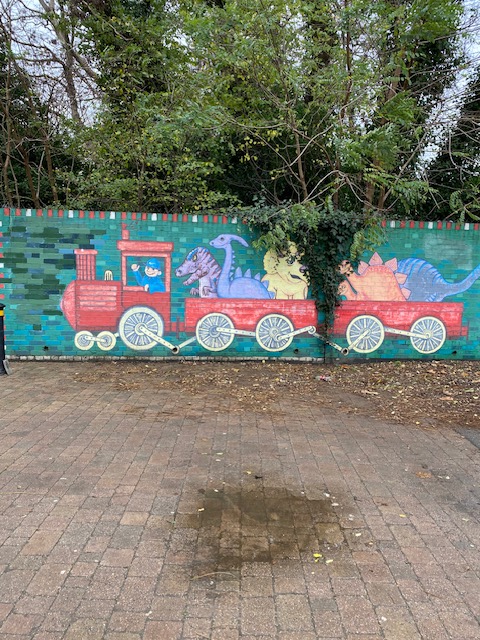
Inside the station is a taste of what’s in store in Crystal Palace Park. There is a dinosaur head above one of the doorways and the feel of the booking hall is distinctly Victorian. Just outside is another reference to the amusement that the kids will have, with a colourful mural of a train carrying dinosaurs – though they seem to be going away from the Dinosaur Park, not towards it!
Remember that the park is being regenerated so some of the attractions aren’t available to see. But it’s still possible to catch some of the animals in the Crystal Palace Park Farm – in particular the sheep and goats even when the farm is closed – and walk further round the pathway and you’ll see a (sculptured) Hylaeosaurus Head. This is the original head, displayed separate from the dinosaur park and is on a hill overlooking the park. This is an historic artifact and is part of the larger collection of sculptures from the 1850s, which were some of the first attempts at dinosaur reconstruction. It had fallen off the original sculpture owing to its heavy weight.



While you find your way back to the bus stop, you’ll pass the athletic stadium and the Crystal Palace Transmitting Station. The stadium is part of the Crystal Palace National Sports Centre and has a 400m 8-lane track for all track and field events. There’s seating for 16,500 people with 9,500 covered. The transmitter is on the site of the former television station and transmitter operated by John Logie Baird from 1933. The station is the eighth-tallest structure in London and is the highest structure above sea level in London.


3. Anerley Road/Anerley Station bus stop
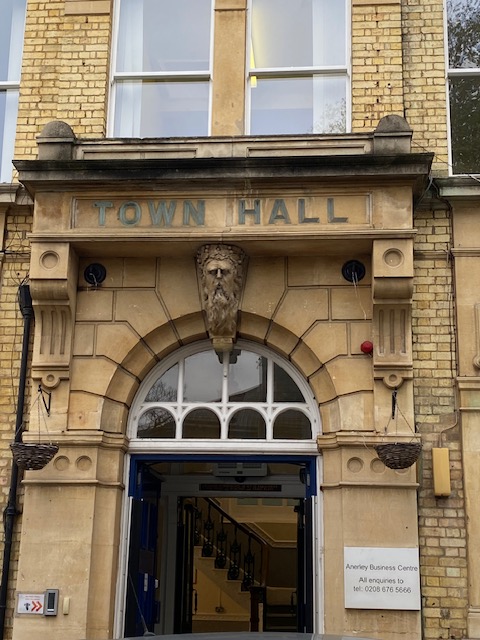
The bus stops outside Anerley Town Hall, which started out as Anerley Vestry Hall and was built in 1878 at a cost of £4,341. It became the Town Hall in 1900 following the London Government Act of 1899. It was considerably enlarged in 1911 and contained offices, a council chamber, committee rooms and a public hall. A petty sessional court (known today as a magistrate’s court) later opened in 1925. Over the years, the building has been under threat but it has been renovated and converted into 28 offices, serving as both town hall and a business centre. The original design was Italianate with a zinc-clad clock-tower containing a clock by Messrs Smith of Clerkenwell, which is still there.


4. Seymour Villas bus stop
This is the stop for Betts Park and the Croydon Canal. The park has been here since at least Saxon times when it was a common and given to thane Lyfing by King Eadwig for services rendered. It eventually passed down to the Earl Spencer. The canal was built in 1806.
The public park was initially created from a house and land donated by Mr. Frederick Betts, a local property owner. The house, a Victorian villa, became a public library and the gardens became recreation grounds. Betts Park was opened in December 1928 and named in memory of Frederick’s late mother, Sarah Betts.
One of the main features of the park is an obelisk called “Heart of Anerley”. It was erected in 2024 as a monument to all the people whose names are never written on monuments. There has been some controversy and plenty of comments about the shape of the obelisk – I’ll leave it to your imagination as to why …
The Croydon canal opened in 1809 and closed in 1836, the first canal to be abandoned by an act of Parliament. It was always in competition with the Grand Surrey Canal, which had already had its petition passed, so Croydon joined up with the Grand Surrey Canal instead of with the Thames. Despite all this, there was a grand opening of the canal with a procession that left Sydenham at 11am on Monday 23 October 1809 to a band playing “God save the King” and a 21 gun salute. Sadly however, the canal was never a success and was subsequently used by the London and Croydon Railway Company, which had bought the canal, for part of the railway between London Bridge and West Croydon station. The canal that can be seen in Betts Park is all that remains of the original.


5. Portland Road bus stop
As you get out of the bus, you’ll pass under the Portland Road railway bridge where there is an extensive mosaic. This consists of nine panels divided into three spaces underneath the bridge. The colour palette is minimalist, mainly consisting of green, white and brown pieces of glass and ceramic. It offers a chance to tune into the local history of South Norwood and the ideas of the local community in the 1990s.
The third of the mosaic shown here tells the story of the Great North Wood, showing images of trees, plants, dancers, oaks, bonfires, and modern people enjoying the outdoors. This is paired with words such as ‘charcoal burners’, ‘forest dwellers’ and ‘recreation’.


Now head towards the South Norwood Clock Tower which was created in 1907 by Gillett & Johnston of Croydon and is a replica of Little Ben which is found in Victoria. The Little Ben clock design was registered although there are only a small number of copies, one of them being the South Norwood Clock Tower.
This clock tower was built because local people wanted to mark the golden wedding anniversary of William and Eliza Stanley who had done so much for the area – including employing many local people and creating Stanley Halls and Stanley Technical School.
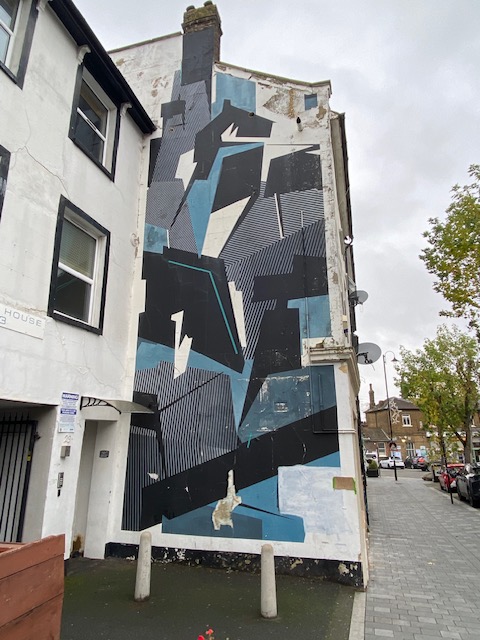
Adjacent to the clock are a couple of murals, one of which is by Polish artist Seikon. He has travelled extensively around the globe and paints murals wherever he can. He says “There are no questions about how big or how colourful the wall is. The point is to enjoy time during the process and finish when you feel happy with your realisation.” This one here in South Norwood was one such and although is looking slightly the worse for wear, is still pleasing to the eye.
The second mural, opposite Seikon’s, is by an anonymous artist and of an indeterminate topic. If you know what it is and who created it, do please let me know!


6. Church Street tram stop bus stop
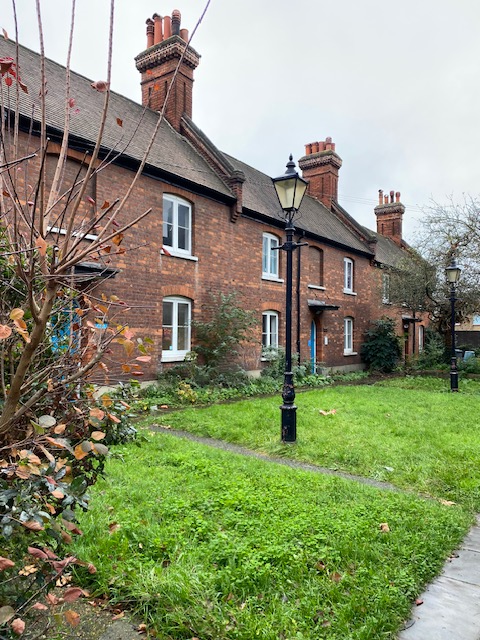
If you didn’t know about Croydon Minster, then do read here and visit it when you can. The bus stops a short walk away and on the way to the Minster, you’ll pass some Elis David Almshouses – some were seen on bus route 154 but these ones here are considerably older and date from 1875 – 1887. The almshouses were founded in 1476 by Elye Davy, a successful London cloth merchant who had been inspired by Richard Whittington, also a cloth merchant, to build an almshouse. The almshouses were founded in perpetuity and intended to be a community of prayer and care.
Now walk to Croydon Minster and be very pleasantly surprised by its magnificence and grandeur. It feels as if it’s out of place and should be in a more majestic setting – and talking to the team inside, this is exactly what they are planning to do in the coming months. As the word Minster is derived from Monasterium, you realise that this was once somewhere that monks used to inhabit. The church was established in Saxon times and is indeed mentioned in the Domesday Book of 1086. The medieval building underwent some restoration in the 1850s, but on 5 January 1867, a fire broke out which eventually gutted the entire building. It was rebuilt over the next two years, incorporating some of the medieval remains (notably the west tower and south porch).
There are six archbishops of Canterbury buried in Croydon Minster, including Gilbert Sheldon and John Whitgift. In fact, next door to the church was Croydon Palace, a residence of the Archbishop of Canterbury from at least the beginning of the 13th century to the beginning of the 19th.
Inside, there is much to see. The beautiful stained glass window depicts scenes of the life of Christ. These were installed after the fire by the Victorian firm Clayton and Bell. Beneath the window is an alabaster reredos (ornamental screen) carved with reliefs of the nativity, crucifixion and resurrection. There is a Victorian octagonal font made from alabaster which depicts biblical scenes of baptism. Above it hangs a very tall canopy, in medieval style, originally with carved figures of Archbishops Davidson, Sheldon and Whitgift, and is topped with a self-wounding pelican.
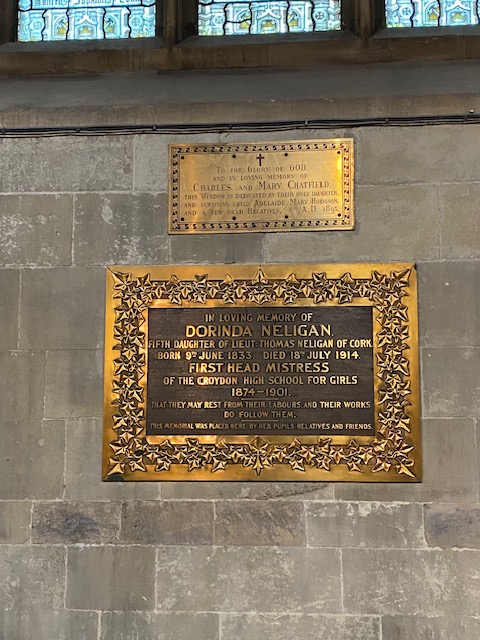
In the north aisle is a plaque commemorating the distinguished American-born artist, John Singleton Copley R.A. (1737-1815), who is buried in the churchyard. Along from this plaque is one dedicated to Dorinda Neligan, the first head mistress of Croydon High School for Girls as well as a prominent Suffragette. She died in 1914, so missed the results of her efforts – and her co-suffragettes – that some women got the vote a few years later.




7. Mellows Park bus stop
Mellows Park is another of the borough’s open spaces. It’s got lots of open grassland and trees as well as a well-stocked and warm Pavilion café. There are plenty of sports facilities – including a playground for the little ones, tennis courts and football pitches. The park was established after local councillor and benefactor, Frank le Maitre Mellows, purchased the land in 1913 to prevent its development. He sold the land to the council at cost with the stipulation that it would remain a public recreational space, which it does today. The park is named after him and also contains the remains of a WWII air raid shelter.


8. Carshalton Ponds bus stop
The number 127 also stops here but there is plenty to see, so it’s worth a visit. The Honeywood Museum which is situated on the side of one of the ponds, was described in some detail in that blog and wasn’t visited again on this route.
The two adjoining Carshalton ponds are really picturesque. Historically, the ponds were fed by natural springs and streams. The lower east pond was divided from the upper west pond in the 15th century and used as a reservoir for a mill. These days, the ponds are home to various wildlife, including ducks and swans, making them a popular spot for locals and visitors to enjoy a leisurely walk or a moment of tranquillity.
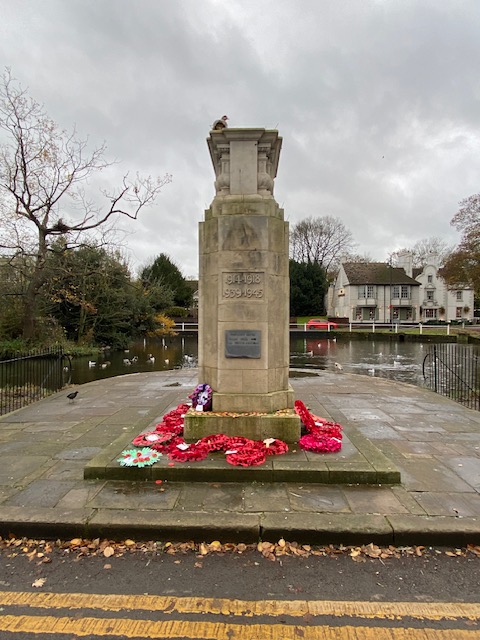
Next to one of the ponds is the Carshalton war memorial. It’s a stone block rectangular cenotaph, surmounted by an ornate altar. The original bronze plaques were stolen by thieves and later replaced through the generosity of local businessmen. The memorial is dedicated to those who died in both world wars and the conflicts in Aden and Northern Ireland. Opposite the cenotaph is a small memorial garden, with benches for resting and reflecting.


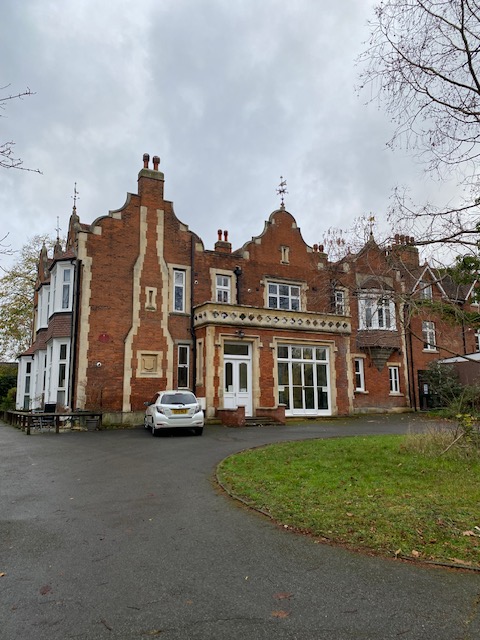
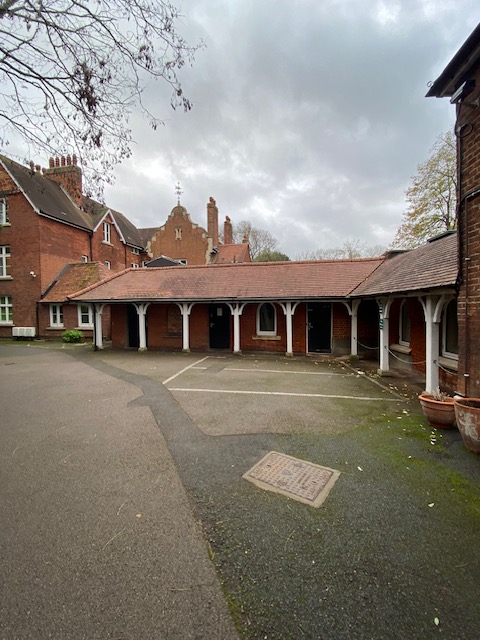
Round the corner is tucked the Sutton Ecology Centre, the grounds of which are a Local Nature Reserve and Site of Borough Importance for Nature Conservation. The area was recorded as an orchard called Cook’s Orchard from 1590. In the 18thC, it was the kitchen garden for Stone Court, which was demolished in about 1800. The grounds also include The Old Rectory, built in the early 18thC. The Ecology Centre opened in 1989. As you walk around the grounds, you will find information about the various habitats such as ponds, woodland, meadows and marshlands. There are also small demonstration gardens.
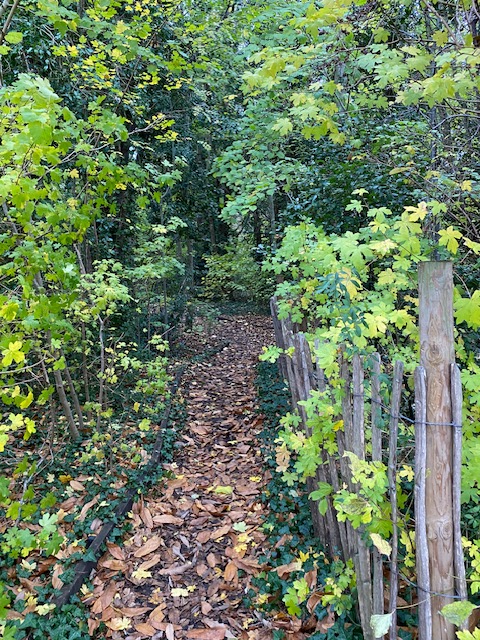

The Ecology Centre was a lovely place to end this route. Yet again, there was plenty to engross and engage with the highlight being Croydon Minster. Revisiting Crystal Palace was a treat, despite the fact that the park is being renovated. I still managed to find places in the area that I hadn’t come across before. It was lucky that the rain stayed away, since most of the places I had planned on seeing were outdoors. Also, visiting in winter gives a different perspective than the spring or summer, which is the last time I had seen parts of the route, most notably Carshalton Ponds. All in all, a worthwhile day out with plenty to interest all tastes.
Toilets that are open to the public and free of charge:
- MacDonald’s Crystal Palace
- Croydon Minster
 london routemistress