
Wimbledon bus station to Vauxhall bus station
Highlights:
- Sculptures – Women Walking, Fanny Wilkinson and installations at Effra Quay
- Steam Works Gallery
- Sambrook’s Brewery
1. Wimbledon station bus stop
Near the bus stop is the Prince of Wales pub which dates back to the 1860s and was built during a period of expansion in the area. It was probably named after Victoria and Albert’s oldest son, who later became Edward VII. The pub was famously renamed the Princess of Wales in 1997 to honour Princess Diana, though it reverted to its original name in 2010. It was once used as an auction house when Wimbledon was being built and local developers were selling off land and then houses. And one of its claims to fame is that it had its own lunchtime theatre in the 1970s, set up by local actor Michael Robbins, who had found fame in TV sitcom On the Buses.
Over the road is an interesting sculpture called Walking Women. The artwork is of two larger-than-life women, who appear to be striding purposefully towards you when you encounter the statue, striking a pose which is left up to the viewer’s own interpretation.
Head into Wimbledon Quarter, a shopping mall with the usual array of shops. Also see the welcoming Fire Station café housed in a Grade II listed building which was Wimbledon’s former fire station from 1904 to 1980. It only became a café in January 2025. The conversion has managed to retain certain elements such as the original signage and brickwork, blending the building’s past with its current use.


2. Avondale Road bus stop
This is the stop for Gap Road Cemetery where there are two lovely disused chapels, one was for Church of England services and another for Dissenters (Nonconformists). There are also many war graves here and the cemetery is well maintained. The two Gothic chapels with spires, are attractive and have been kept in good condition. It’s not obvious why neither is in use today, especially as new burials are still taking place.


3. Standen Road bus stop
Walk round the corner and you will find Coronation Gardens, a small green space, most noted for the water feature with a cute bronze statue of Fanny Wilkinson. She was the first professional female landscape designer in Britain, being responsible for the design and layout of more than 75 public gardens across London, including Coronation Gardens. The recently restored water fountain on which the statue has been placed, was originally installed in 1904. Coronation Gardens dates back to 1902 and commemorates the coronation of King Edward VII in August of that year. It was donated to the people of Wandsworth by Sir William Lancaster, a businessman, philanthropist and politician who served as the second Mayor of Wandsworth between 1901 and 1902.


My research led me to believe that there is a theatre nearby but I wasn’t able to locate it so I went instead inside the Earl Spencer pub, which has a long history, dating back to the late 1800s. It has undergone several name changes before reverting to its original name in 2004. The building is an Edwardian structure, and these days, the pub has a reputation for its gastropub food and a quiet, traditional atmosphere. The Earls Spencer historically owned significant amounts of land that included parts of modern-day Southfields, so although they did not live there, it seems fitting that a pub is named after an ancestor of the present Earl.


4. The Park Tavern bus stop
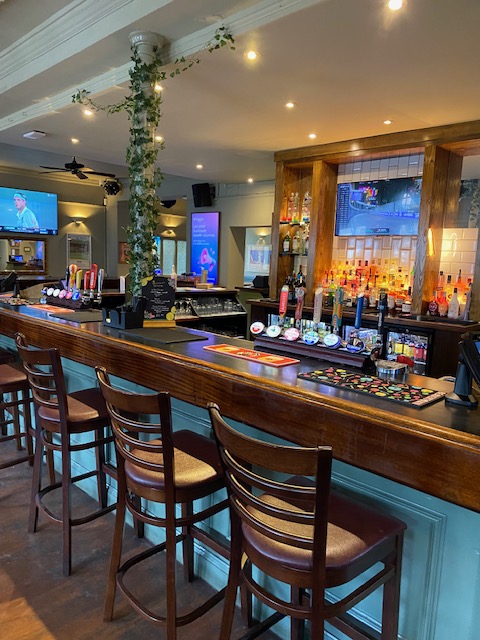
Another pub of note along this route is the Park Tavern. The pub was built in two stages: the original pub was constructed in 1902, and a large, single-story extension was added in 1926. Although the Park is not a listed building, it is a Two Star pub on the Campaign for Real Ale’s (CAMRA) National Inventory, mainly on account of its interior that has little changed since its construction.


5. Wandsworth Plain bus stop
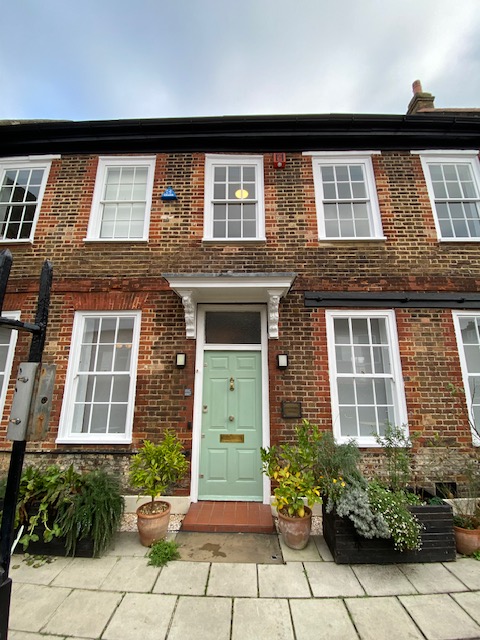
This is a great stop where there are a couple of diverse places to see. Start off at Steam Works Gallery, housed in Wentworth House, a grade II listed Georgian building, built in the early 18th C. It was at one time home to the Wentworth Family whose firm manufactured beam engines, and supplied two to the nearby Ram Brewery. Wentworth House is one of the few surviving residential buildings from Wandsworth’s first phase of industrialisation, when proprietors lived next to or within their businesses. These days it’s an artist-run studio that was founded by artist Mark Nader in response to a lack of long-term studio provision for creative practitioners in London. Only opened in 2024, it’s a mixed use site with 17 studio spaces, a project space with two attached artist residencies, gallery space and communal rooms.
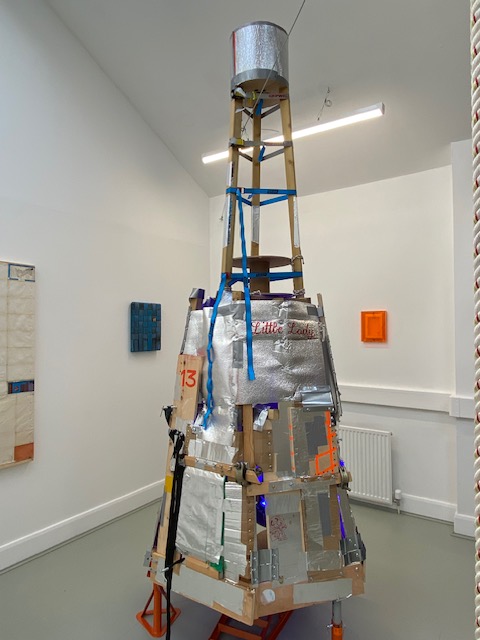
The current exhibition (Nov/Dec 2025) is Mercury 13 by artist Eva Dixon. Eva created her exhibition in deference to the mission of the same name, where 13 women, having passed arduous Astronaut training, were denied their chance at space flight after the programme was scrapped in 1962. One of the ladies who had passed the astronaut training was Wally Funk, an American aviation pioneer and member of the Mercury 13 team. The command module exhibit imagines that she actually was the first American woman sent to space in 1961.
It’s worth noting that on July 1, 2021, Blue Origin announced that Wally Funk would fly on the first New Shepard flight with passengers, one of only four on the flight, including Jeff Bezos, his brother Mark, and 18-year-old Oliver Daemen from the Netherlands, who became the youngest ever person in space. During the successful flight Funk, at age 82, became the oldest person to fly to space.
As well as the make-shift command module using reclaimed timber and (stolen!) street signs, on display are also exhibits made from woven fire hose.

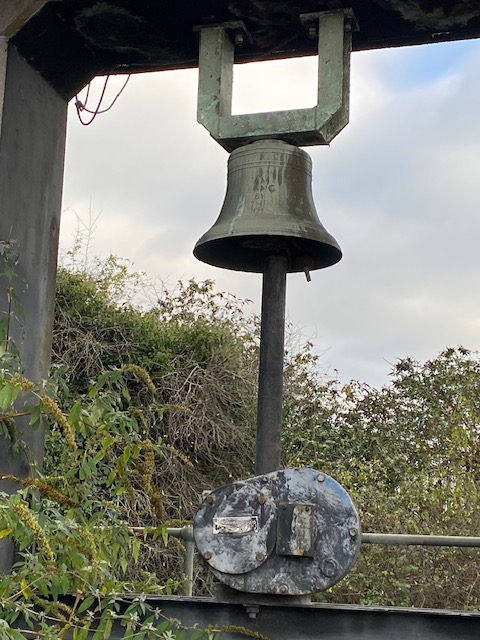
Now walk towards Bell Lane Creek, a Grade II ecology site. The sluice gate structure has been used for a DELTA (flood prevention) project and from it has been hung a bell, rung by the tides – four times in every 24 hours. Round the corner from here is The Spit, a nature reserve situated on a promontory of land at the mouth of the River Wandle. Wetland terraces were created to enhance the ecological value of the river and form a crossing boardwalk leading out to an ‘island’ at high water. The river walls have been reduced in height to allow the high tides to flood the terraces, creating a range of conditions suitable for wetland plant species. The small island houses a sculpture by artist Sophie Horton, entitled “Sail” made from recycled wood and designed to resemble a dinghy’s sail. Beyond the sculpture are views of the river – this is the location where the Wandle meets the Thames.


6. Wandsworth Town Hall bus stop
It’s possible to walk from the previous places to Sambrook’s Brewery, or just hop on the 156 for one stop. It’s set in the former Young’s Ram Brewery buildings in Wandsworth, the oldest continuously brewing site in the UK, with roots tracing back to the 1550s. Structures like the Boiler House and Chimney House were built around the 1830s, with significant rebuilding occurring between 1882 and 1883 after a fire in 1882. Once Young’s left, brewer John Hatch, a former Young’s employee, maintained a “nano-brewery” on-site, ensuring brewing tradition continued.
Sambrook’s was founded in 2008, and in 2020, took over this historic site, thus bringing the tradition of brewing back to the location. They have established a Heritage Centre in the buildings to document the site’s extensive brewing history, which includes remaining artifacts like beam engines and coppers. The Sambrook’s Taproom is situated in one of the former industrial buildings, and still has a fermenting tank and a very welcome array of drinks, hot and cold, to be supped in a cosy, warm environment.


7. Battersea Dogs and Cats Home bus stop
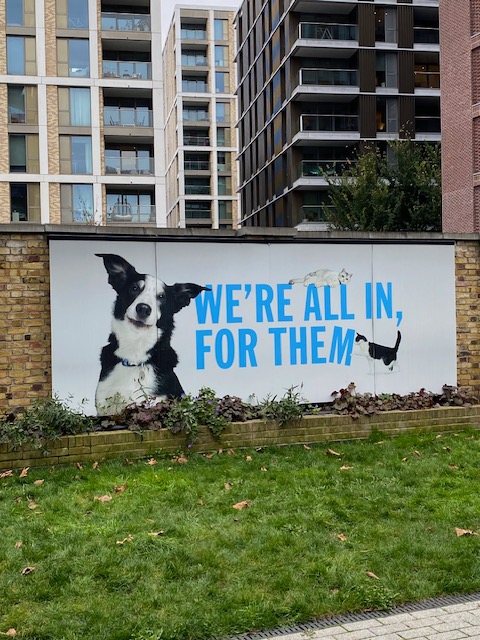
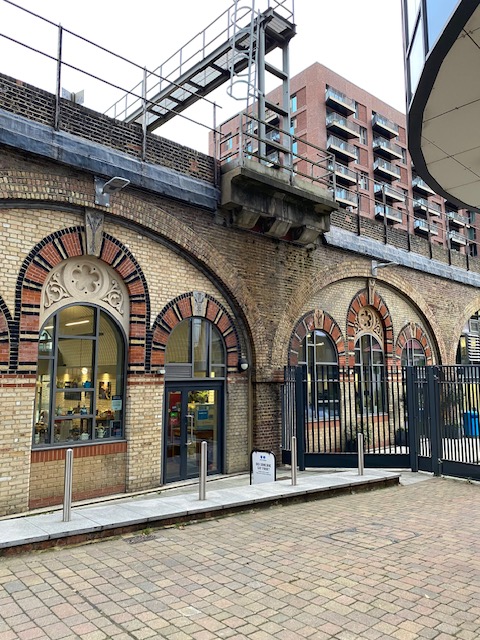
The bus stops outside Battersea Dogs and Cats Home which was founded by Mary Tealby in 1860 as the “Temporary Home for Lost and Starving Dogs” in Holloway, North London, before moving to its current Battersea location in 1871. After a public meeting in 1883, cats were included and its role was further solidified when Queen Victoria became its patron in 1885. From its beginnings as a small, volunteer-run stable-yard, these days it’s a large, multi-site organisation that has cared for millions of animals. Battersea rescues dogs and cats until their owner or a new one can be found and at any one time, it cares for an average of 240 dogs and 145 cats across all three of its centres.
Mary Tealby had lived in Hull, at the time when the first RSPCA was formed in 1840. She moved to London, to look after her ailing mother, and while there, cared for an abandoned dog that had been found by one of her friends. The dog died and she decided to set up a place where abandoned dogs could be cared for. The rest, as they say, is history.

8. Vauxhall Bus Station bus stop
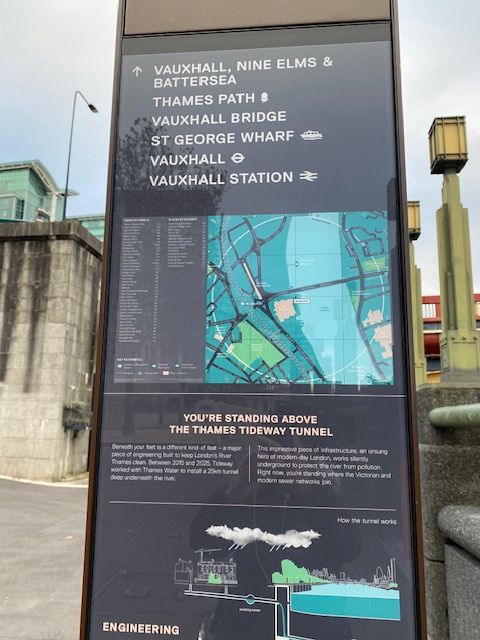
Final stop on this route is at Vauxhall where outside the station is a staircase with the names of local shops on each of the risers, in different colours. A few minutes’ walk from here is the Isle of Effra and Effra Quay, two new areas of foreshore. The spaces get their name from the fact that one of the two Combined Sewer Overflows (CSOs) that connect to the main tunnel at this site was previously the River Effra. The Effra was one of London’s ‘lost’ rivers, Thames tributaries which became so polluted they were put in underground pipes to form part of London’s first sewerage system.
Fast flowing currents in this part of the river have created challenging conditions for the establishment of planting on lower terraces but planting on the upper terrace has been successful. At Effra Quay, artist Richard Wentworth has created a set of bronze-cast sculptural seats, enabling people to sit and look out across the river. Also here are two giant bronze ventilation columns, serving as an exhaust system, by removing air displaced by flows into London’s new super sewer. This air will be filtered through air treatment chambers. There are 19 of these columns along the Thames and each one is inscribed with newly commissioned poetry celebrating the local area’s heritage, often with reference to London’s ‘lost rivers’. One of which is the river Effra.



Despite the fact that it was a bitterly cold day, there was much to enjoy and appreciate on this route. There were a good selection of interesting sculptures – Walking Women at the start of the route in Wimbledon, the lovely small statue of Fanny Wilkinson in Coronation Gardens and the bronze seats at Effra Quay. Luckily there were a couple of buildings where I could thaw out – Steam Works Gallery where I spent a very pleasant time chatting to the artist in residence, Eva Dixon and Sambrook’s Brewery where I was given a very welcome cuppa! The outside spaces were worth seeing too, from the Bell at Bell Lane Creek to Effra Quay and the Isle of Effra. All in all, I would recommend the 156, although perhaps on a warmer day …
Toilets that are open to the public and free of charge:
- MacDonald’s in Wimbledon High Street
- Fire Station Café
- The Earl Spencer
- Steam Works Gallery
 london routemistress