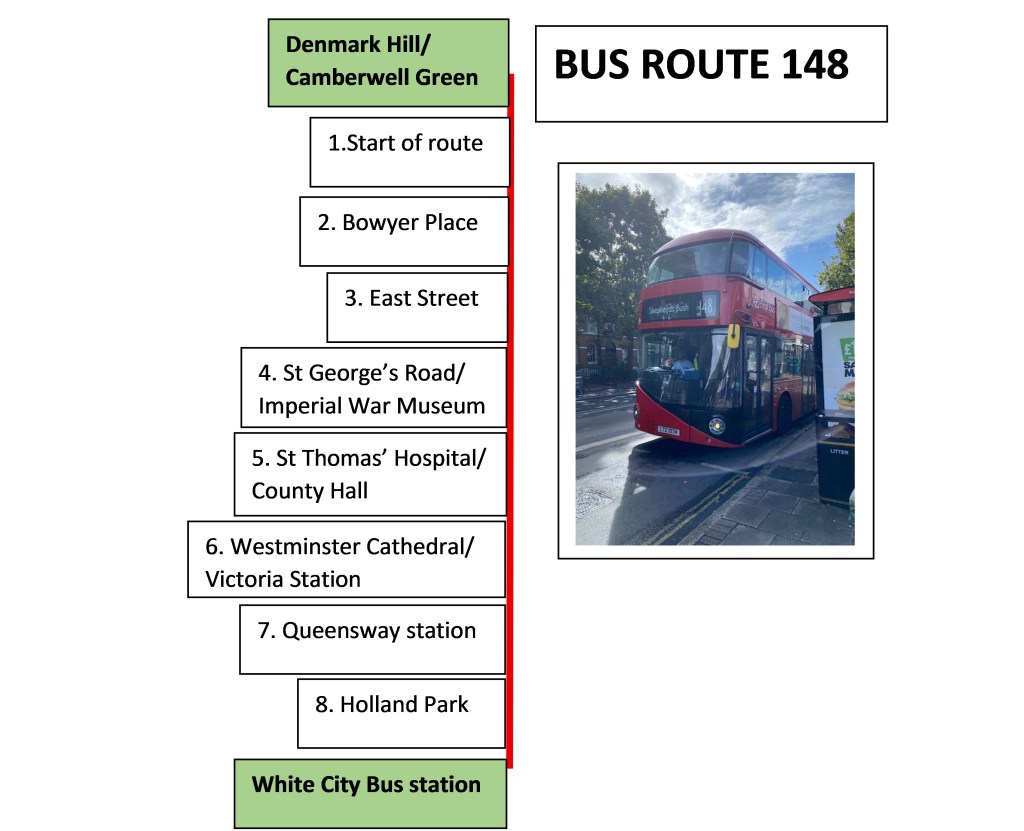
Denmark Hill/Camberwell Green to White City
Highlights:
- West Square & its Mulberry trees
- National Covid Wall
- Imperial War Museum
- The Cosmic House
1. Start of route
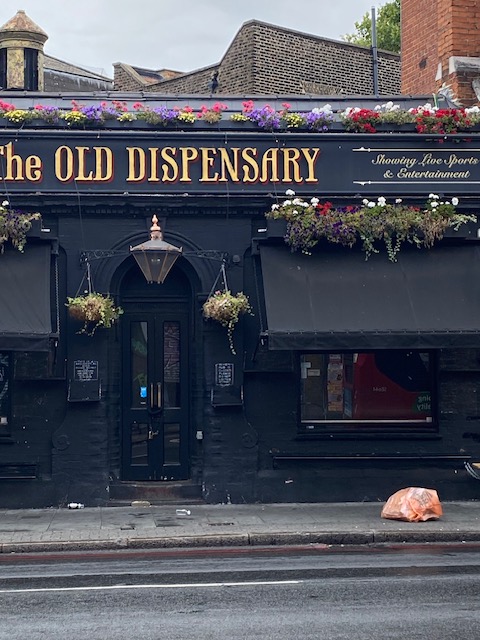
Walk round the corner from the start of the route at Camberwell Green and you’ll see a building that’s The Old Dispensary. In its former life, it was The Camberwell Provident Dispensary and was established in 1862 for the purpose of assisting the poor. During 1873, married women were attended in their confinement. Operations were performed by the dentist, Mr. Thomson, of Denmark Hill – it’s debatable whether this was a Good Idea! Today it’s an Irish-themed pub, very popular especially for its live music.
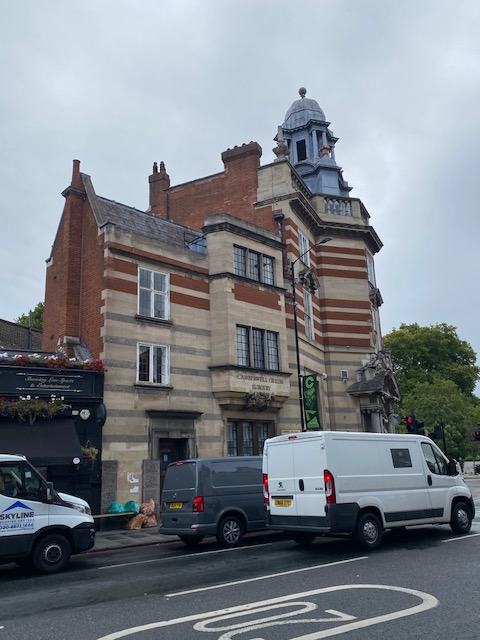
Situated at 17 Camberwell Green, is a Baroque Revival-style building constructed in 1899 as a branch of the London & County Bank. Once it stopped being a bank, it received grade II listed status, and it’s now a GP practice. It’s really an eye-catching building.
Walk back round the corner and find yourself at the Lighthouse Theatre. The building opened in 1940 as the Regal Cinema and has changed from cinema to bingo hall and now is an events venue and theatre. It only opens its doors when an event is taking place but you can get a quick peek if you look inside from the window.

2. Bowyer Place bus stop
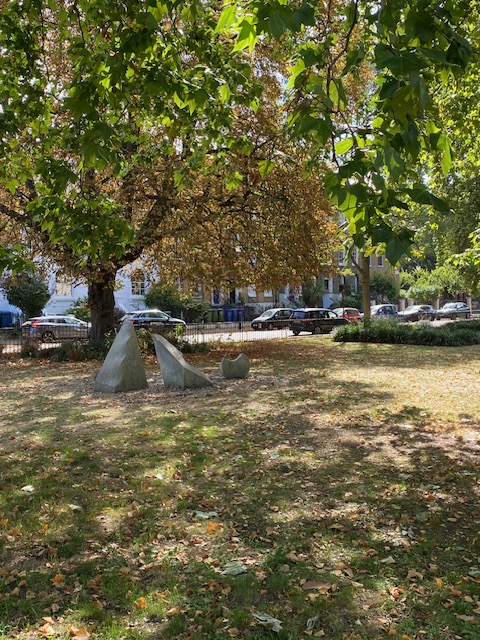
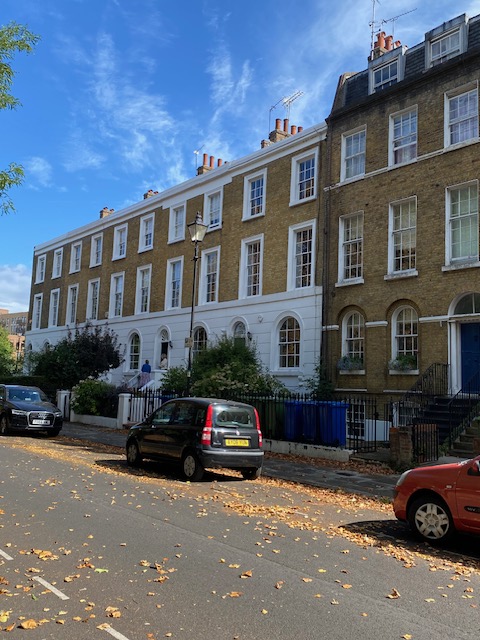
Around the corner from the stop is 1 Addington Square, home to Cornerstone Studios, a hub for creatives set in a beautiful grade II listed building. Walk up a short way and find yourself in a leafy, peaceful garden set in the middle of the Georgian and Regency Addington Square. Almost all the properties here are grade II listed and it’s easy to see why – they are all architecturally lovely and kept in very good condition.
In the 1960s, the square was the base of the Richardson Gang, a south London rival to the Kray twins. They ran a private drinking club from the square, which had “Mad” Frankie Fraser and two dancing bears in residence. The bears managed to escape one night but managed to get caught and brought back.
One of the sides of the square backs on to Burgess Park, ensuring that the area is fairly free of traffic and helps to preserve an atmosphere of calm.


3. East Street bus stop
There’s another interesting street here called Liverpool Grove. It’s a notable surviving example of social housing that began in the 1890s with Octavia Hill as benefactress. The architecture lends itself to a Garden City suburban character with the housing typically consisting of two-storey terraced cottages and three-storey tenements.
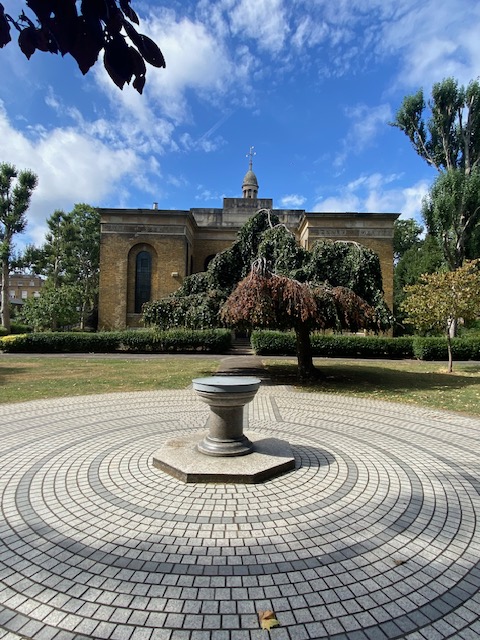
Set within the heart of the conservation area is the Grade I listed St. Peter’s Church, designed by Sir John Soane. Its foundation stone was laid in 1823, by the Archbishop of Canterbury and was consecrated just 2 years later. People had to pay for seats – anything from 5 Shillings (25p) to 22 shillings (£1.10) a year for a pew for the whole family. This was quite a lot of money then. The cost rose the nearer the seat was to the heaters. Working people, and the servants, were given seats upstairs, out of the way of the ‘gentry’. Two small galleries either side of the organ pipes were specially for ‘Charity Children’, whose families were very poor indeed.
The weather vane on top of the steeple was frowned upon when first erected. By the end of the nineteenth century most people who lived in the area were poor people, living in slums. The parish priest at the time, Father Horsley, was very concerned for the poor. The first thing he did was clear all the gravestones from the churchyard, and make it into a small park, which survives to this day. Along with the weather vane, it caused a great fuss at the time.


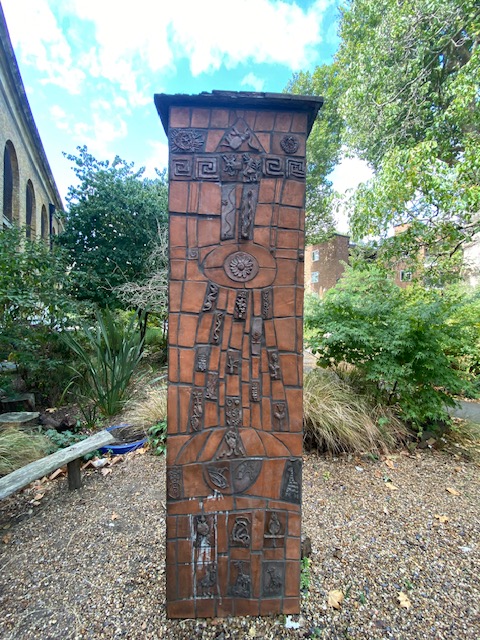
Father Horsley set up a small zoo in the rectory garden, which was nicknamed the ‘Monkey Park’. This could explain why there is a wooden sculpture of a chimp with the words “Dragen Malakai Henriques – Gone but never left”. Nearby is a Totem Pole which had been created by artists Claire Freer and Elin Solstad, together with children from a local primary school. Its design was inspired by the architecture and ideas of Sir John Soane.


4. St George’s Road/Imperial War Museum bus stop
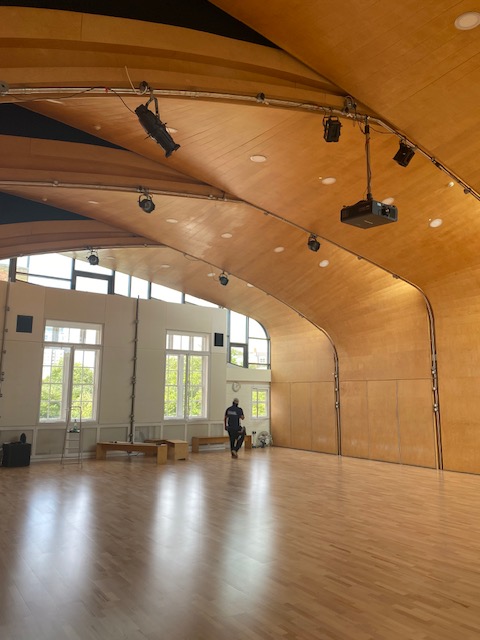
You will almost certainly want to visit the museum, but before you do, take a walk from the stop to find Siobhan Davies Studios. Dame Siobhan was a dancer with the London Contemporary Dance Theatre during the 1970s, and became one of its leading choreographers. In 1988, she founded Siobhan Davies Dance. This dance company has won a number of awards including the Olivier Award for Outstanding Achievement in Dance and overall winner of the Prudential Award for the Arts. The building that houses the Studios was purpose built in 2006, with the architect taking scrupulous care to cater for the needs of the dance company. The main studio has been created on the roof so they could feel what it would be like to dance high above the city, and that the dancers should have daylight.
According to their website, Siobhan Davies Studios “is a place to play, question and experiment. We host regular events and classes for all ages, some programmed by us and others run independently.” You’re invited to try out all or any of their dance classes and they aim to make it as inclusive as possible. It certainly is a welcoming environment as soon as you step through the front door.
The Studios are adjacent to the Charlotte Sharman School which has just been closed down, owing to a lack of families in the area. There had been collaboration between the school and the studios so it was with sadness that this chapter in the Studios’ history has now closed.


Round the corner from here is West Square and inside the garden square are three rather gnarled but splendid mulberry trees. They are part of a larger network of historic mulberry trees across London and linked to the city’s fruit-growing heritage. At one time, there were four mulberry trees in the square, but only three now remain. Their horizontal branches have to be supported by props owing to their age and history.
The square itself was laid out in 1799 and among its first inhabitants were staff from Bethlem Hospital and in the beginning of the 20th century, the garden was enlarged and restored, and opened to the public. In the middle of the square is a tree that marks the bicentenary of the square being built.


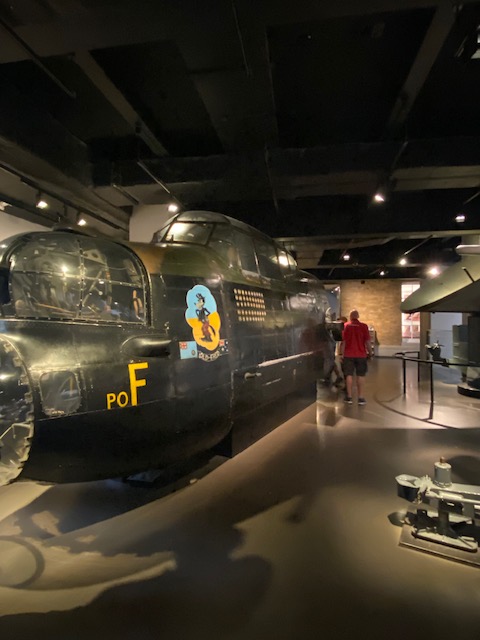
And now head back round to the Imperial War Museum. It’s also on other routes (40 and 59 to name but two) but this one stops virtually right outside. IWM was founded in 1917 when the War Cabinet approved a proposal to create a national war museum to record the events still taking place during the Great War. It was set up to collect and display material as a record of everyone’s experiences during that war – both civilian and military – and to commemorate the sacrifices of all sections of society.
Outside the front entrance is a large stone that was part of the Berlin Wall. The graffiti on this portion of the wall was created by artist Jurgen Grosse who used it as a canvas to create eye-catching murals that had personal, social and political meaning. There is so much to see inside the museum, that you just have to go and explore for yourself. It’s free entrance and you can spend all day there – in fact, you probably wouldn’t have seen all the exhibits in that time.
There are original planes – Lancasters and Spitfires – both on the ground and suspended from the ceilings and vehicles that were used for transporting people and press vans. There are six floors, covering all wars and in particular, World Wars I and II and a whole section on the Holocaust. In addition, there are always temporary exhibitions.



5. Lambeth North station bus stop
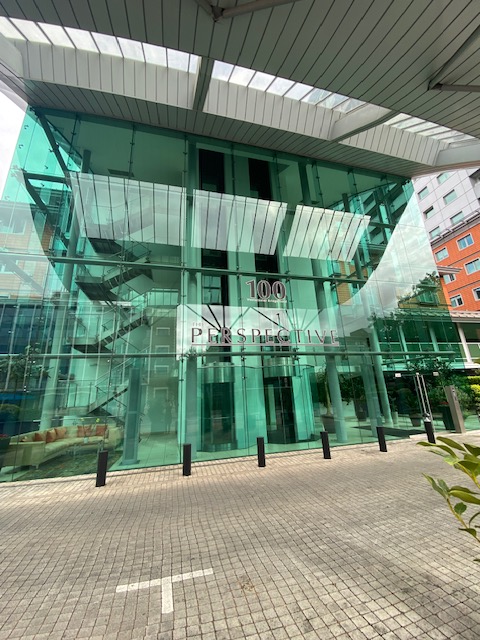
It’s only a few minutes’ walk from the museum to the next place but you may just want to alight at this stop. The main thing to see here is the Perspective Building that was once known as Century House. Built between 1959 and 1964, it was once home to MI6’s anti-espionage team. Having been described as “irremediably insecure” owing to its being made largely of glass and having a petrol station underneath, the Secret Service was forced to move to new premises. Century House became the Perspective Building in 2003 and is now a residential apartment block.


6. St Thomas’s Hospital bus stop
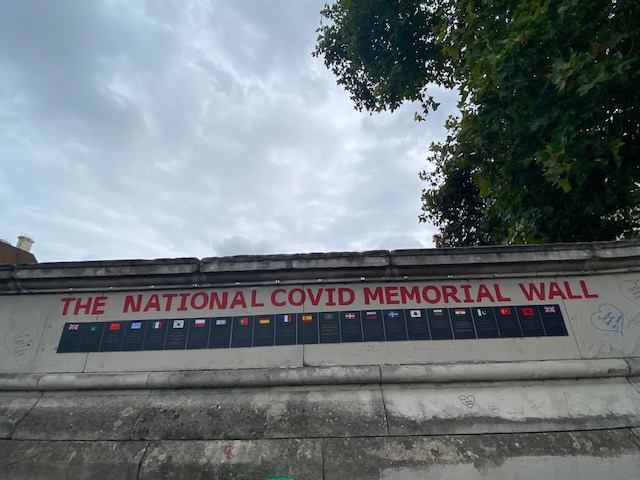
This stop is the place to see the Covid Memorial Wall. Five years on and it still is a sad reminder of how many people died in the pandemic. There are always a crowd of visitors – many tourists – coming to pay their respects and to look at all the messages that have been left by those who lost someone.

7. Westminster Cathedral/Victoria Station bus stop
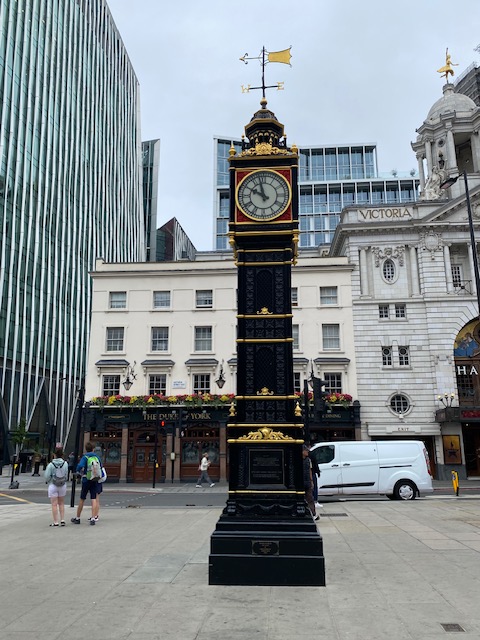
Near this stop is Little Ben, a miniature replica of Elizabeth Tower, better known as Big Ben. This small cast-iron clock tower was installed in 1892. On one of the sides is a little couplet that reads:
My hands you may retard or may advance
my heart beats true for England as for France.
This refers to the hands on Little Ben that should always be fixed to British Summer Time. However, this policy doesn’t seem to to be implemented as the clock is changed so that the time reflects that of every other clock in the UK.
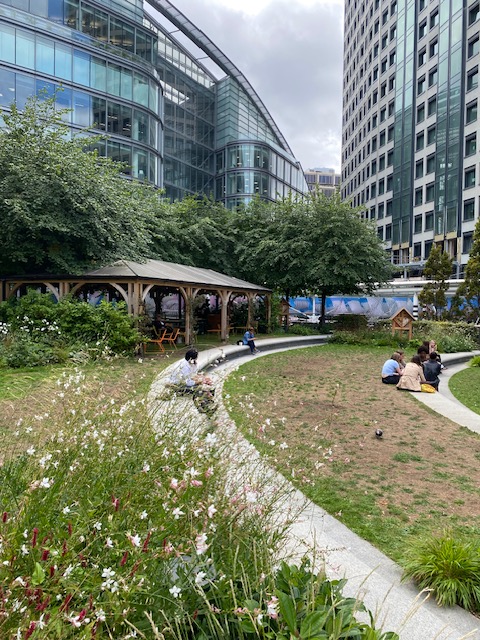
Now walk round the corner and visit Cardinal Place. This is a shopping centre in the centre of Victoria and has a host of shops as well as a pretty rooftop garden. Here, there’s a green space where you can sit and relax, little huts to shelter inside if the weather is inclement as well as seasonal flowers and plants to brighten your day.


8. Queensway station bus stop
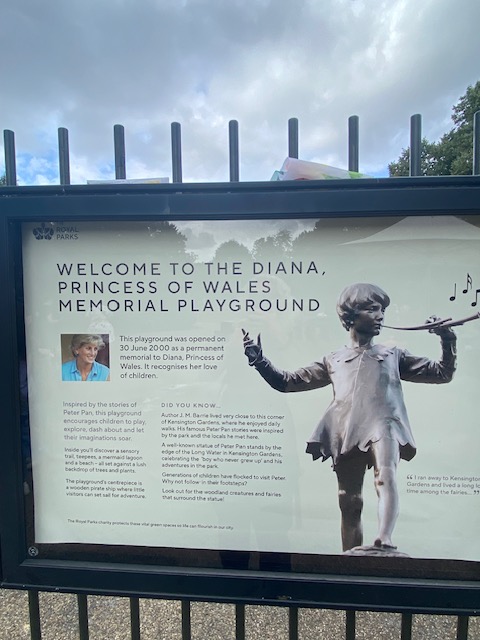
Head over to Kensington Gardens where there is plenty to see. If you have young people with you, you’re entitled to enter the Diana, Princess of Wales Memorial Playground. If you don’t have any, you will be barred from entry. You have been warned! The playground was opened in 2000 as a permanent memorial to the Princess as a recognition of her love for children.
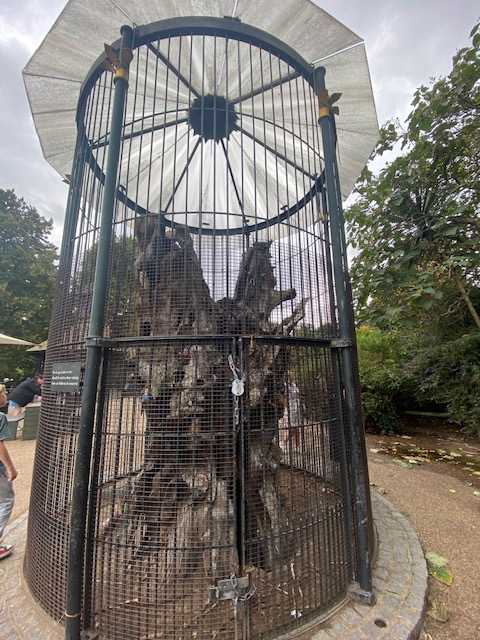
Next to the entrance is the Elfin Oak. It’s the stump of a 900-year-old oak tree that has been carved and painted to look as though elves, gnomes, fairies and small animals are living in its bark. It had originally been in Richmond Park and was moved to Kensington Gardens in 1928 as part of a scheme of public improvements in London. Over the next two years the illustrator Ivor Innes carved the figures of the “Little People” into it.
Look out too for the Time Flies Clock Tower and water fountain. This was erected in 1909 to the memory of a beloved son and of one who loved little children. On each of the four faces of the clock tower are the words “Time flies”. Strangely, the inscription fails to name the person(s) who erected this substantial memorial, nor does it name those to whom the dedication was made.


9. Holland Park bus stop
This is the last place to get off the bus on this route. Walk round from the stop to The Cosmic House but again, another warning – if you want to have a guided tour (recommended) you need to book in advance and there is an entrance fee. I was only able to see the reception area but the little I saw, it looks a fascinating building and definitely worth booking up to see what’s in store. The house is an 1840s end-of-terrace villa that’s grade I listed but don’t be deceived by its apparent normal exterior. Inside it’s packed full of early Post-Modernist designs.
The house was initially bought by Charles Jencks and his wife Maggie Keswick in May 1978, and the main transformation was completed in 1983. The house is home to such interior features as pedimented bookshelves, a sundial window seat and an upside-down classical dome serving as a jacuzzi. It really has to be seen to be appreciated.


And so ends another good, if not great, bus route. After last week’s 147, it was a relief and pleasure to find another bus journey that was better than expected. There really is something for everyone – playground and Elfin Oak in Kensington Gardens for the little ones, some beautiful garden squares for admiring the architecture, mulberry trees if you like nature and the Imperial War Museum to get your fill of knowledge and history. Don’t ignore the Cosmic House but don’t just turn up (as I did!) and hope to be able to tour the house – remember to book well in advance.
Toilets that are open to the public and free of charge:
- Siobhan Davies Studios
- Imperial War Museum
- Cardinal Place
- The Cosmic House
 london routemistress
3 responses to “Bus route 148”
Tiny nigg
LikeLike
Didn’t Spike Milligan restore the fairy oak?Sent from my iPhone
LikeLike
Dear Helen,I meant to ask if I could come
LikeLike