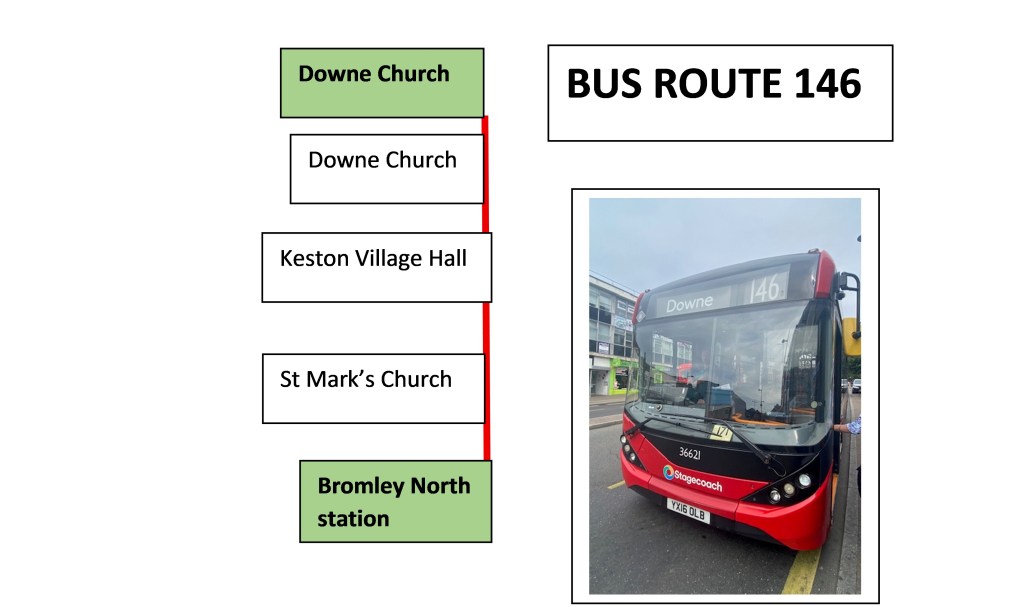
Downe Church to Bromley North station
Highlights:
- Down House and grounds
- Keston Windmill
- Keston Fishponds
This route and blog is atypical. This is mainly due to the fact that bus 146 runs only one an hour on the hour so if you miss it …
I usually get on and off the bus 6-8 times because there is a maximum 15 minute wait at the bus stop but on this route, it’s important to get your timings sorted out before venturing. For this reason, I spent a lot of time at both Down House and Keston and had to give up on seeing other places that I had previously researched for this route.
1. Start of route
Having given that introduction, it’s worth noting that you won’t be disappointed if you decide to take the 146. Downe Church is the end of the line (or start) and it’s a five minute walk to Down House, Charles Darwin’s family home for the last 40 years of his life. There’s plenty to see here so be prepared to spend at least a couple of hours or so. As the bus is only one per hour, you won’t want to rush off anyway.
There is an entrance fee for the house which is run by English Heritage and if you’re intending going, do pre-book as it’s cheaper than on the door. The staff are very welcoming and informative and there’s an audio guide which explains all the downstairs rooms – what they are, what the Darwin family used it for etc. Upstairs are a series of suites and rooms with plenty of informative wall posters. It’s worth noting that photos aren’t permitted inside the house so it’s not going to be possible to show you here just how lovely the interior of the house is.
So what is there to say that you may not already know about Darwin? First of all, his grandfather was none other than Josiah Wedgwood. So he came from good – and wealthy – stock. As an amusing aside, Darwin was born in the same year (1809) as Alfred Lord Tennyson, William Gladstone and Abraham Lincoln.
Darwin married his cousin Emma Wedgwood and it was in 1842 that they moved to Down House, where he spent the rest of his life. It was from here that he published On the Origin of Species in 1859, which set out his ground-breaking theory of natural selection.
It was of course before its publication, that Darwin went on HMS Beagle as a passenger, with Captain Robert Fitzroy leading the helm. As a young naturalist at the time, Darwin joined the Beagle’s surveying expedition around the world, which lasted from 1831 to 1836. It was his observations during this voyage, particularly in the Galapagos Islands, that provided crucial evidence leading to his ideas on natural selection and evolution.
Coming from a moneyed family, Darwin was in the very fortunate position of not having to go out and find a job, so that his time was devoted exclusively to his research. Even after he himself was convinced of his findings, he appreciated that they would be construed as controversial, especially in religious circles, so he delayed publishing for several years. It was only when he realised that someone else was working on a similar theory, that he knew he had to make a decision. He was put in a difficult situation since the person in question – Alfred Russell Wallace – had sent Darwin his findings that were remarkably similar to Darwin’s own. After taking advice from his good friends Charles Lyell and Joseph Hooker, it was arranged that Wallace’s paper and Darwin’s sketches would be read together at the Linnean Society (the oldest learned society devoted to the science of natural history, founded in 1788). It was a year later that On the Origin of Species was published. Wallace’s reaction to Darwin’s beating him to publication was incredibly gracious and they remained life long correspondents.
Without being able to post photographs of the interior of Down House, it’s difficult to describe the sense of the building. When you’re there, you can feel the presence of Darwin and Emma and their many children – they had 10 in all although 3 of them didn’t survive past 10 years old. Darwin’s study is as you would imagine it, having been restored to its original 1870s arrangement. Almost all the furniture is original as are the papers and pamphlets and other of Darwin’s possessions. Most of the rooms are spacious and have been restored to their original setting.
And so to the outdoors where photography is thankfully permitted. Darwin chose the house owing to its large size and the fact that there were no close neighbours, as the grounds were so extensive. When they moved here, Emma was pregnant with their third child and their home in London was too cramped for an ever-growing family.
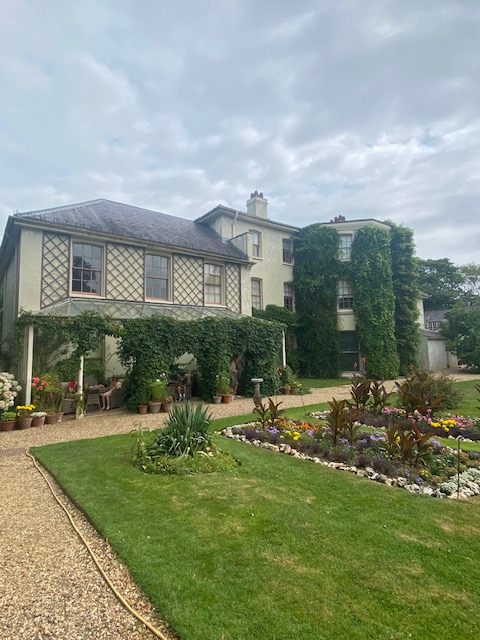
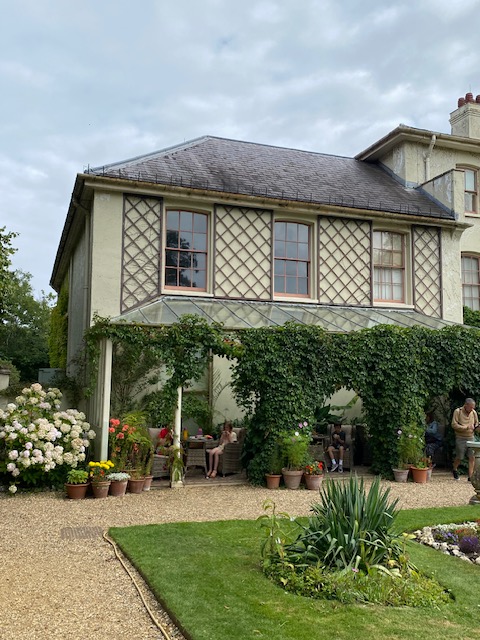

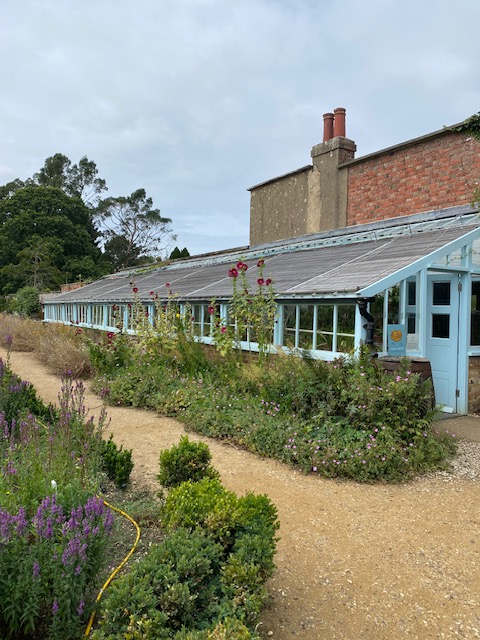
The gardens are a delight to walk around and in their time were both an outdoor laboratory for Darwin’s experiments and a place where he could reflect deeply upon their meaning. There’s plenty to see at any time of the year but in particular in the summer months when the flowers are blooming.

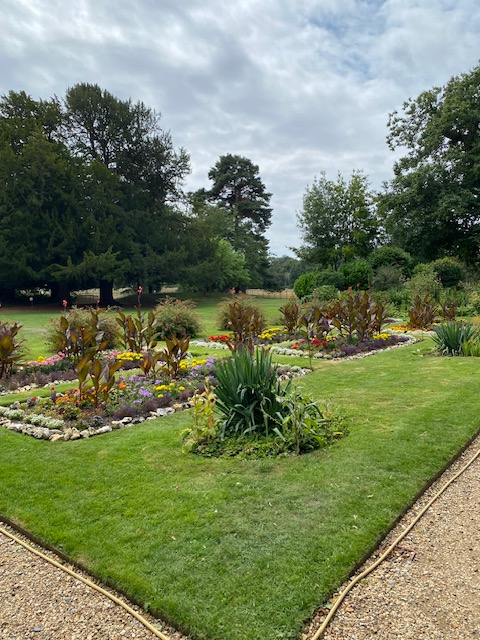

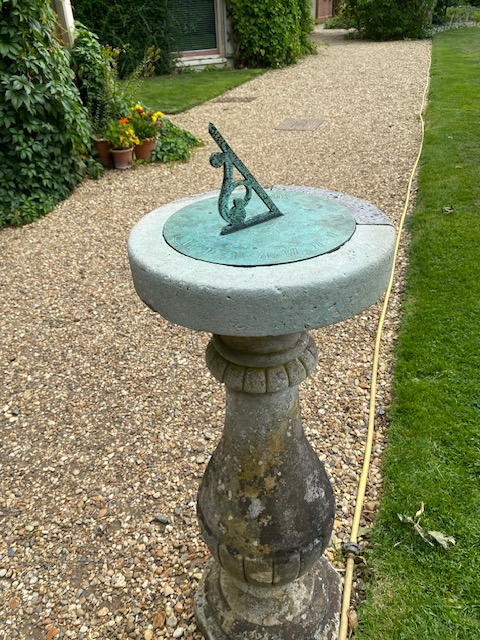
See too the sundial, by which Darwin used to set the household clocks. It is here that one of the most famous photographs of Darwin – which you have probably seen, bearded and looking every inch the thoughtful Victorian naturalist, was taken.
Then next on your must-see is the glasshouse with adjoining laboratory. In the early 1860s, Darwin had built both a hothouse and a greenhouse in the kitchen garden to provide him with the specialised growing environment he needed for experimentation. The sloping glass roofs were able to capture the sun’s rays and a boiler system kept the environment warm and well-suited to delicate specimens. Next to the glasshouse is a room known as Darwin’s laboratory which he had built in 1882. He died soon after its construction and it’s thought he didn’t get to make use of it.


It’s not possible to do justice to the house and gardens so take my word that it’s worth a visit!
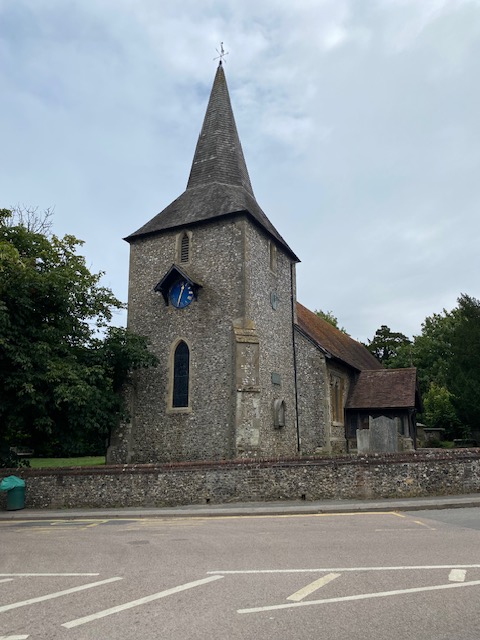
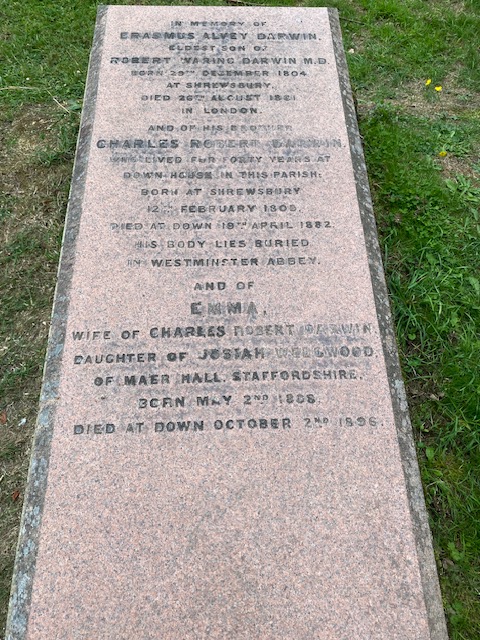
Head back towards Downe Church, where in the churchyard you will find the grave of Emma Darwin who is buried in the same plot as her brother-in-law, Erasmus Alvey Darwin. The grave also mentions Charles Darwin, stating that he is fact buried at Westminster Abbey. The church building is medieval with much restoration having taken place in the 15th century. During WWII, there was some bomb damage with consequent repairs and additions including a stained glass window in 1950.
The font dates to the late 15th/early 16th century and is made of
Purbeck marble. One of the stories that abounds is that on 30th November 1559 Margaret, daughter of Henry Manning, was baptised “after ye Queenes visitasion”. This has led to speculation that it was
Queen Elizabeth l herself who attended this baptism and it is why the inn next door is named The Queen’s Head. It may just have some validity as Henry Manning, Margaret’s father, was a man of some
standing, being Master of the Household to Elizabeth l.



2. Keston Village Hall bus stop
In all fairness, that one stop at Downe Church would be enough to see and to enjoy on this route. Bear in mind, too, that the bus comes once an hour on the hour so you need to make sure you’re at the bus stop in plenty of time.
Hop on and alight at Keston Village Hall. This is a thriving community centre that hosts many different activities and is a suitable venue for all sorts of celebrations, including weddings. Stroll down the road, and you’ll come across Keston Windmill. Although it’s set on private land, it’s possible to catch a glimpse from just inside the gate and if you’re brave enough, knock on the door of the Mill House next door and you may well be lucky enough to get permission to get a close up view.
The mill was built in 1716 and is conserved with its machinery intact but not in working order and is grade I listed. It was built to grind corn into flour and was working by wind until the end of the 19th century. The windmill was built on a roundhouse and has three-storeys. The roundhouse enclosed the trestle and the date 1716 is carved on the main post.


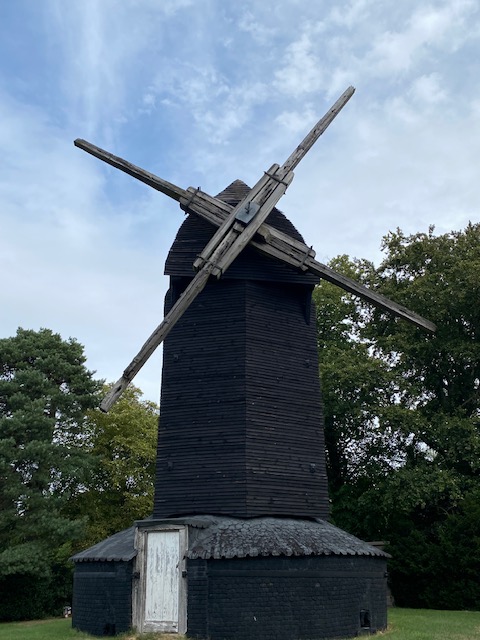
Luckily, you’re not finished with finding things to explore from this bus stop, always bearing in mind you have an hour to kill between the bus arrivals. Cross over the main road where you’ll find the start of Keston Common. Walk a short distance on a decent path to Keston Fishponds, which form a veritable oasis. The common with its ponds is adjacent to Holwood House, once home to the then-Prime Minister William Pitt the Younger. He and William Wilberforce are known to have walked on Keston Common. These days the area is registered as a Site of Special Scientific Interest (SSSI).


3. St Mark’s Church bus stop
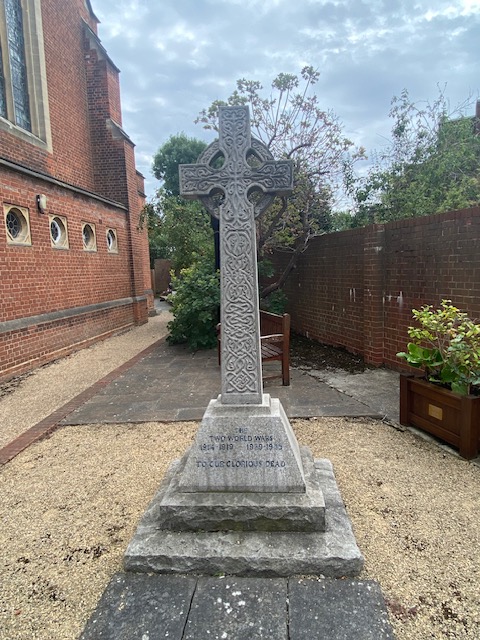
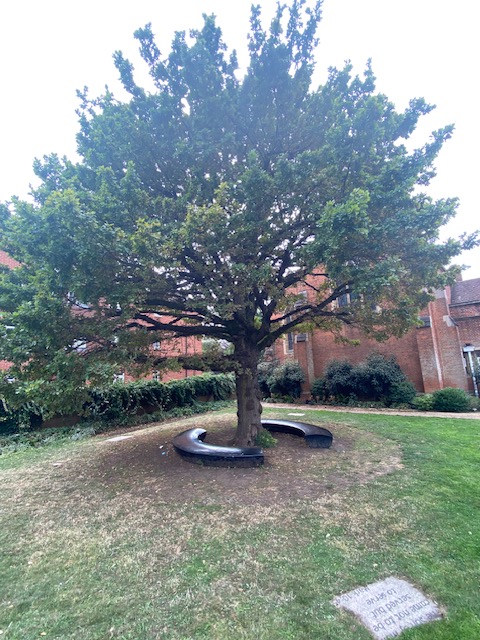
You may feel by now that you have seen and done enough for this route and you’d be entitled to finish at the Fishponds. But as the bus does go towards Bromley and you need to catch it in order to take your homeward journey, you may want to stop off at St Mark’s Church – which is also on route 138. There isn’t much else to see there, especially if the doors of the church are closed. Outside is a memorial to those who fell during the two world wars and there is a garden adjacent to the church with a large tree taking centre stage and a bench surrounding it. Scattered in the grass are several stones with biblical quotes such as “Whoever wants to be first of all must be servant of all”.


So ends the route and what a great one! Assuming that is, that you enjoy looking round the former homes of great people and their families. Down House in itself could well have been enough because there are so many rooms to explore and grounds to admire. The one shame is that no indoor photographs were allowed so that I can’t show off the interior in all its glory. Downe Church was also interesting in its simplicity and connection both to Darwin and the inference that Queen Elizabeth I had probably attended a baptism here.
I was lucky that one other stop had more than enough to be worth waiting an hour between the bus arrival. The windmill at Keston was a delight as were the grounds that surrounded it that seemed to go on for miles. I had made the false assumption – owing to its enormity – that this space was public but apparently the windmill, along with the landscape as far as the eye can see, all belong to the owners of the Mill House.
The 146 route isn’t for the faint-hearted as it’s a long way out from the centre of London and as I keep saying, the bus only turns up once an hour. I’m delighted that I was able to do it and enjoy what it had to offer. Let me know if you decide to follow my example …
One last comment to make if you’re puzzled as to the spelling of Downe Church and Down House. The village and church were once known as Down but over time, the name gradually shifted to Downe. Down House has obviously kept its original spelling.
Toilets that are open to the public and free of charge
- Down House
- The Queen’s Head pub
 london routemistress