
Edmonton Green bus station to Muswell Hill
Highlights:
- Alexandra Palace and Park
- Turnpike Lane murals
- St Aldhelm’s Church
1. Edmonton Green bus station
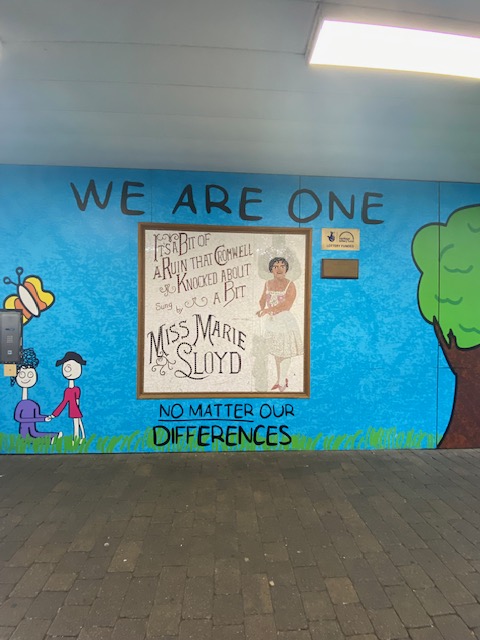
At Edmonton Green shopping centre, there are some colourful murals lining the walls. One such features Marie Lloyd, the music hall artist (1870 – 1922). The small plaque next to the mosaic mural reads:
“Lost treasures – Empire Music Hall (Granada Cinema) 1908 – 1970
The Empire Theatre opened on 26th December 1908 as a 1,300 seat music hall theatre with some film use. Famed as the final performance venue of music hall star Marie Lloyd in 1922. In 1951 it became the Granada and closed in 1968.”
Set within the shopping centre is the library with a very small museum upstairs. There are a few items on display that show an association with the local area such as a plaque and photo of a fruiterer G Rafferty and Son, a selection of fireman’s helmets from Southgate District Fire Brigade and a rather lovely wooden memorial wall that describes the good deeds of several of the local community from days gone by.


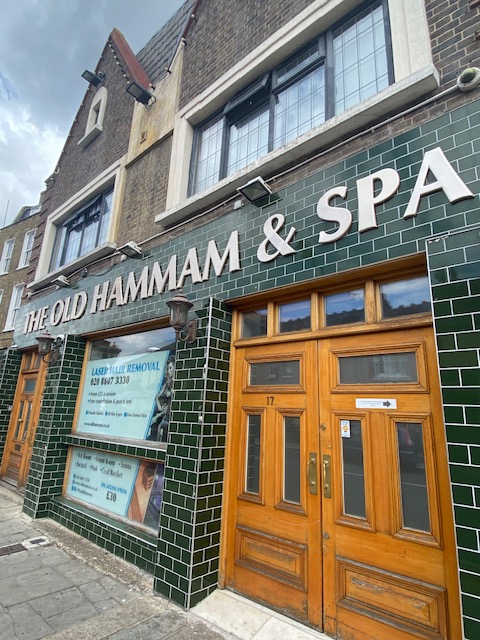
After the museum, head over to Church Street and take a look at the Old Hammam and Spa. Based on the old Turkish and Moroccan ancient bathing tradition, it’s possible to indulge yourself to the full at this lovely spa. You can’t just take a look around however, unless you’re actually booked in for some treatments but it looks very clean and welcoming.
Opposite the spa is the Lower Edmonton Sorting Office which is a single-storey Edwardian building built around 1900, with a Baroque-style façade. Admired by locals for its heritage, it is listed for its historical significance. This iconic building is remarkable for its red brick construction and stone dressings. These days it’s a delivery office, though it was originally designed for the mechanised sorting of mail, handling a large volume of mail each week.


2. Pymmes Park bus stop
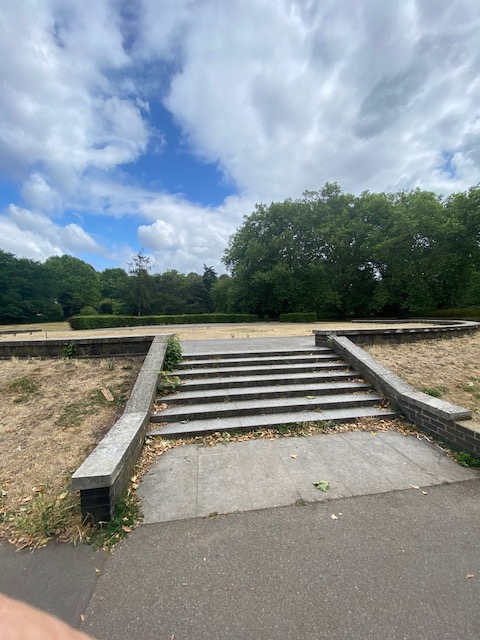
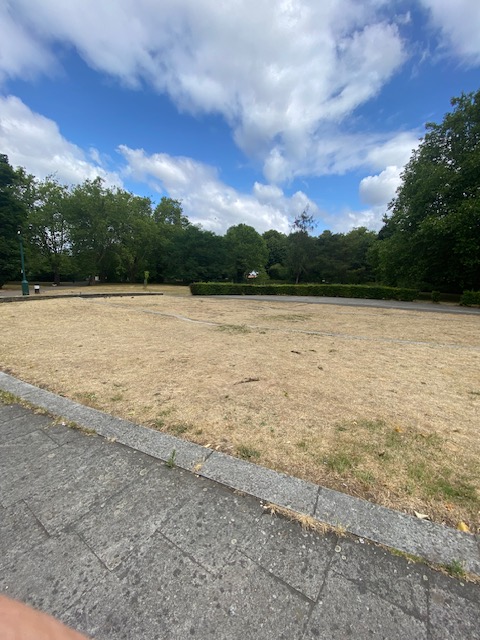
This stop is also on the 34 and 102 bus routes. Set within Pymmes Park is an amphitheatre. It’s not known if it has been there since the park was part of the Pymmes House estate but it certainly looks like somewhere that entertainment would have taken place in the open air. Pymmes House was built by William Pymme in 1327 in what is now Pymmes Park. It had a succession of notable owners, particularly in the Elizabethan period, and was remodelled and rebuilt several times. It was demolished after a fire in 1940. Pymmes Brook is a tributary of the river Lea and runs through the park as well as flowing through New Southgate and ending at Tottenham Lock. It’s very pretty here in this setting.

3. Millfield Theatre bus stop
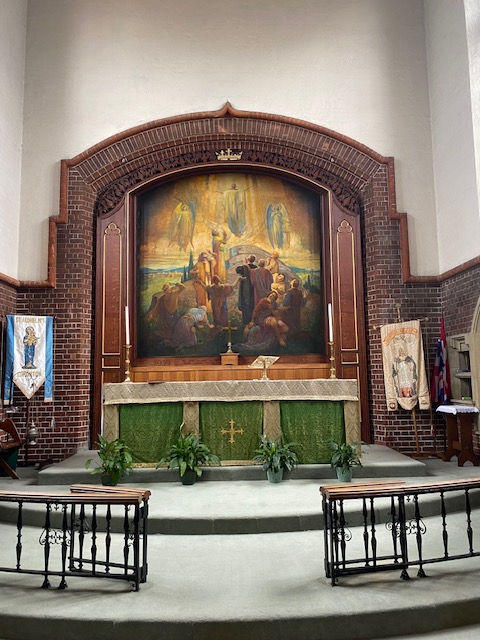
This stop is also on other routes – 34 and 102. Although written up in the 102 blog, nevertheless, it’s worth revisiting St Aldhelm’s Church to take another look at what it has to show. It’s Grade II listed and was built in 1903. It was designed by W.D. Caroe (1857 – 1938) and built in a somewhat unusual style. Described in its listing as “Gothic style very individually interpreted with Art and Craft influence”, it has been called one of Caroe’s “pretty toys” and, rather like the Tardis, it seems larger on the inside than the outside.
Have a look at the striking reredos painting behind the altar and the stained glass – both were done by the same artist, Walter Starmer. The stained glass windows mostly depict individual figures, either saints or characters from the Bible. In one of the side chapels is a Holy Table that is a memorial to W G Brocklebank, the first vicar of the church. One final interesting fact is that some of the scenes of the film of “Dad’s Army” were filmed in St Aldhelm’s – in particular where the platoon infiltrated the church where German paratroopers were holding hostages.


4. Perth Road bus stop
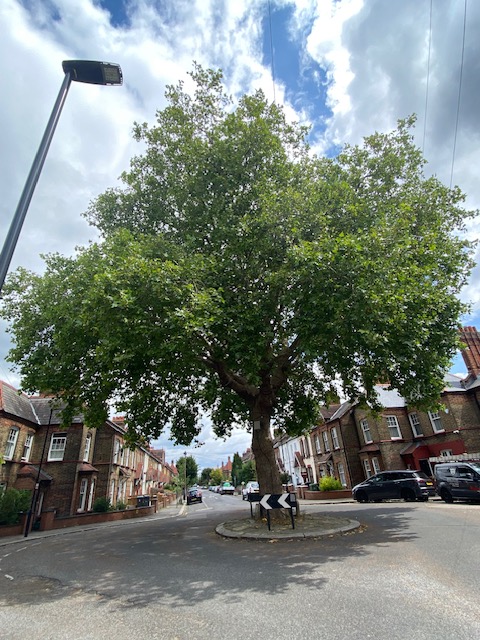
Walk round from the stop and you’ll come to Morley Avenue where there is a large tree, affectionately known as the Noel Park Friendship Tree. A plaque at the bottom of the tree was placed there on 19th February 2009 with the words “celebrating the value of friendship in Noel Park and across the world”. The tree itself has been there since the 19th century. Noel Park was one of the earliest garden suburbs in the world. The Noel Park Estate was designed to provide affordable housing for working-class families wishing to leave the inner city; every property had both a front and back garden.
Head back to the bus stop and go to Chapman’s Green, a small but pretty open space. At one time it was a bowling green with a small pavilion at one end but this was wound up in 2018 and the Friends of Chapman’s Green have been busy transforming the pavilion into a mixed use community hub, and to improve the quality and usability of the park – setting out to partly re-wild the old bowling green, allowing it to revert to a meadow whilst also adding an orchard.


5. Turnpike Lane station bus stop
This stop is also on route 121 where I have already written up about some of the street art in the blog. There was one additional mural this time – that of a fox by street artists Boe & Irony whose works can be seen on walls across the city – all of them animal-themed. This fox, a few minutes’ walk from Turnpike Lane station, has been there for a few years now and is probably one of the area’s most recognisable landmarks. Like many street artists, this pair have chosen to remain anonymous, mainly for safety reasons, since they feel that street artists are often investigated by the police. There is also an element of people interpreting their work as vandalism rather than art.
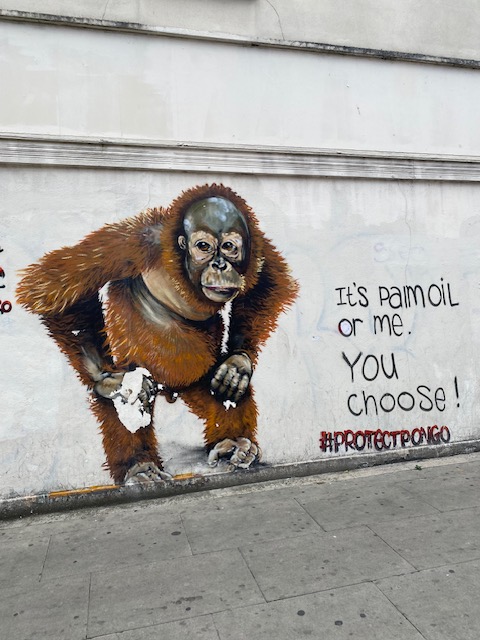
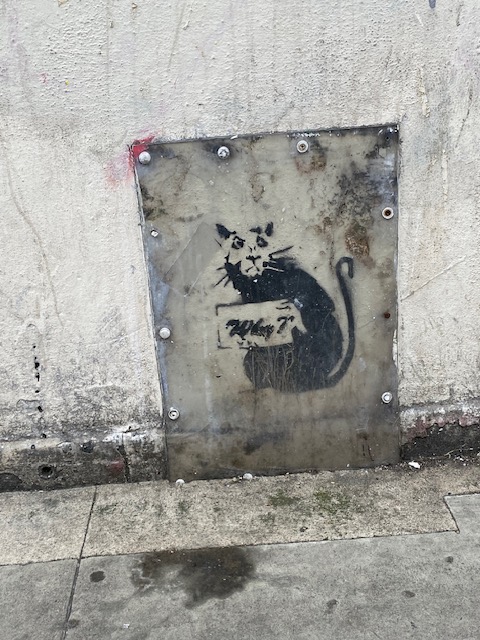
Back to the station and stand in front of the few graffiti that have been seen before. The orangutan has the words “It’s palm oil or me. You choose” as part of the Protect Pongo campaign. The campaign highlights the plight of orangutans and encourages people to make conscious decisions about whether to purchase palm oil. The use of the orangutan character “Pongo” is to personify the message and make it more relatable.

6. Grosvenor Gardens bus stop
Alight here to see the magnificent Alexandra Palace. For those who don’t know about “Ally Pally”, it opened in 1873 and is renowned for its Victorian architecture, its role as the “People’s Palace” in the style of the Crystal Palace, and its place in the history of television broadcasting. Initially built as a venue for exhibitions, concerts, and other events, it also became the site of the world’s first regular television broadcasts in the 1930s.
The park of 250 acres in which the palace is situated was opened in 1863 and was named after Princess Alexandra of Denmark who had married Edward, Prince of Wales (later Edward VII), earlier that year.
Having stated that the palace was built in 1873 and was actually opened on the 24th May of that year, tragedy struck just 16 days later when a fire burnt the building to the ground. A second Palace was opened on I May 1875 just two years after the earlier disaster. The new building, occupying seven and a half acres, featured the Great Hall with seating for 14,000. This second palace was not without its difficulties too. Financial constraints led to its closure in 1889 and it wasn’t until 1901 that it was reopened with funding from local authorities.
For most of the duration of WWI, the Palace and Park were closed and requisitioned first as a transit camp for Belgian refugees and then to house German, Austrian and other internees. Normal operations were restored in the 1920s and in 1934 the BBC leased the east wing of the building. The first TV transmission was made on 2 Nov 1936 from the aerial erected on the south-east tower.
Ally Pally is truly still a Palace for the People, being the go-to venue for a wide range of events and celebrations. Firework displays originated by James Pain in 1875 have remained popular to this day. Balloon ascents and parachute jumping were popular with the Victorian and Edwardian crowds. Large Scout rallies involving tens of thousands of young people were held in 1913, 1922 and 1930. Ice-skating is now on offer and of course, it’s very popular as a theatre and other performance venue.
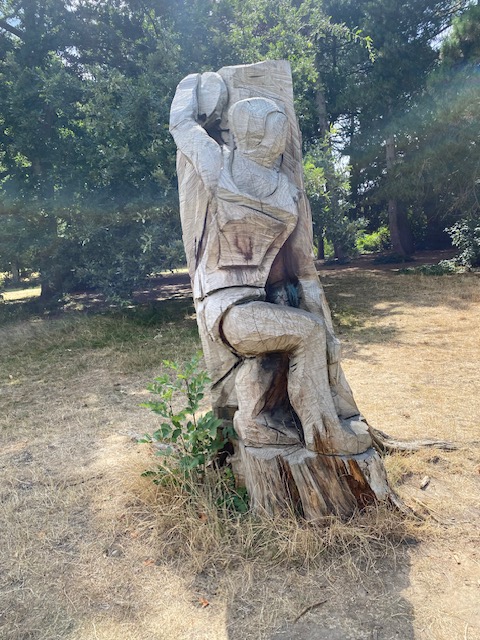
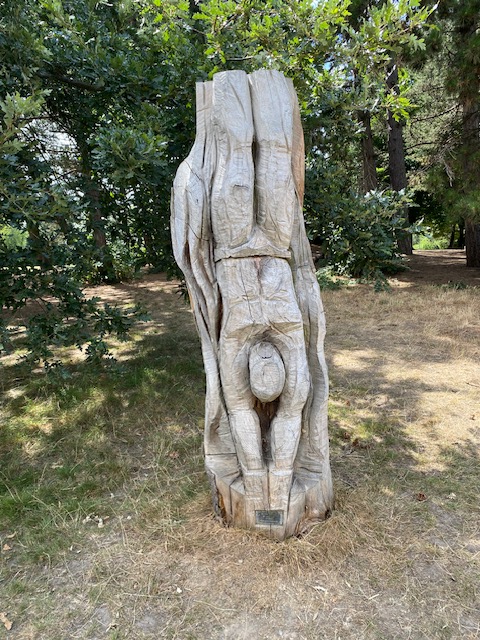
Inside the park are some interesting wooden sculptures, carved out of tree trunks. Find two together that are 2012 London Olympic sculptures, one is a discus thrower, the other a diver. There are six in all, created by sculptor Shane Green and are well worth a visit to admire his handiwork.

So ends the 144 route though much of it is also covered in other bus routes. It’s not always easy to find imaginative and interesting things to say about a route when much of it has been tried and tested previously. However, if it’s a different season in the year, the sights can be seen in a different light. This is particularly true of outside parks and gardens where the flora and fauna can vary a lot, depending on the time of year. Also, bear in mind that buildings aren’t always open even though the website says it’s possible to go inside. This was true of Alexandra Palace when there was a private event taking place. So the fact that there are overlaps on the routes isn’t always a bad thing, if you’re able to visit places that had hitherto been closed to the public.
Toilets that are open to the public and free:
- Edmonton Green Library
- Pymmes Park Visitor Centre
- Alexandra Palace
 london routemistress
