
Crystal Palace to Plumstead
Highlights:
- Crystal Palace statues
- The Moustache Café
- St Antholin’s Spire
1. Crystal Palace Parade
Crystal Palace is a gem of a place and if you’re going, I would advise to go on a day when the weather is fine as there is a lot to see that’s outdoors.
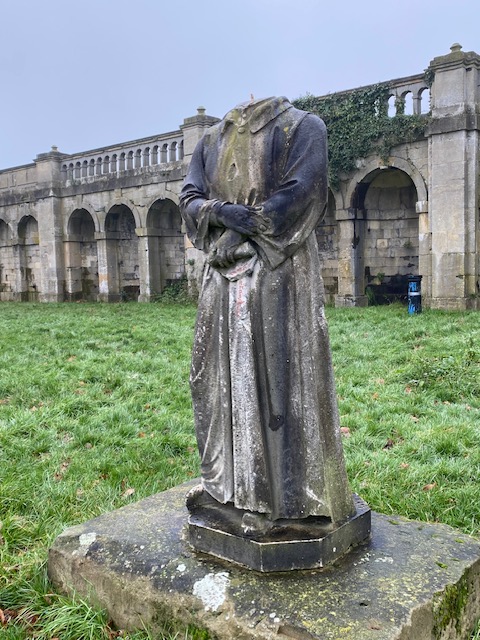
Head towards Crystal Palace park and once inside, find your way to the Seated Lady. This is a stone sculpture sitting in the middle of a lawn – and she is without her head. It’s probable that she was once a Palace decoration but she’s now a well-worn relic. Go further into the park and near the upper terrace is the Turkish statue. It is of a turbaned male (this one has his head on) and he’s thought to symbolise Turkey. Remember that this is on the site where the original Crystal Palace (in Hyde Park) was removed to, so there would have been many statues representing manufacturing countries in the world who would have exhibited at the 1851 Great Exhibition.
Down from the upper terrace is another stone statue, this one is Dante and sadly he, too, has been decapitated. This headless statue is dressed in fine robes and is holding a scroll.


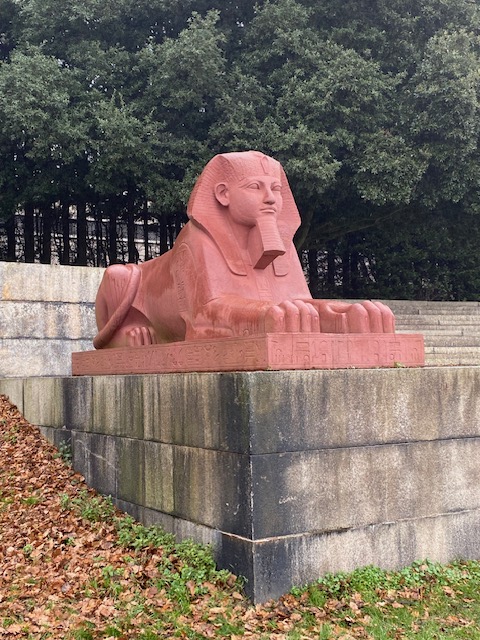
Go back up to the upper terrace and you’ll see the two sphinxes that were based on the red granite Great Sphinx of Tanis, held in the Musée du Louvre in Paris. They were repainted in terracotta red in 2016 – as they had been until the end of the 19th century.
2. Crystal Palace Parade/College Road bus stop
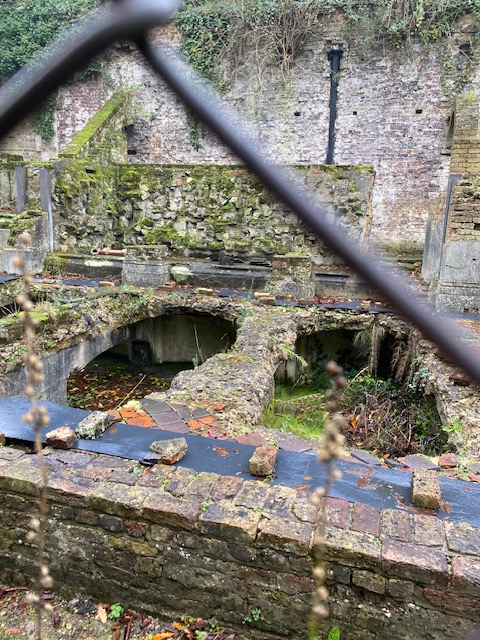
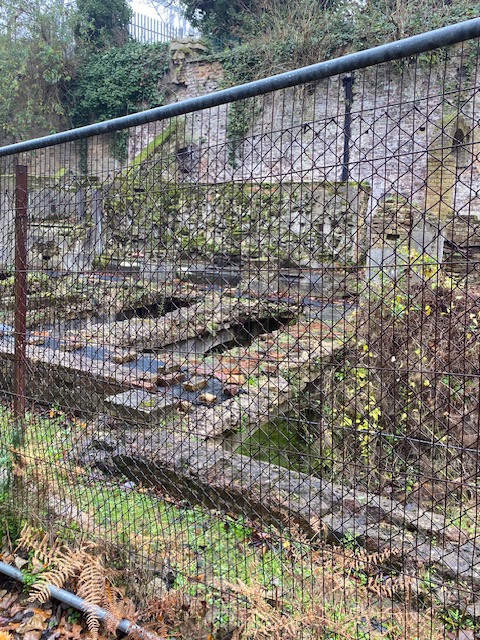
It’s possible to walk from the sphinxes to here or you could get on the bus and alight at this stop. Still inside the park is the Old Aquarium. It’s difficult to get a decent photo because of the fencing surrounding it but you can see what remains of it. After a fire in 1866, which destroyed the north nave of the Crystal Palace, a new public attraction was built – the largest marine aquarium of the time, designed by the first professional aquarist William Alford Lloyd. The Aquarium held 120,000 gallons of seawater which was brought by train from Brighton. Sadly although the aquarium was popular, it wasn’t a financial success and it was declared bankrupt in 1886.
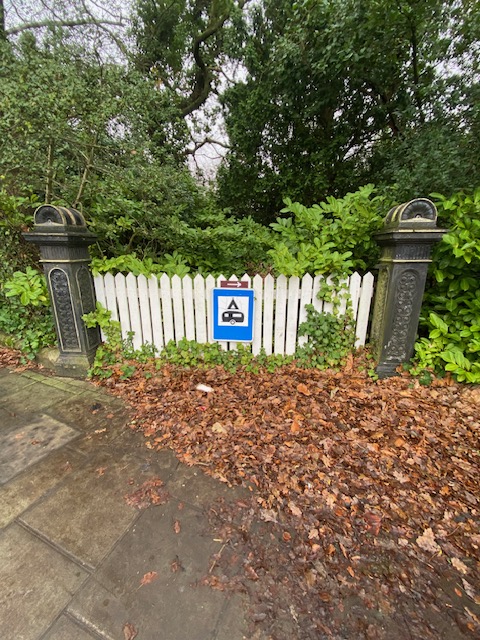
Just at one of the entrances to the park at Rockhills Gate, are two gatepiers, These were the gatepiers to Rockhills where Sir Joseph Paxton, designer of the adjoining Crystal Palace, lived from 1852 and died in 1865.
3. Peak Hill bus stop
Round the corner from the stop is Jews Walk, a lovely tree-lined street with some splendid houses. One of these belonged to Eleanor Marx, the youngest of Karl Marx’s children. She had been involved for years with Edward Aveling but she discovered he had secretly married another, so she poisoned herself at the age of 43.
On the corner as you get into Jews Walk is a drinking fountain that had been erected to celebrate the diamond jubilee of Queen Victoria in 1897. It had evidently fallen into some disrepair because the plaque at the bottom states that it was restored to celebrate the silver jubilee of Queen Elizabeth II in 1977.
It’s interesting to dig and find out why the road is called Jews Walk. It appears that two Jewish brothers lived in Westwood, a large house on the edge of Sydenham Common. In about 1769 the brothers obtained permission from Lord Dartmouth, the Lord of the Manor, to create a tree-lined walk across the common from what is now Kirkdale to their house. This walk became known as “the Jews’ walk”. When Sydenham Common was enclosed in the early 19th century the name was retained. By at least 1854 the residents of Jews Walk felt that such a name was not appropriate and they began referring to the street as “The Grove”. In 1878 the Metropolitan Board of Works, a London-wide body amongst whose responsibilities was making sense of house numbers and street names, was petitioned to officially rename Jews Walk to “The Grove”. To their credit the MBW refused to change the name and “Jews Walk”, one of the oldest street-names in Sydenham, survived.


Walk up the hill and the building that had been The Woodman pub is on the corner. These days it’s the Journey Café but it started out as early as 1845 as a public house and confusingly, the original name is still writ large over the building so you could be forgiven for expecting to go in and order a beer or two. Perhaps the name has been kept to remind passers-by that at one time it was a favourite place for woodmen – who would have been working in the nearby Great North Wood – to congregate.
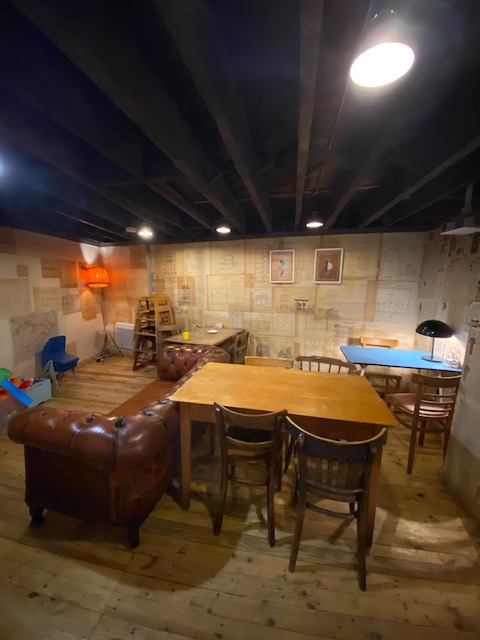
On the opposite side of the road is The Moustache café and as you would expect, the patron Pawel Wasek has a fine moustache. However, the derivation of the cafe’s name comes from Pawel’s surname of Wasek since the Polish “Was” means a moustache.
Pawel and his wife pride themselves on the fresh coffee they serve and food with the best and mainly locally-sourced ingredients. By day the Moustache is a coffee shop but unusually for this type of establishment, becomes a bar at night, serving alcoholic beverages. As well as being patron, Pawel is a prolific artist and his work is scattered throughout the café, both upstairs and downstairs. The Waseks are so enterprising, that the Moustache is sometimes hired out as a venue for weddings and other celebrations.


4. Dartmouth Road/Thorpewood Avenue bus stop
There’s just one place to visit at this stop but it’s definitely worth getting off the bus to see it. It’s St Antholin’s Church spire which was designed by no other than Sir Christopher Wren. After the Great Fire of London in 1666, Wren was commissioned to rebuild many of the burnt churches. He designed this spire in his typical baroque style, for the damaged St Antholin’s Church which had originally been built around 1682. In 1829, the spire was storm-damaged and was only salvaged by one of the churchwardens, a wealthy business man called Robert Harrild. He had built a manor house in Sydenham, paid the princely sum of £5 for the spire and had it brought to this spot where he placed it on a plinth in his garden. The original weathervane is recorded as ‘bearing the arms of the bishopric of London’. Today (and possibly since the 19th century) it is a wolf’s head.


5. Forest Hill station/Dartmouth Road bus stop
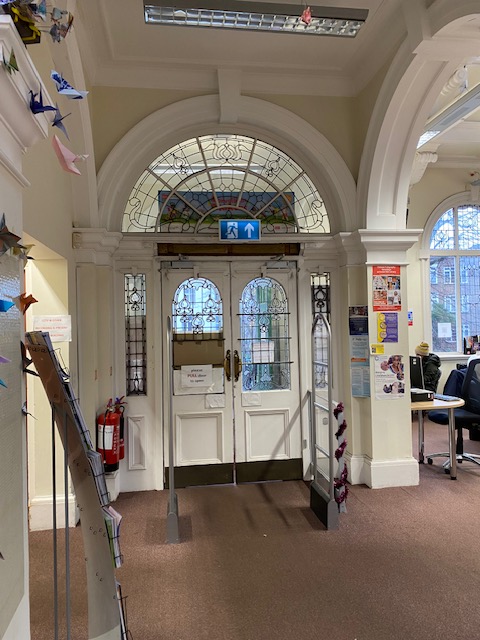
Walk round to Forest Hill Library, built in 1901 as one of the 600 Carnegie libraries in the UK. It was run by the local council until 2016 when a bidding process ended with it becoming a partnership that was community led. The building was refurbished in 2008 and is now grade II listed. Inside the building are some lovely features with its arched windows and large sun-lights whilst outside, the exterior still retains its grandeur with its Arts and Crafts design.


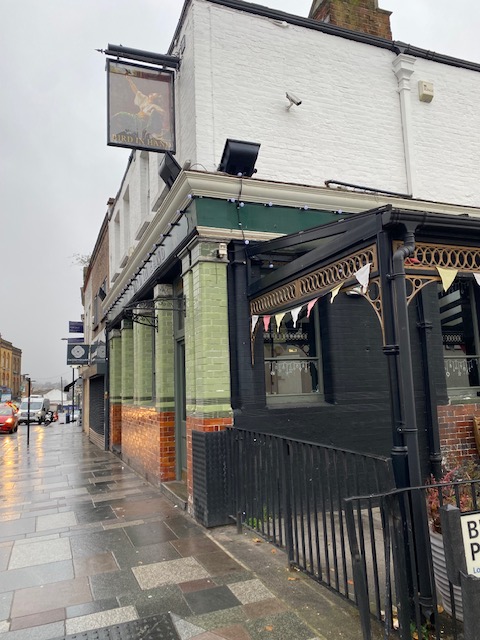
Next, walk round to Bird in Hand Passage, where there is a pub with that name on the corner. Interestingly, a “bird in hand” derives from an old sport – it refers to the craft of falconry where the owner holds the bird using his gloved hand, ready to release it to catch its prey.
The cottages in Bird in Hand Passage are most likely from the mid-to-late 19th century, when the area experienced significant development, particularly around the time the Croydon Canal was operational in the early 19th century and ran at the bottom of the passage.


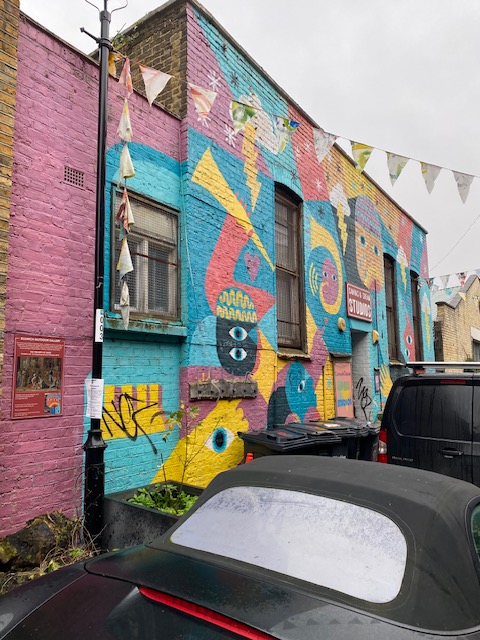
Now make your way to Havelock Walk, where you will immediately see a lively and colourful mural. The Walk is in fact an old mews, now a haven for artists who have adopted its long row of former warehouse buildings. The sculptor David March, who created the falling telephone boxes in Kingston (see bus route 71 for images of this work of art), is a resident of this mews. As well as the jungle mural at the start of the mews, there is another one over the walls and door of the Canvas & Cream studios, with a reference to the Dulwich Outdoor Gallery. The jungle scene that you see on entering Havelock Walk is by London artist Priya Barot, who has a proclivity to painting animals.


6. Brockley Park bus stop
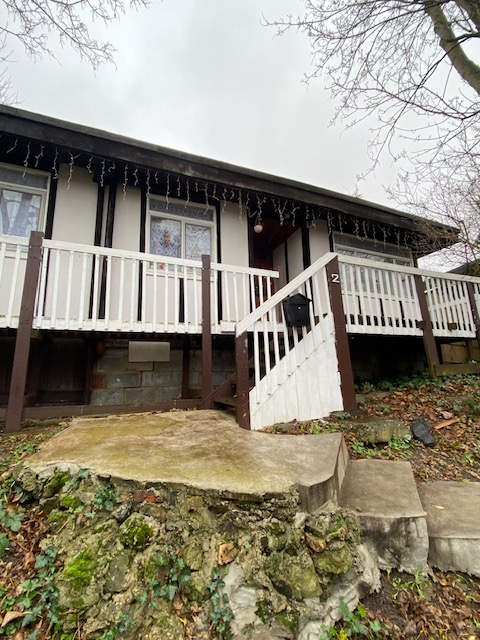
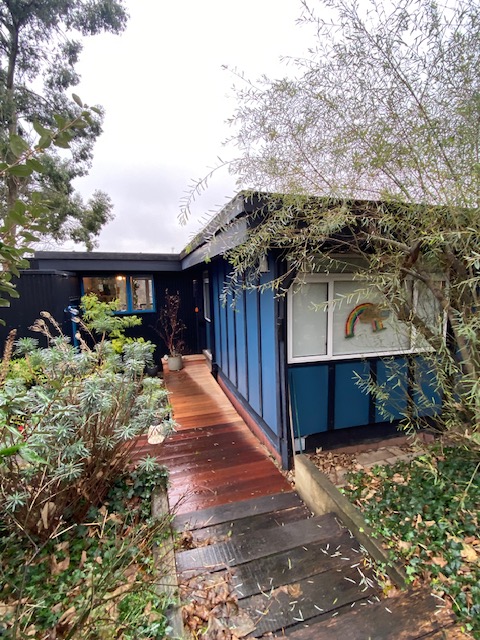
The next place to see is somewhat different from the norm. It’s a cul-de-sac called Segal Close and consists of seven homes. They are unusual, both in the way they look and in the way they were conceived and built. They were designed by modernist architect Walter Segal and were part of a council-run scheme that allowed ordinary people to build their own homes. The success of the project proved influential for the self-build movement which has grown over the last 30 years, gaining widespread exposure through TV shows such as “Grand Designs”. Because of the sloping nature of the site they were built on, this Segal method of construction led to the use of timber stilts rather than traditional foundations.

7. Brockley Jack bus stop
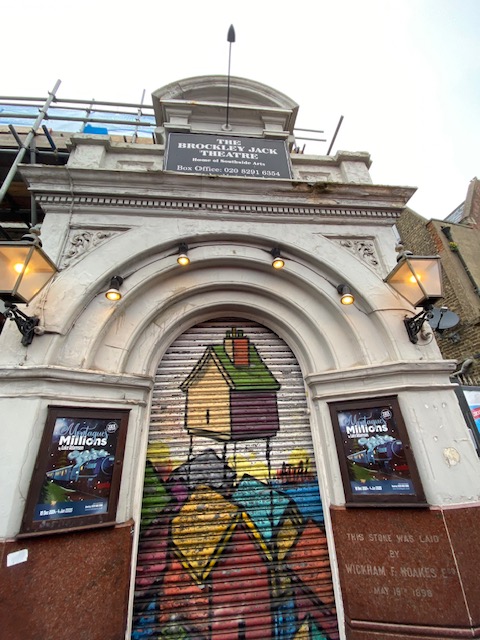
The bus stops very near the Brockley Jack pub and theatre. However, on the day of this visit (mid December 2024), the pub was almost entirely covered in scaffolding. That said, it has some interesting history to tell – a pub of the name of Brockley Jack has stood on that spot since 1863, though the current building, as the date at the top states, has stood there since 1893. Before being named the Brockley Jack, the inn had been previously known as The Crooked Billet in the eighteenth century, and The Castle in the first-half of the nineteenth century. During this early period, the pub was apparently frequented by numerous dastardly highwaymen including the infamous Dick Turpin. More recently, in fact since 1993, the old function room of the Brockley Jack has been used for theatrical productions under the name of The Brockley Jack Theatre. The venue puts on plays and film screenings, and is used for workshops and rehearsals, encouraging upcoming talent.

8. Brandram Road bus stop
Just where the bus stops is Boone’s Chapel, which is the only remaining building of the Lee Place estate. This was one of a number of large houses and gardens that were built by wealthy London merchants in the 17/18th centuries. The Chapel was built by the Boone family, along with a row of almshouses, three of which were for 12 poor people of the parish of Lee. During the renovation of the chapel in 2006, the remains of Christopher Boone and his wife Mary were discovered.
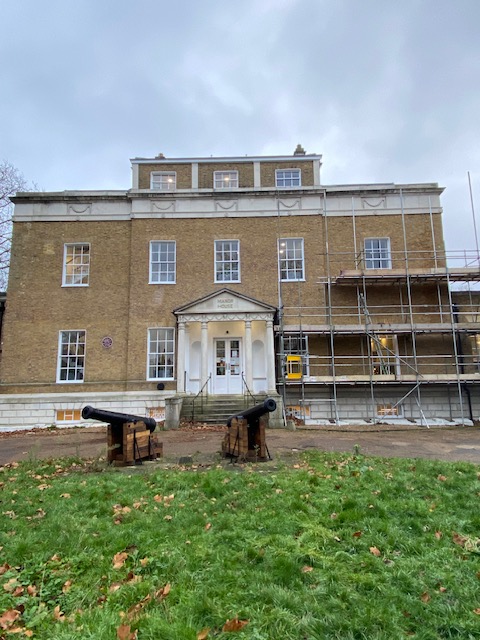
From here, it’s a short walk to Manor Park House and its gardens. As you approach the house, you can see two French naval guns pointing outwards. This pair was made in 1764 and were six-powder cannons. Part of the house is having some restoration work but it is steeped in history. Step inside and you realise it’s now a public library. In the hall is a pretty patchwork quilt, which represents the work of over 100 local residents and workers in the borough. They were asked – if you had one patch to tell a story, what story would you tell? The result is this fabulous patchwork, filled with individuals’ hopes and dreams.



Inside the library proper is a piece of art entitled Stelae, made from resin and fibreglass. The artist Sam Basu reshapes disused industrial buildings by hand. Outside the building is the Ice House, built in 1773, to supply the Manor House with ice to preserve the food. The ice would have been brought from the local lake, or sometimes from overseas and then rammed into the ice-well. The entrance would then be closed and insulated with straw, thus enabling the ice to keep throughout the summer months. The Ice House is open to the public only on a few days during the year so it’s worth checking to find out when their open days are.
The main house had been built in about 1773, by Thomas Lucas (a merchant and treasurer of Guy’s Hospital). The house was then purchased by Sir Francis Baring in 1796 from Mrs. Angerstein (the former Mrs. Lucas). Baring also bought the Manor of Lee, and the house was then known as the Manor House. The house and gardens remained within the Baring family until 1898 when Sir Thomas Baring, 1st Earl of Northbrook sold the Manor House and estate to the London County Council for £8,835 (almost £1.5m as of today).


Finally, on your way back to Brandram Road, you’ll see a remarkable mural on the side of a residential home, of a Caribbean woman, seated. It’s by Spanish artist Wedo Goas, who was born in 1990 in Galicia, Spain. This mural was created for the 2024 London Mural Festival and celebrates the Windrush generation. It’s remarkable because of its size and its authenticity, not to mention the sumptuous colours of the lady’s dress.

This is a fairly long bus route so it’s as well to be prepared for this and to go on a fair-weather day – unlike how it was for me! Even so, I managed to find some great places to see, from the various remains of the Crystal Palace to a Wren church spire and taking in a visit to the interesting Moustache café. There was much to delight and surprise, with some lovely murals and the grounds of Manor Park House with its Ice House. All in all, despite the miserable cold and damp, I thoroughly enjoyed the route and would even place it high in terms of my favourites.
Toilets that are open to the public and free of charge:
- Crystal Palace railway station
- The Moustache Café
- Forest Hill Library
- Manor House Library
 london routemistress
One response to “Bus route 122”
Hi Helen Finally had some time to read this article. It’s so interesting and professional. I will have to do some of your routes in the future. Perhaps you can suggest one to start with? Do you do these all in one day? Have you thought about putting it all in a book? Carole xx
LikeLike