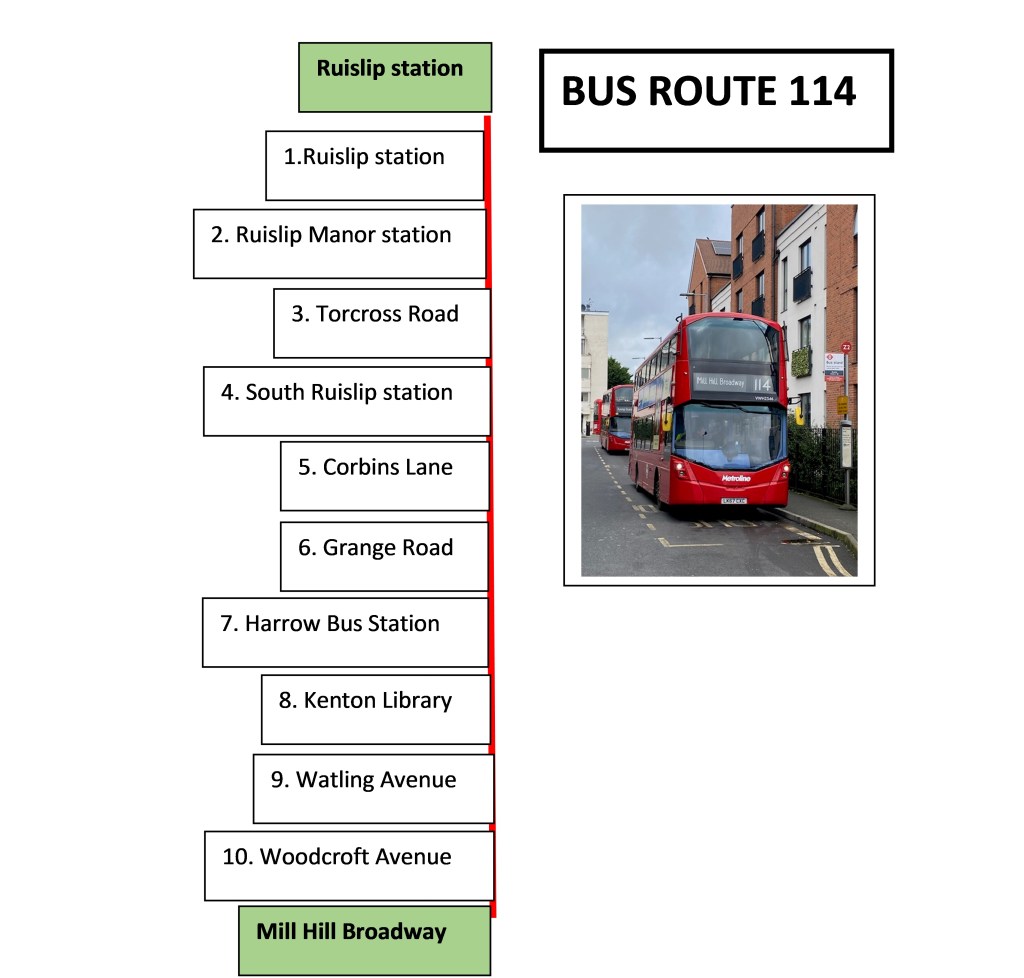
Ruislip station to Mill Hill Broadway
Highlights:
- The Barn
- Black Bull pub, Ruislip
- Kenton Library
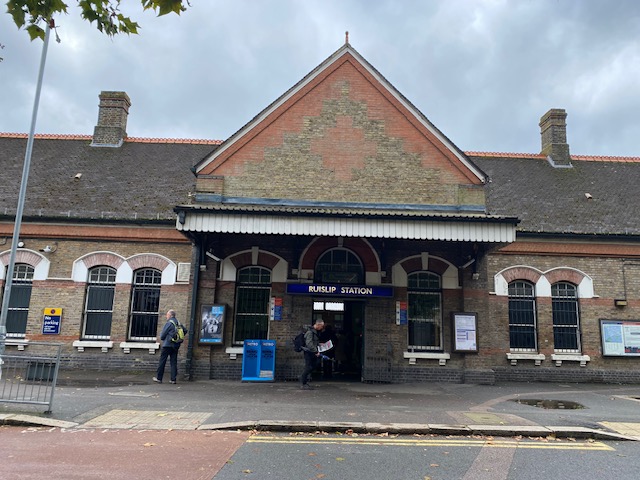
1. Start of route at Ruislip station
Ruislip station itself is worth a quick look before venturing off. Ruislip is on the original Metropolitan line between Harrow-on-the-Hill and Uxbridge and was the only stop when it first operated. The original trains were steam (1904) but the tracks were soon electrified.
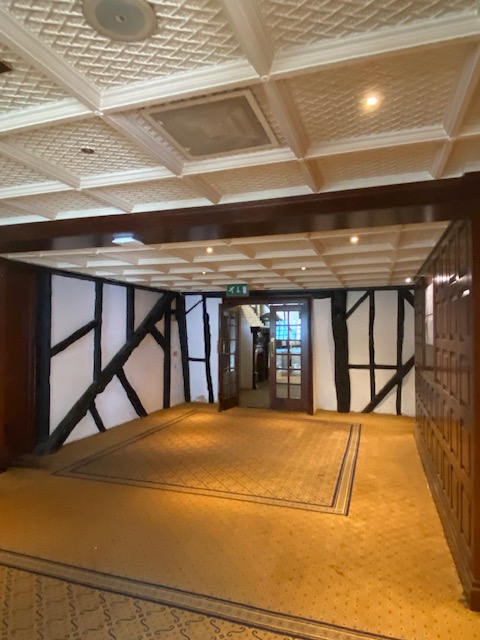
A few minutes walk from the station is the former Barn Hotel. These days, it’s no longer a hotel but it has a rich history. Parts of the estate date back to the 15th century and are mentioned in the Doomsday Book. The two Barns date from the late 1590s. These were working buildings and some of the oak frames used in the building were dragged here from the River Thames, having been scavenged from old
ships.

2. Ruislip Manor station bus stop
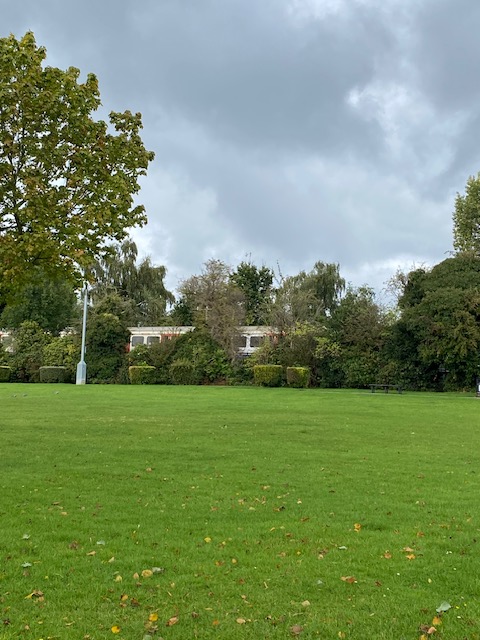
When you get out at the bus stop, you’re helped to find Shenley Park by a large mural pointing the way. It’s a lovely park, owned by the local authority since 1937, with plenty of space for walking and sitting. Autumn was a good time to go, watching the leaves turn a beautiful golden colour.


3. Torcross Road bus stop
The bus stops right outside the Black Bull pub which has an interesting history. When the Ruislip Manor estate was built at the site of this pub stood a massive machine producing bricks or the mortar needed to build the houses locally. When the pub was built it was to be called the Brickmakers, but for some reason ended up being the Black Bull, and it has been called this ever since. Quite possibly because a large percentage of the workers at the brick-making factory were Irish, the Black Bull prides itself on promoting Irish sportsmen and women. Inside one of the rooms is a wall full of them including William O’Connor (darts), Alex Higgins (snooker) and the race horse The Minstrel. The pub has undertaken a refurb recently such that it’s very welcoming and has a warm atmosphere.

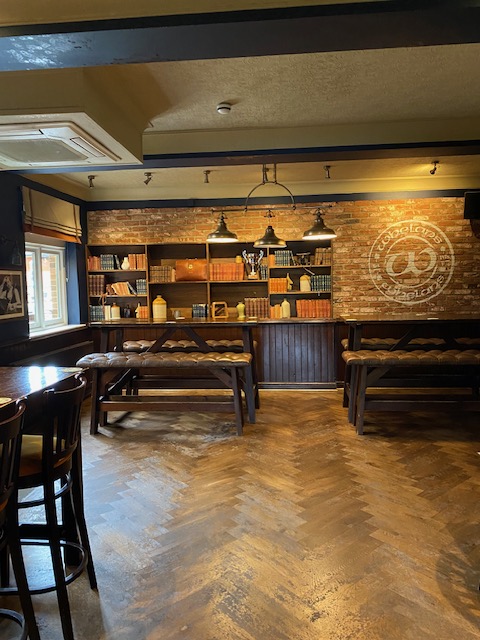
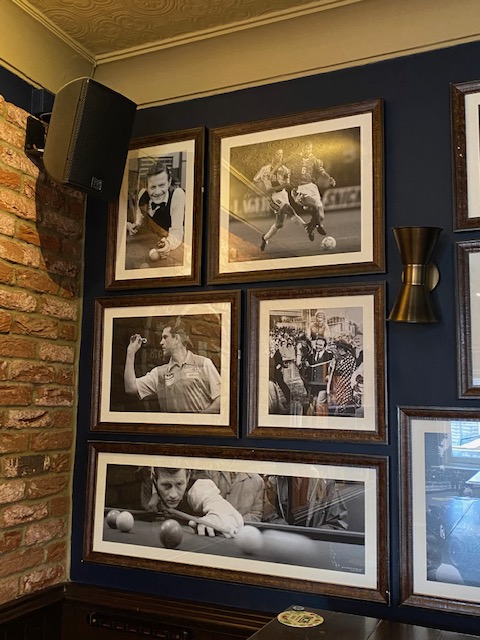
Down the road from the pub is the Jim O’Neill Walk and Yeading Brook. Hillingdon Council named the new pathway after Jim O’Neill, a local councillor who died in 2004. The path is less than half a mile long, starting from the main Victoria Road and ending near Ruislip High School. The Brook runs alongside the path and is itself 16 miles long, one stretch of which is here in Ruislip.


4. South Ruislip station bus stop
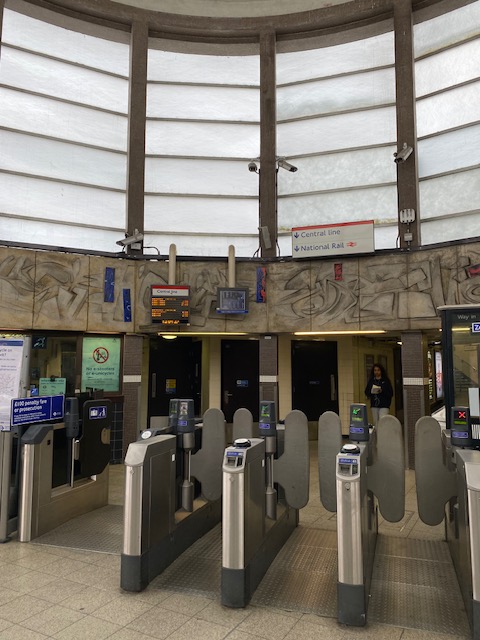
The station at South Ruislip is another that is worth a look both from the outside and inside the booking hall. The station is considered one of the most distinctive on the tube network, as architect FCC Curtis used the circular plan of stations (others include Southgate and Hanger Lane), and made a large ticket hall space in reinforced concrete, lit by windows made up of 12 vertical strips each. The design idea was revised by Kennett and Turner, who used translucent glass instead. Inside the ticket hall, a concrete frieze by artist Henry Haig runs around the interior, depicting the busy rhythms of the station’s day. It is thought by some to date from the 1948 construction of the station.


5. Corbins Lane bus stop
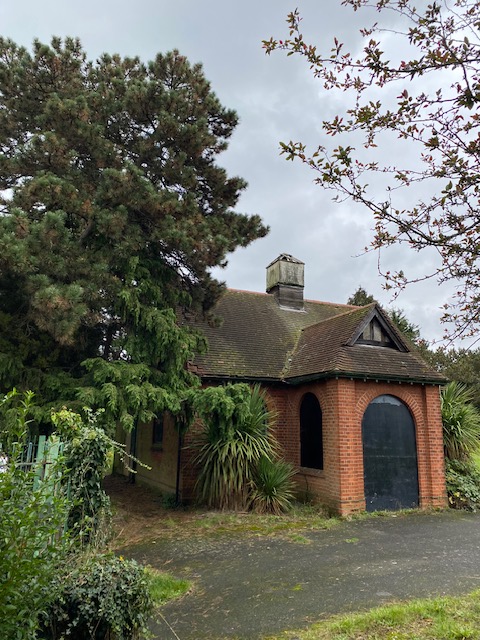
Round the corner from the stop is Eastcote Lane cemetery. Unfortunately the gates were locked on the day of my visit so I was just able to take a glimpse of the gravestones from afar. It is noted to be of special interest for retaining some of its original simple 1920s layout. There is also a picturesque Arts and Crafts style entrance lodge with a small turret and rustic wooden gates. The lodge is also surrounded by a number of palm trees and conifers.


6. Grange Road bus stop
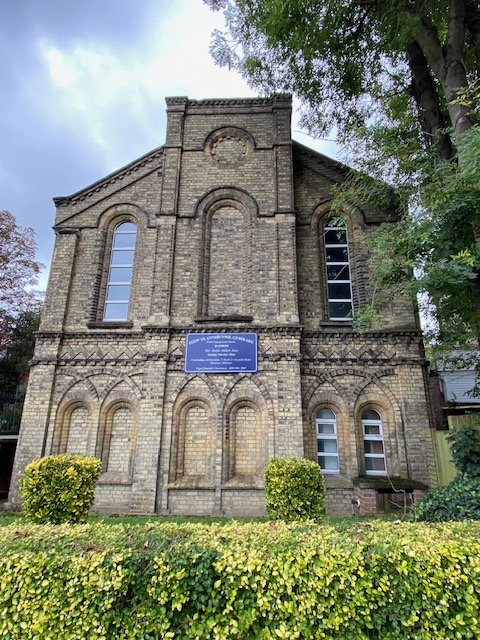
This is the stop to go and see the Welsh Congregational Church which had at one time been home to a Wesleyan Chapel, until 1864 when the Welsh church took over the site. It’s a lovely building that has been designated as having special architectural or historic interest and again, it’s best to find out in advance if it’s going to be open. It had special interest for me as a native Welsh lady!
Close by is the Salt Bar, which started out as the Half Moon, apparently named after the shape of a local pond. It was established in 1862 and rebuilt in 1893, it has half-timbered ornamental plasterwork with stained glass and etched windows.


7. Harrow Bus station bus stop
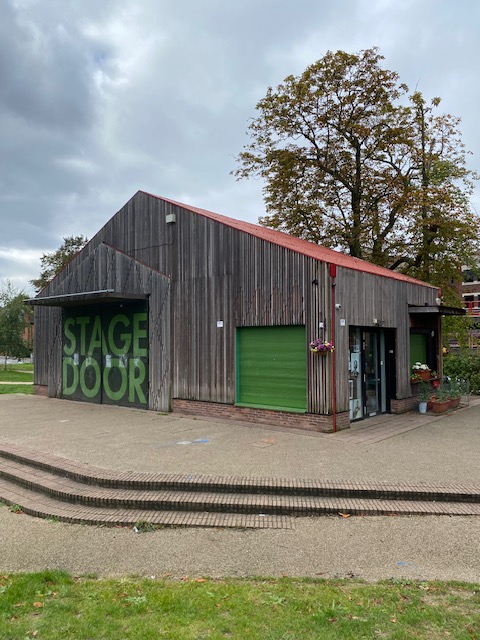
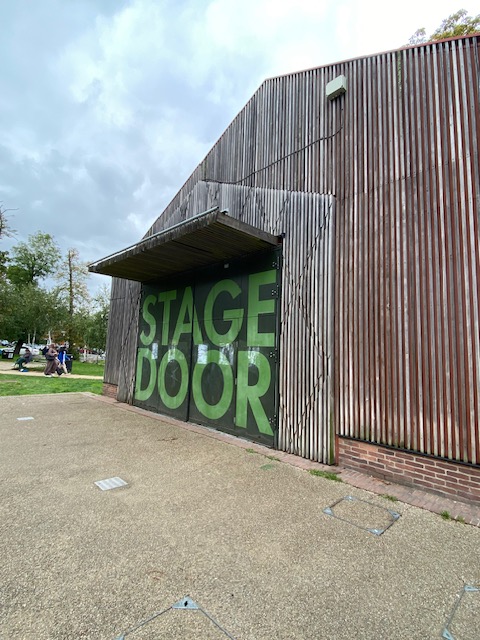
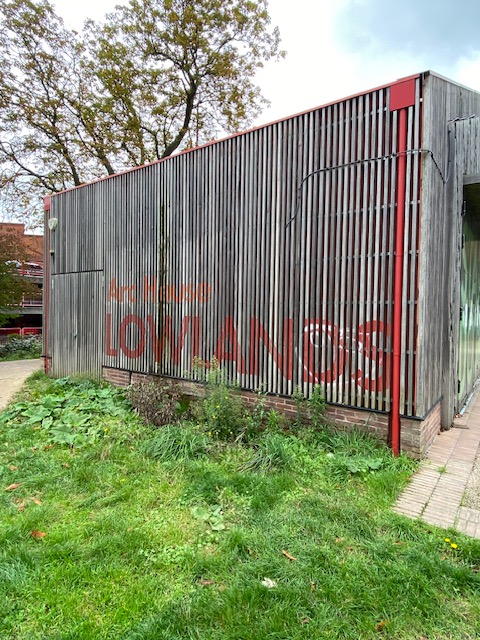
Walk through the tube station at Harrow-on-the-Hill and you find yourself in Lowlands Recreation Ground where the Arc House is situated. Since 2015, it’s been a performance space and café sitting in what was unused scrub land unknown and unloved by the people of Harrow. Sitting as it does next to Harrow College, it’s very well used. The rec ground that it sits in, is also well populated by students to the college, commuters using the underground and all visitors to the area. As well as indoor performing areas, there is a small amphitheatre around the building for putting on outdoor performances.
8. Kenton Library bus stop
Take a walk to Kenton Library and you’ll be very pleasantly surprised at the outside of the building. Built in the 1930s in an art deco style, it was more recently refurbished, keeping many of its interior features. It’s worth checking their opening hours before you go – I wasn’t lucky enough to go inside being a Wednesday afternoon. However, it appears that during the renovations, the original parquet floor was revealed, having been covered with carpet for many years. The original steel bars on the windows have also been restored and the fabric of the library is in keeping with its art deco history.


9. Watling Avenue bus stop
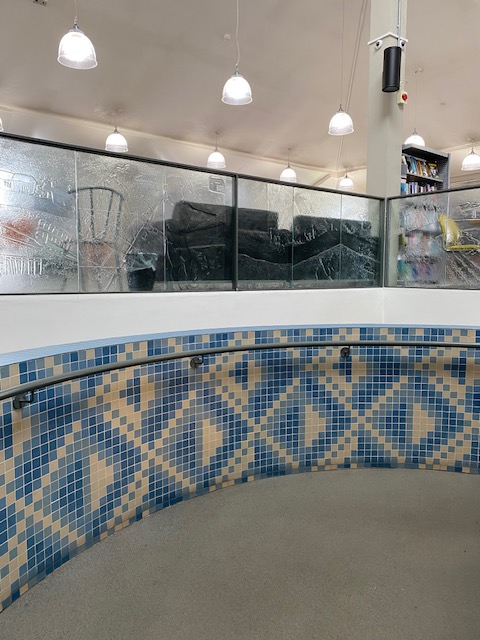
Here is another library that’s worth seeing, Burnt Oak Library, though in a vastly different style. Opening hours meant that it was possible to go inside and take a look around. Originally built in 1968, it’s had a recent 21st century make-over. The new entrance bursts out of the building’s corner, forming the start to a curving route that navigates through the
building. This brightly coloured new route is clad in tiles in a pixelated pattern which is derived from sixties fabric designs and inspired by Enric Miralles and Benedetta Tabliabue’s roof to the Santa Caterina market in Barcelona.
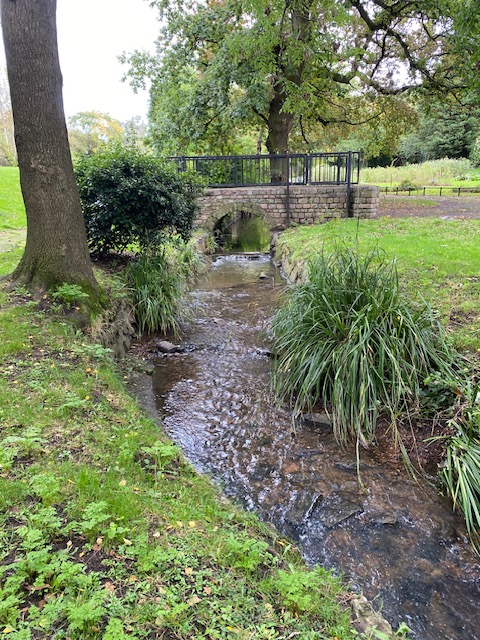
Opposite the library is a lovely open green space with a brook running through the centre. The Burnt Oak brook is a tributary of Silk Stream and this part of it runs through Watling Park. Here, the stream mainly follows a natural course and crack-willows, hawthorn and alder form a woodland corridor for wildlife.


10. Woodcroft Avenue bus stop
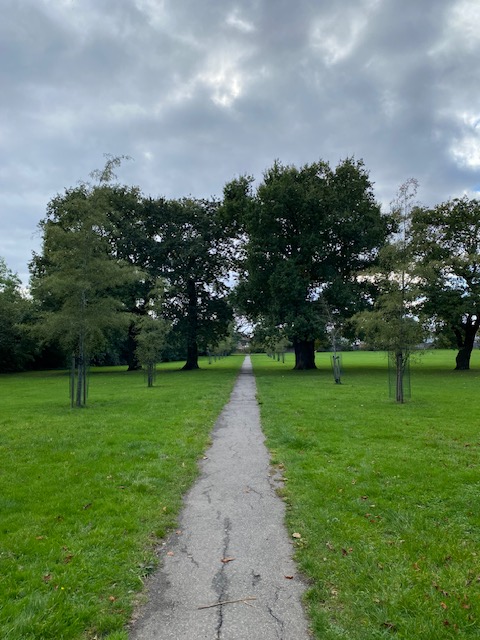
Final stop on this route is at Lyndhurst Park. This is another lovely open green space for walking the dog and meeting friends, being as it is very near the shops at Mill Hill Broadway where in fact the 114 terminates. The far end of the park is the site of the Mill Hill Old Railway Nature Reserve, much of which is only open on the weekend.

I found this route very mixed – I don’t think there was anything that had a wow factor but it’s not always possible to find a working observatory on each route! There were certainly parts I enjoyed such as the Black Bull pub and finding out about its history, as well as seeing some lovely buildings. However, it was frustrating in that many places were closed or inaccessible such as Eastcote Lane cemetery, Welsh Congregational Church, Kenton Library and the Barn Hotel.
What it proves is that there is always something worth seeing on each and every route and that I have to accept that sometimes I’ll be disappointed or at least not as wildly enthusiastic as on some routes.
Toilets that are open to the public and free:
- The Barn
- The Black Bull pub
- Harrow-on-the-Hill station
- Kenton Library
- Burnt Oak Library
 london routemistress
One response to “Bus route 114”
Thank you, dear Helen, another fascinating report from the London Routemistress. Who else could make bus routes sound so interesting
Mandie x
LikeLike