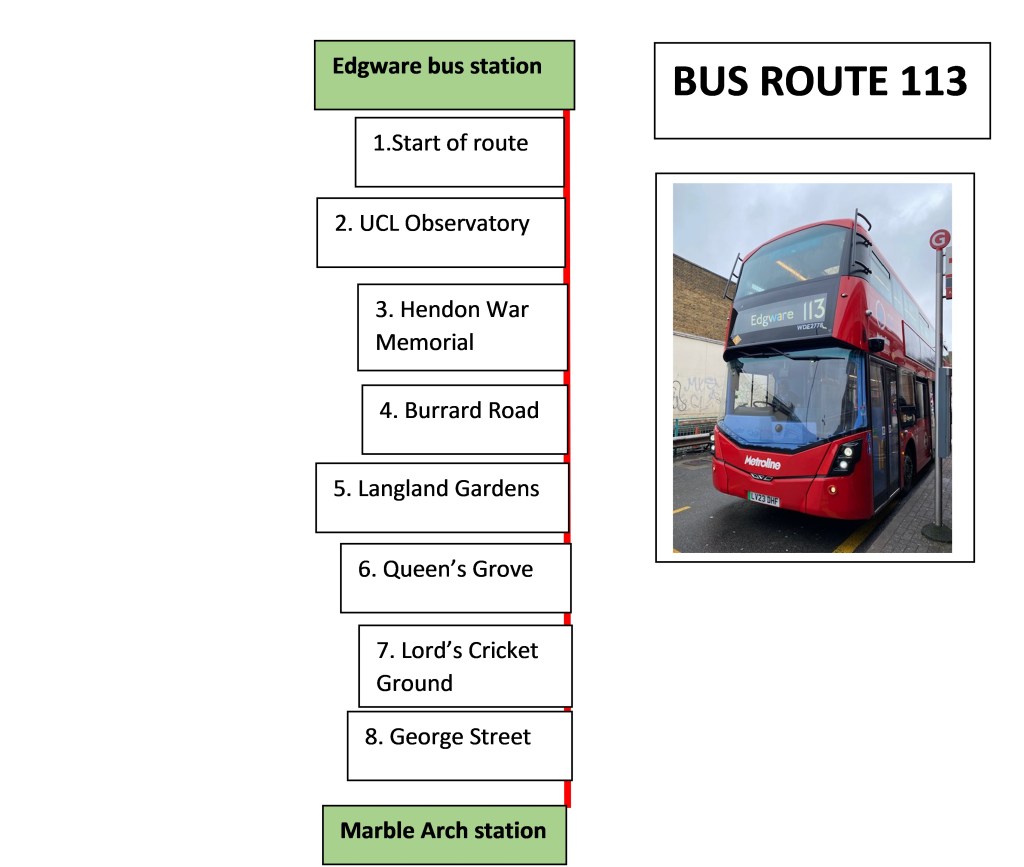
Edgware bus station to Marble Arch
Highlights:
- UCL Observatory
1. Start of route
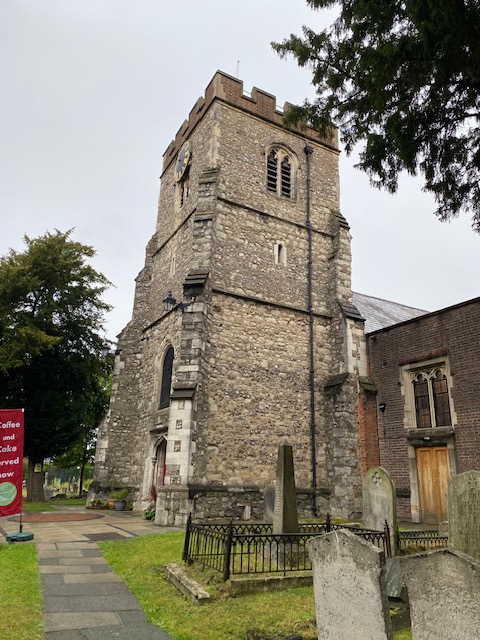
At Edgware station is a large mural saying Stop and Smell the Flowers – it’s by Holly Graham and is “a call to action addressing the climate emergency through the lens of access to clean air and green space”. Walk up the road from the bus station, and find St Margaret of Antioch church. This is also on routes 32, 79 and 107. Just inside the grounds is a grave for Frank Williams, who played the ineffectual vicar in Dad’s Army and further back is a “Saxon Cross” which marks the communal grave where the remains were reinterred of the people whose graves had been unlucky enough to have been caught up in the floods of 1908. The church itself has a medieval tower, dating back to the 14th century and the clock on one of its sides dates from 1756.


2. UCL Observatory bus stop
And so to possibly the most interesting place I’ve yet discovered. The bus stops opposite the UCL Observatory and you have to walk in the underpass to get there. Along the walls of the tunnel are pictures and references to the planets in our solar system – these give a foretaste of what’s to come. I was lucky enough to have a private tour of the observatory by the director, Dr Fossey. We first of all visited a room that houses an 1862 telescope, donated by Mr H R Fry (he of the chocolate fame). It was made by the celebrated telescope maker Thomas Cooke, and was presented to the Observatory in January 1930. At the risk of sounding too technical to the layman/woman (of which I am one), the telescope is an 8-inch refractor with a focal length of 126 inches.
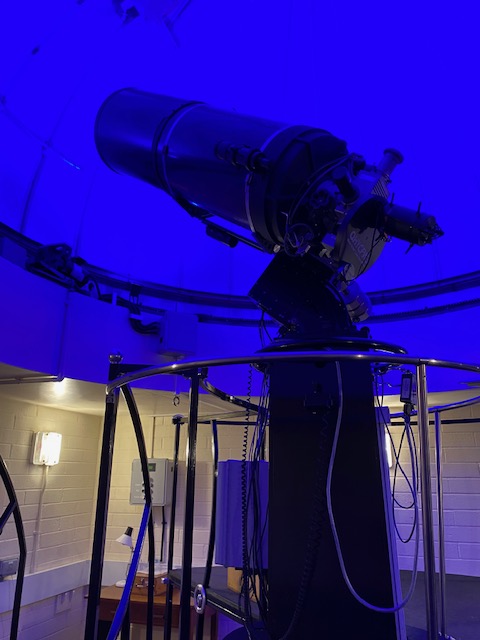
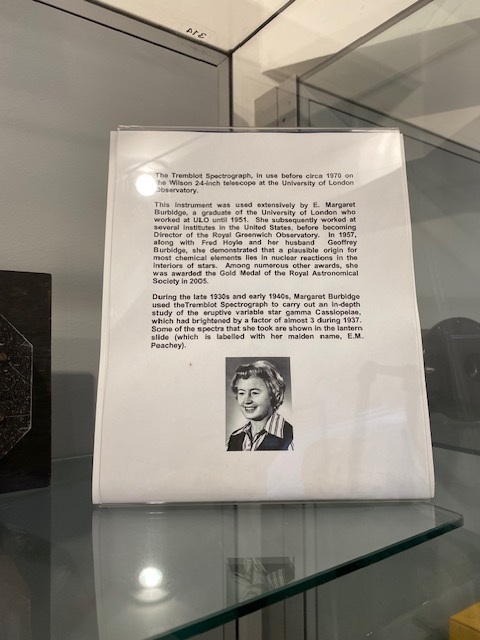
We then went to the room next door where there is a Celestron C-14 telescope. As if this wasn’t fascinating and mind-blowing enough, Dr Fossey then talked about Margaret Burbidge, a pioneer in observational astronomy and astrophysics. She had studied at the observatory and in fact continued throughout World War II, despite having been interrupted on at least two occasions, by V-1 flying bombs.

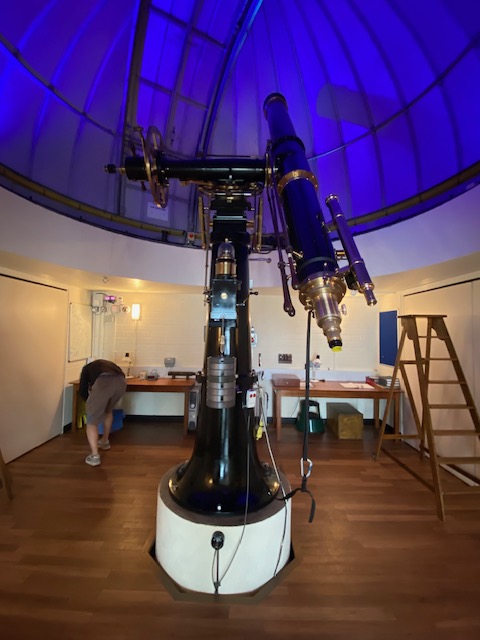
The third room we entered was even more astonishing than the previous two. We had to walk up some steps to get to the level where the Radcliffe telescope is positioned. This twin refractor was built in 1901 by Grubb of Dublin, originally for the Radcliffe observatory in Oxford. It was offered to UCLO in 1935 and transported and erected at this site in 1938. It has been mainly used for research in positional astronomy and for undergraduate teaching in practical astronomy.
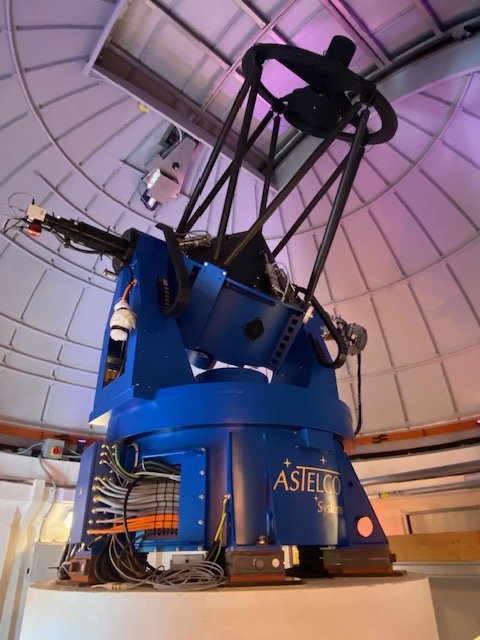
The final room we entered houses an Astelco telescope, the most recent acquisition by the observatory. It’s a Perren Telescope and is computer-controlled with an 80 cm diameter. It’s the most powerful telescope in the UK and is used to study planets, asteroids, and other astronomical phenomena.
Even walking around the outside of the buildings is a delight. The oldest building dates back to 1929, so the centenary isn’t so far away.
The observatory does have public tours which need to be booked in advance. If you have any interest in the sky and the stars, it’s a fantastic place to visit and learn from experts.


3. Hendon War Memorial bus stop
In an island in the middle of a very busy A road is the War Memorial. It was unveiled on St George’s Day, 23 April 1922, on a different site and was moved to its present location in 1962. On 2 of the faces, on bronze plaques, are listed the 224 names of those of the Central Ward of Hendon who died in WW1, and on the right face, a similar bronze plaque lists the 138 names of the West Ward of Hendon.
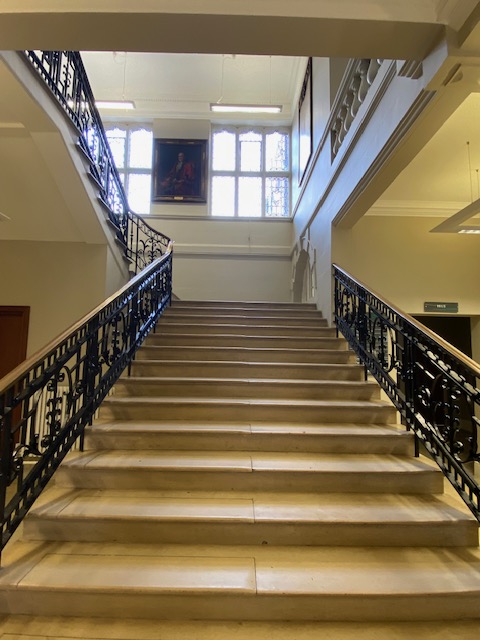
Now head towards the Town Hall and Library, sitting next to each other. The Town Hall is also home to Middlesex University. As early as 1896, there was a need for new municipal buildings and the foundation stone was laid by the chairman of the council in 1900. The new building was in the Pre-Renaissance style. It became known as Hendon Town Hall in 1932. Margaret Thatcher made her first speech as Prime Minister at the town hall in May 1979 and she returned to unveil a statue entitled the Family of Man by Itzhak Ofer in 1981, a twisted abstract form representing figures of a family, which can still be seen outside. Inside the Town Hall is a small exhibition about Hoop Lane cemetery and crematorium. Notable burials include Leo Baeck, a 20th-century German rabbi, scholar, and theologian and world-renowned cellist Jacqueline du Pré. Both the town hall and the library next door are Grade II listed buildings, with the library being a little newer, dating back to 1929, and designed in a neo-Georgian style.


4. Burrard Road bus stop
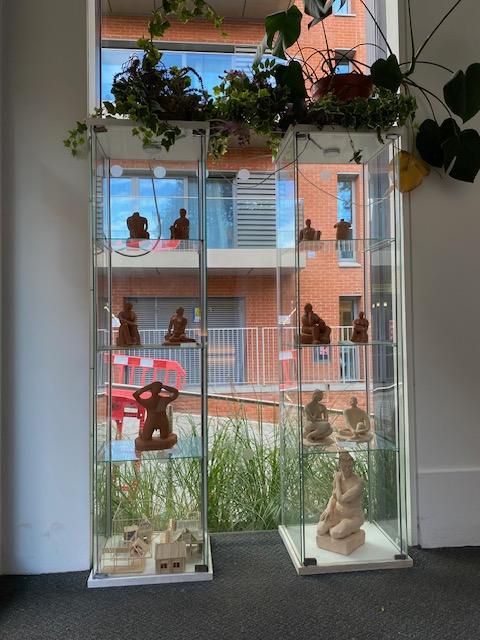
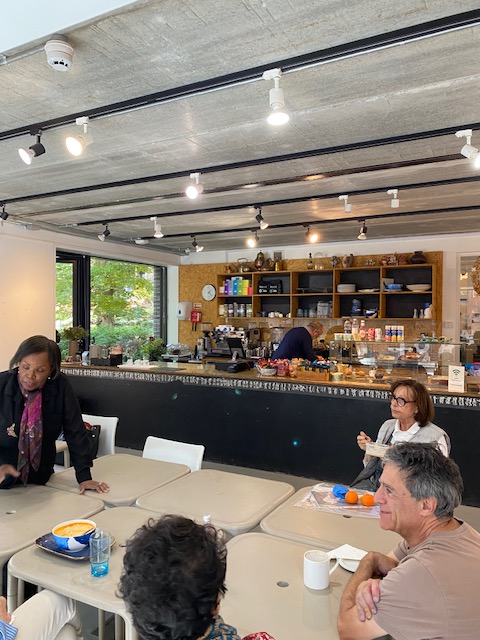
Alight here for the Hampstead School of Art, which prides itself on being the oldest, non-profit, contemporary art-making and learning centre in North London. The school has many studios, for art, sculpture, life-drawing and even jewellery making. They run courses on all these and more. Scattered throughout the building are various pieces of art that can be admired as you walk through. The café is welcoming and it’s a great place to meet other students.


5. Langland Gardens bus stop
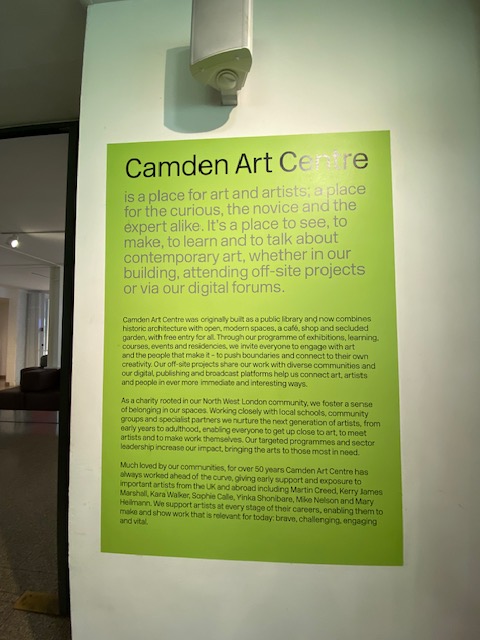
This is the stop for Camden Arts Centre (CAC), another place where art is central to its existence. CAC prides itself on championing over-looked and under-represented artists from every generation. The Victorian building was opened in 1897 and survived World War II, despite hits by enemy incendiary bombs in 1940 and a blast from a V2 rocket in 1945 which destroyed some of the building and a row of houses next door, where the garden is now situated. Every year, the centre offers an Emerging Artist Prize, giving the winner an opportunity to showcase their art. They also offer an annual Ceramics Fellowship, providing an extended residency opportunity for talented young or emerging artists. At present (end September 2024), the galleries are closed for exhibitions as they are in the process of preparing for the next one. It’s worth looking out for what’s coming up and taking advantage of this free gallery.
Over the road from CAC is JW3, where there is a huge mural outside, created by London-based artist Leon Fenster. It measures 9 storeys high and captures the colourful history of the Jews in London. He has managed to include over 100 stories, memories and people from historical figures to local legends. Featured in the mural are notable personalities like Freud, Benjamin Disraeli, and a host of rabbis including Julia Neuberger and Jonathan Sacks, all of whom are vividly brought to life. In addition to these prominent figures, the mural highlights cultural moments such as Brian Epstein with The Beatles and Mr Fish’s 1960s fashion boutique. It’s fun to look at it and try to establish what stories he’s represented here.



6. Queen’s Grove bus stop
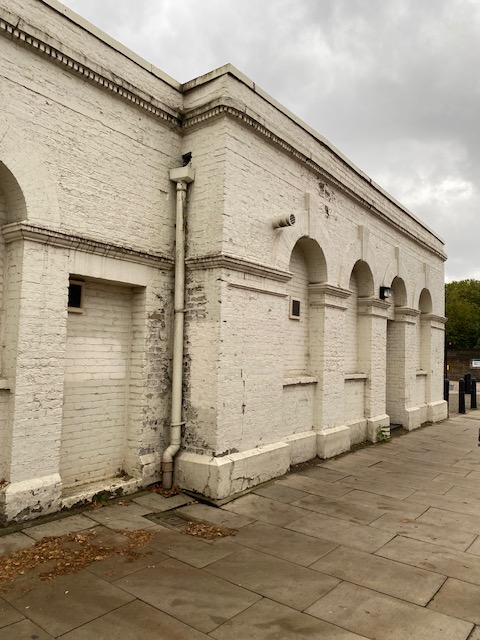
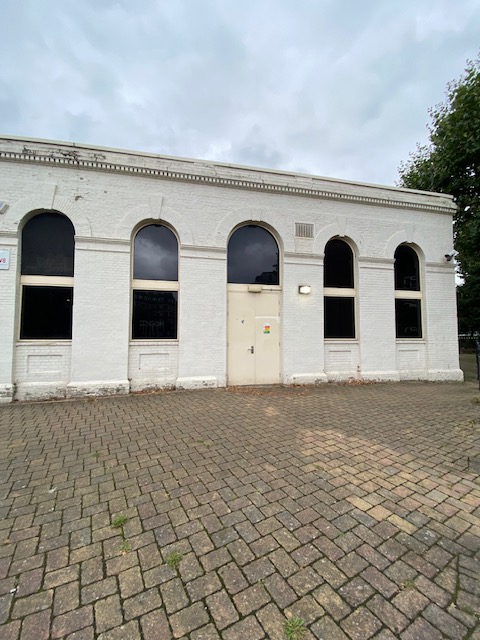
The bus stops right outside the next place of interest which is the former Marlborough Road tube station. Once you realise that this is what it was, it’s obvious to the eye, but I suspect many a passer-by would walk past without so much as a second glance. The station opened in April 1868 on the Metropolitan & St. John’s Wood Railway line. In the mid 1930s, there was a lot of congestion at this end of the line and deep tunnels were built to ease the congestion. This then became the Bakerloo (later the Jubilee) line and Marlborough Road station closed, to be replaced by St John’s Wood station. During its existence, it was mainly used for visitors to Lord’s Cricket Ground which is nearby. It has in later days been a restaurant and now contains a substation installed as part of the power upgrade programme to support the Metropolitan line.

7. Lord’s Cricket Ground bus stop
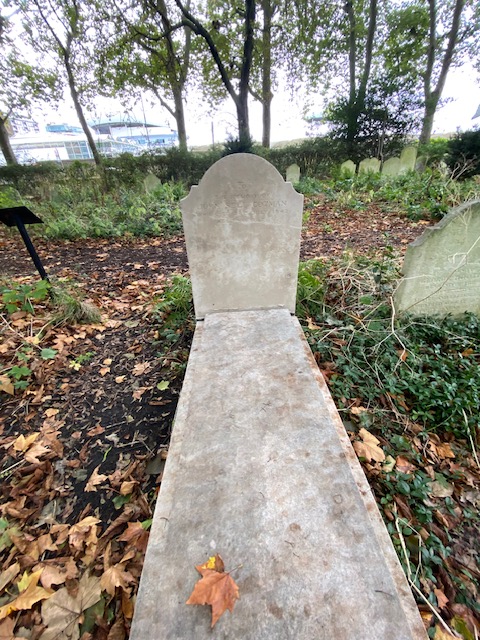
Go round the corner to St John’s Wood Church Grounds, a disused graveyard which is now a public park and a Site of Borough Importance for Nature Conservation. St. John’s Wood was part of the Great Forest of Middlesex in medieval times. From 1323 the land was owned by the Knights of the Order of St. John, after whom the area is named, but at the Dissolution of the Monasteries it passed to the Crown. The area began to be developed in the 19th century, and St John’s Wood Church and burial ground were consecrated in 1814. The burial ground was closed in 1855, and converted to a public garden in 1886. Buried in the grounds are some notable people – the artist John Sell Cotman who was a watercolour painter and Private Samuel Godley, who fought bravely at the battle of Waterloo.
Samuel Godley enlisted in the Life Guards and fought at the Battle of Waterloo, where they took part in the famous heavy cavalry charge against Marshall d’Erlon’s infantry and the French cuirassiers. Samuel’s horse was shot by a French marksman such that he fell from the saddle. The Frenchman caused a terrible blow to Godley and fractured his skull, but Godley didn’t surrender. In fact he got up and killed another cuirassier so that he could take his horse, having lost his own. He died in January 1832, probably as a consequence of the injury he had sustained all those years previously. His former comrades from the Life Guards clubbed together to pay for him to be buried at St John’s Wood Burial Ground, in commemoration of his bravery and exceptional contribution.
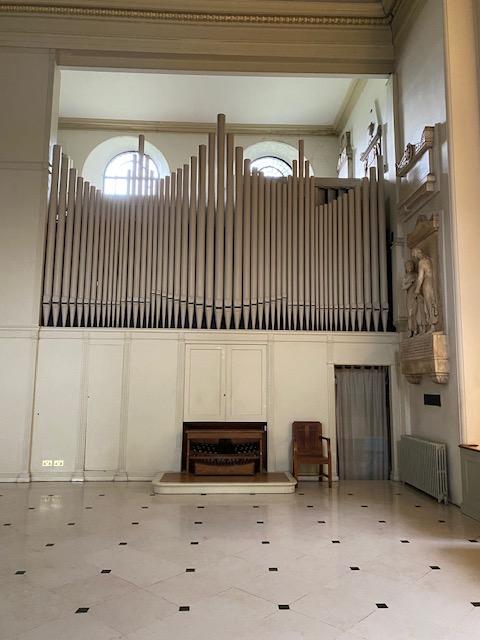
Round the corner from here is St John’s Church itself. The old Marylebone Parish Vestry bought a plot of land in 1808, to use as a burial ground. They also built a chapel – the present St John’s Wood Church – to serve the burial ground. The church is a simple building in Regency style, with a portico of four unfluted columns with Ionic capitals. The interior is very plainly decorated in white and gold and the box pews are original. In the 1990s, the old Victorian woodwork was replaced with Italian marble, which gives the church a very bright air.






8. George Street bus stop
Final stop on this route is to see George’s Pocket park and Portman Square gardens. The former is a bit of “blink and you’d miss it” as it’s a tiny area. It’s generally a space for pop-up food stalls and has an interesting mural which is inspired by flora and fauna. The mural celebrates the nature and wildlife connected to the history of Marylebone and has been placed on a vast brick wall to the side of the park, bringing colour and catching the eye of passers-by.
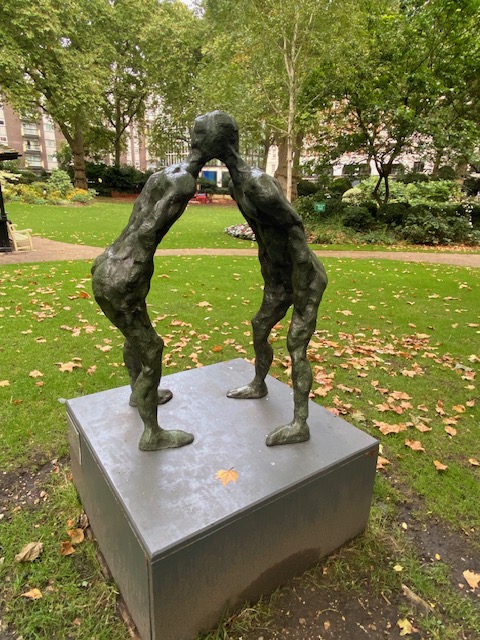
Not far away is Portman Square Gardens, a private park in the middle of the square. I was lucky enough to be allowed in by the head gardener but the gates are usually locked. Inside the park are two sculptures, both by artist David Breuer-Weil. The first is entitled Brothers, with two people holding on to each other but pulling in opposite directions. The second is called Brothers II and the sculpture forms a human arch showing the joining of two minds. Described by the artist, “It is an image of coming together, resolution and peace. But, it also offers a suggestion of symbolic meanings showing the arch as a symbol of connection and resolution. Distances between people that were formerly unbridgeable are now connected in less than a second and Brothers expresses this miraculous element of modernity.”


There is no doubt in my mind that this was the most memorable and fascinating route that I’ve travelled on. The highlight was unquestionably the tour of UCL Observatory which was in fact a bonus, as I had expected it to be closed. That said, there were other delights along the way – the massive mural at JW3, both Arts Centres in Hampstead and Camden and the sculptures set within Portman Square Gardens. Even finding out about Samuel Godley in St John’s Wood burial ground was a delight and all this highlights just how special is my project of travelling on all TfL bus routes.
Toilets that are open to the public and free:
- Broadwalk shopping centre, Edgware
- UCL Observatory
- Hendon Town Hall
- Hampstead School of Arts
- Camden Arts Centre
 london routemistress