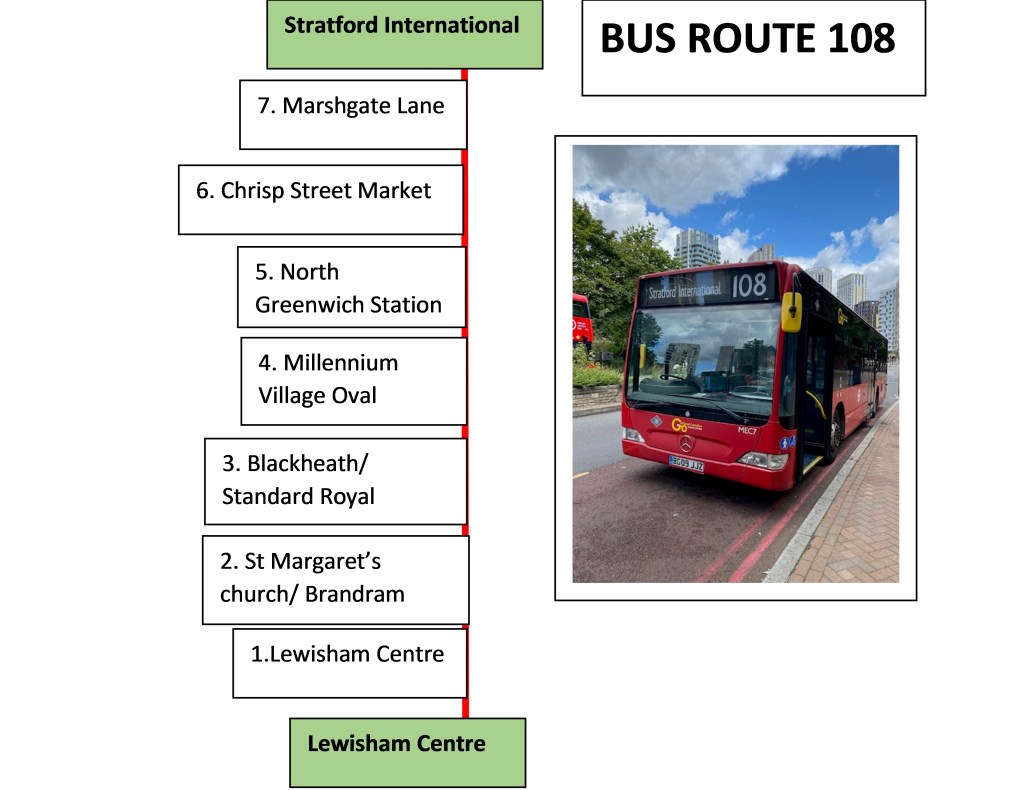
Lewisham Centre to Stratford International
Highlights:
- St Margaret’s Churchyard
- St Andrews chapel
- Mycenae house and gardens
- Greenwich peninsula
1. Lewisham Centre
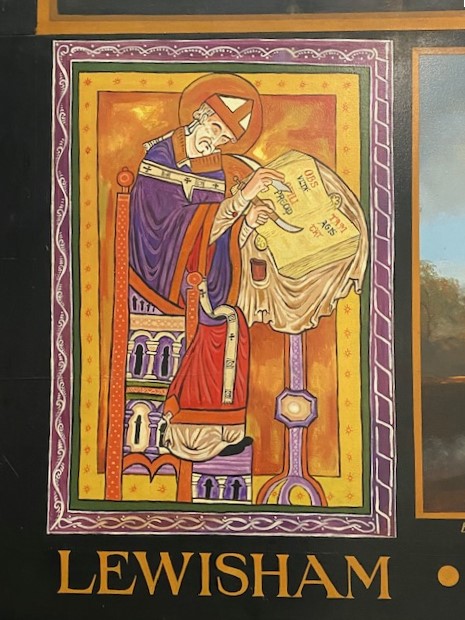
This route starts at the same place as others (see 54, 75, 89) but there are always things to see that are new, or previously overlooked. Take for example, at one of the entrances to Lewisham Shopping Centre, there are a series of images portraying Lewisham and its surroundings over the years. Take a look at St Dunstan, an abbot of Glastonbury who had helped King Edgar to the throne. He had been sheltered by the monks at St Peter’s Abbey in Belgium and as a reward, Edgar bestowed the Manor of Lewisham upon the abbey.
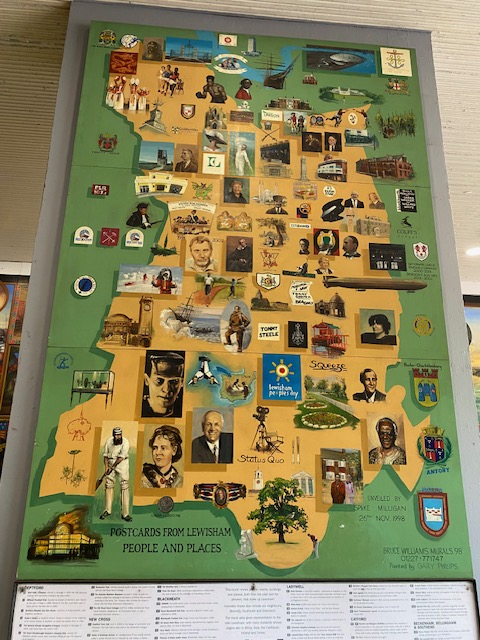
There is also a pictorial description of Postcards from Lewisham (and its surroundings) People and Places. You can see The Armoury Mill which had made armour and firearms then in the 19thC, it became a Silk Mill. There’s also Lewisham Clock Tower, built to commemorate Queen Victoria’s Diamond Jubilee in 1897.
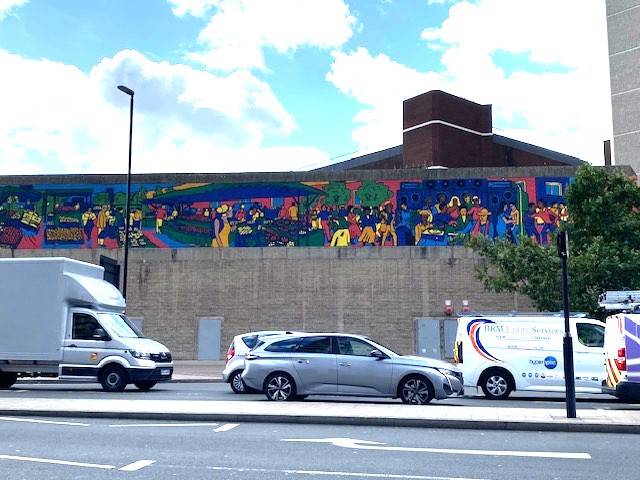
Before getting on the bus, take a look at the mural entitled “Lewisham” which was created by artist Gaurab Thakali, to celebrate Lewisham being London Borough of Culture 2022. “Lewisham” depicts the vibrant mix of cultures and everyday living in Lewisham market, and celebrates the borough’s buzzing sound system culture and jazz scene.
2. St Margaret’s Church/Brandram Road bus stop
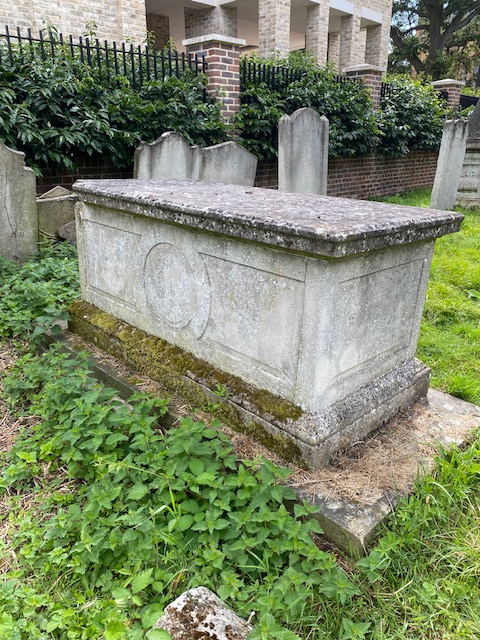
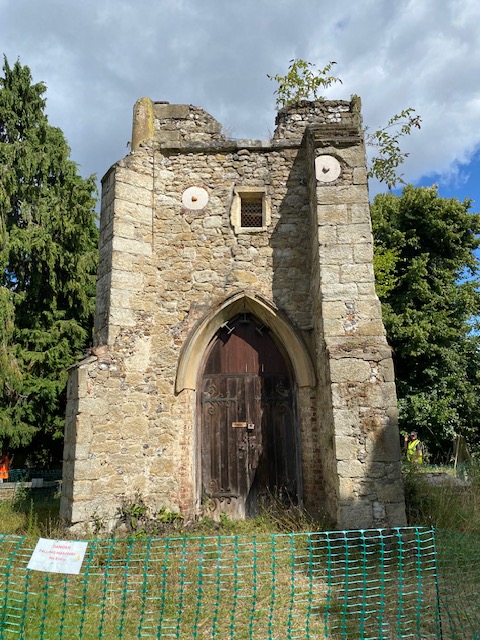
This was a bit of a find so be prepared to enjoy the delights near this stop. Head immediately for the mediaeval churchyard in which lie the ruins of the original church building. The churchyard is usually open only by appointment owing to current restoration work but if you’re lucky, you can have a quick look – if not, you can see the ruined building from the street. Buried here is Edmond Halley (1656–1742), who from 1720 was England’s second Astronomer Royal and is best known for computing the orbit of Halley’s Comet.
The ruins are the remains of the west tower of the medieval former Church of St Margaret and consist of the ground and part of the first stage of the tower, the rest of the church being demolished in 1813. It was the first of three churches dedicated to St Margaret of Antioch, and was probably built around 1080.
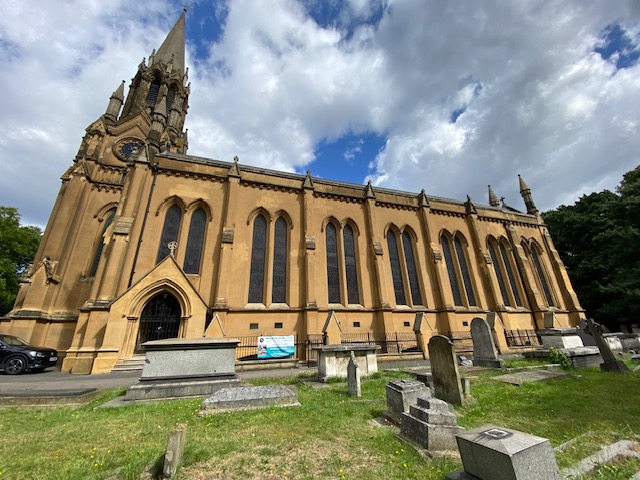
On the other side of the road is the more recent and grade II* St Margaret Church, dating back to 1839-41, built by John Brown of Norwich. These days, the church is one of the best preserved and most interesting examples of a lavishly decorated gothic revivalist interior in London. However, it’s not always open to view inside – the exterior is pretty impressive anyway.
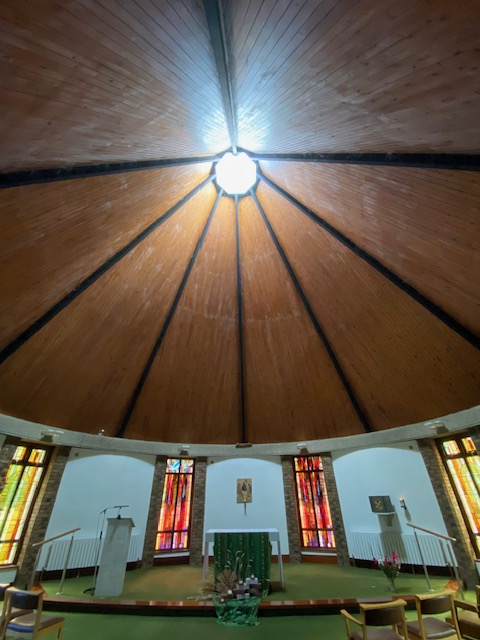
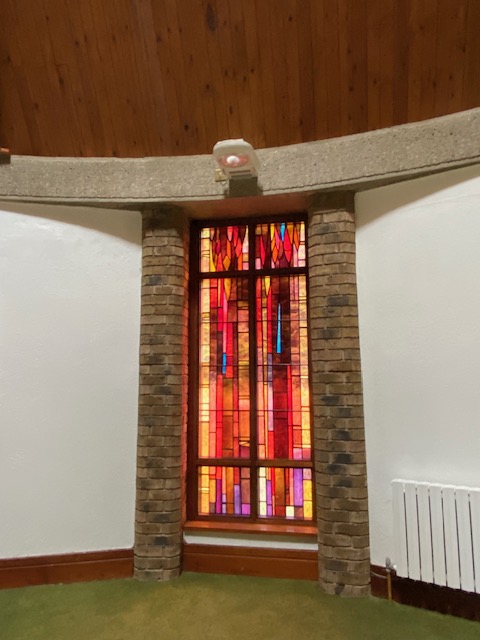
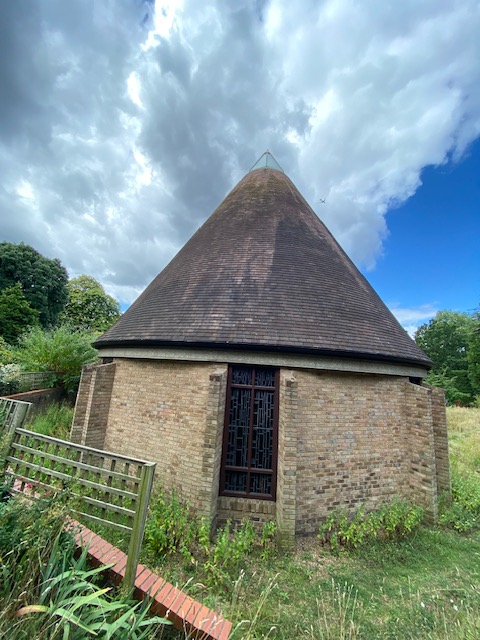
Go back to the original churchyard and there is a surprise next door. A gate separates the street from St Andrews, a convent for the sisters of St Andrew. They were initially in Tournai (then France, now Belgium). In the 14thC, the sisters cared for the sick and destitute. The hospital chapel was consecrated to the apostle Andrew. By the 17thC, the sisters chose monastic life, and began to educate young women. In 1795, the convent closed following the French Revolution so the sisters continued an undercover community, disguised as a seamstress’ workshop.
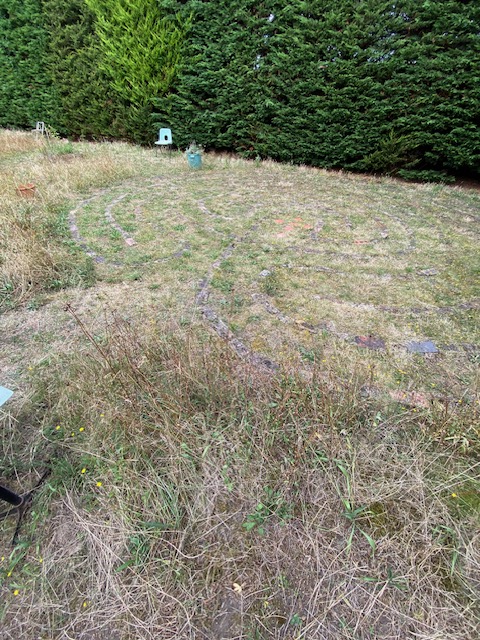
Soon after, the convent and sisters spread further afield and opened in Jersey, followed by other countries, including England and this convent in Lewisham opened in 2014. There are 5 permanent sisters here, all involved in the running of their spiritual home. I met Sister Christiane who very kindly showed me around the chapel and garden, with its labyrinth.
3. Blackheath/Standard Royal bus stop
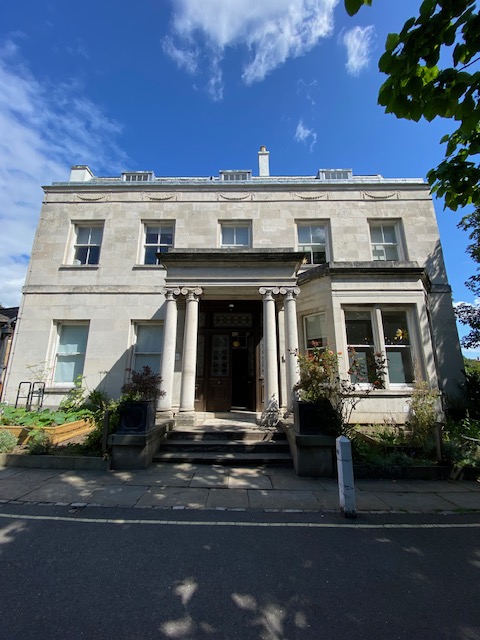
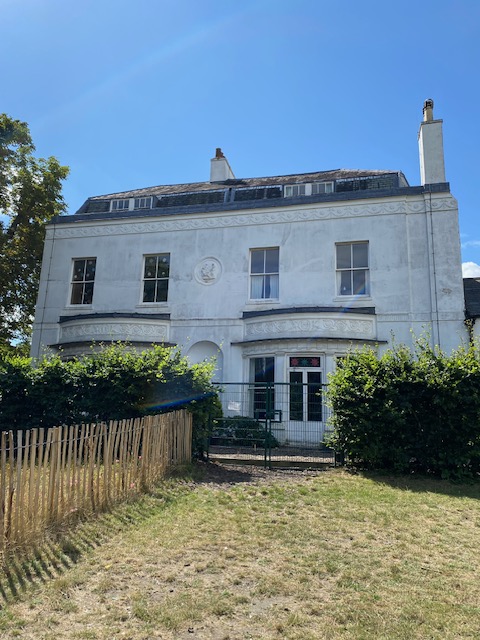
Another great stop. First of all, walk round the corner and you will come to what is now Greenwich Waldorf School, formerly Woodlands House. The building was built on a site leased in 1774 to John Julius Angerstein (a Lloyd’s underwriter). Angerstein made his fortune in the East Indian trade as well as having West Indian business links, including a third share in a slave plantation in Grenada. His art collection was bought in 1824 to form the nucleus of the National Gallery, London. The house stayed in the Angerstein family until the 1890s when it was bought by the shipbuilder Sir Alfred Fernandez Yarrow. During the First World War, it served as a hostel for Belgian refugees, after which it was sold to a Catholic religious order, the Little Sisters of the Assumption, for use as a convent. When the Little Sisters moved out, the house became a local history library and contemporary art gallery until 2003. It is now one of the many Steiner schools and still retains its beauty and grandeur.
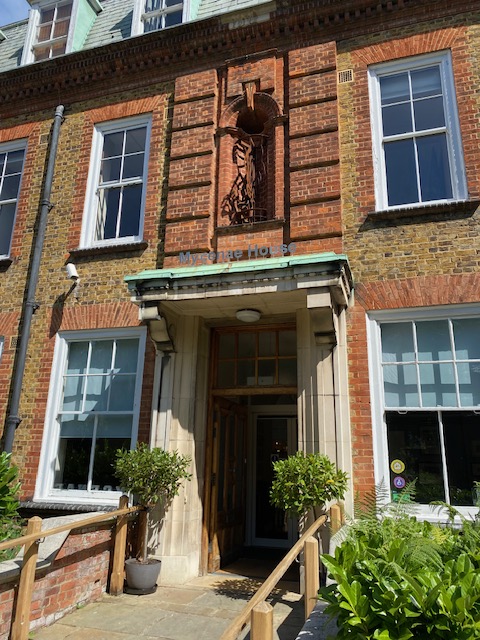
Next door is Mycenae House. This building is a rare example of a purpose-built convent of the 1930s. Although it has always been architecturally and historically overshadowed by its illustrious neighbour, Woodlands, it nevertheless has its own interesting history. At the end of World War I, Woodlands was sold to The Little Sisters of the Assumption for use as a convent. The sale of the adjacent land by the trustees of The Little Sisters paid for the building of a Novitiate House which was blessed in 1931 and opened in 1933.
When the Order left Woodlands, a local historian, Cyril Fry, who lived in Mycenae Road, persuaded Greenwich Council to acquire Woodlands and the Novitiate House. They bought and converted the House into a Community Centre in 1968 called Kidbrooke House and renamed it Mycenae House in 1994 when it became independent from the council.
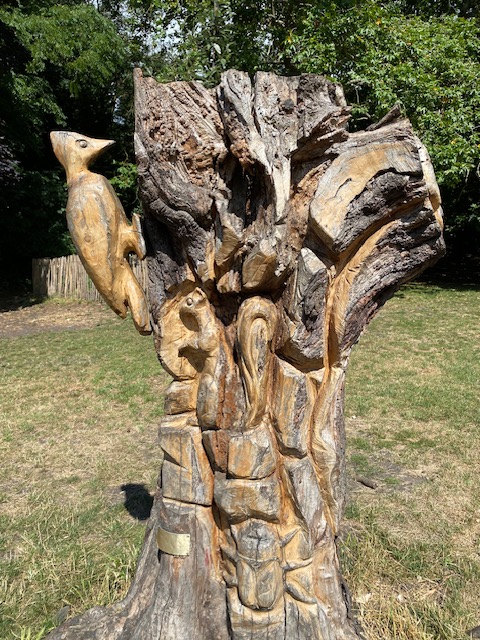
The gardens surrounding the house are lovely. They are quite extensive and form part of Westcombe Park conservation area. It’s thought that some of the trees may even have been planted by the Angersteins (owners of Woodlands House next door). In the centre of the garden is a wood carving, formed from a dead tree trunk. Animals carved are a woodpecker, squirrel and owl.
4. Millennium Village Oval Square bus stop
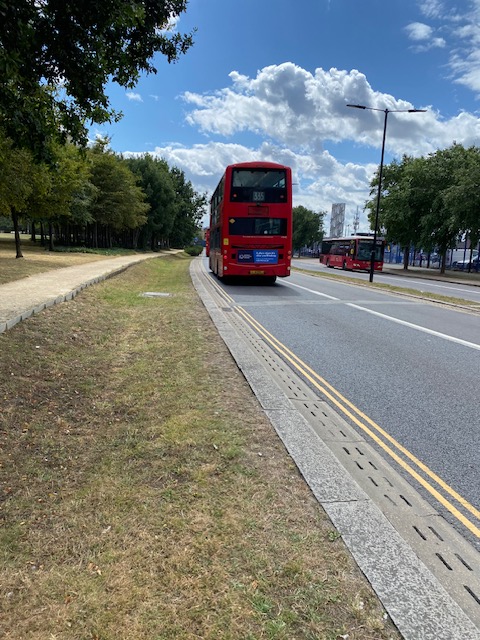
This is the stop where you will find the Pilot Busway. It was originally called the Millennium Busway as it was built as a link to the new Millennium Dome. It had to be mentioned here, simply because I am londonroutemistress and am interested in things connected with London buses! The busway has more recently been converted into a regular dual carriageway.
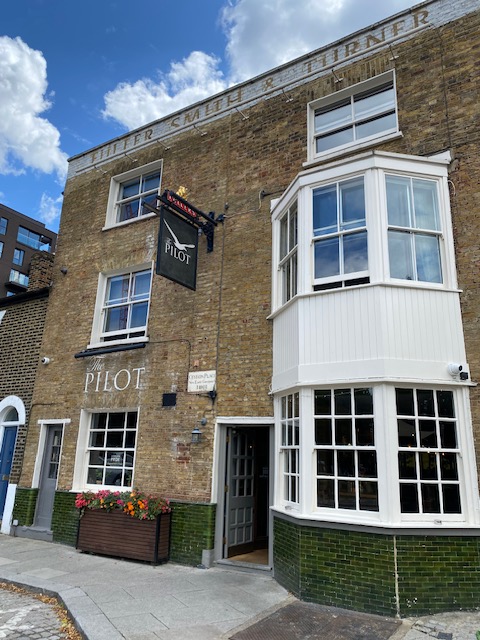
Along the route is the Pilot pub which actually dates back more than 200 years, built in the early 1800s to serve the local coal workers. A painted stone tablet on the wall of the pub reads “CEYLON PLACE New East Greenwich 1801” – dating The Pilot as probably the oldest surviving building on the Greenwich Peninsula.
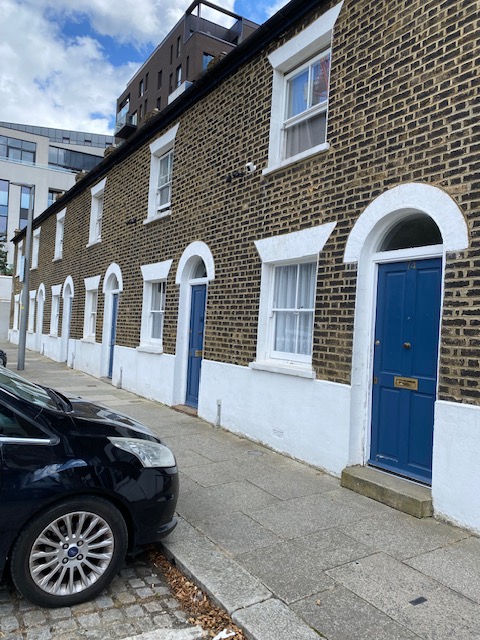
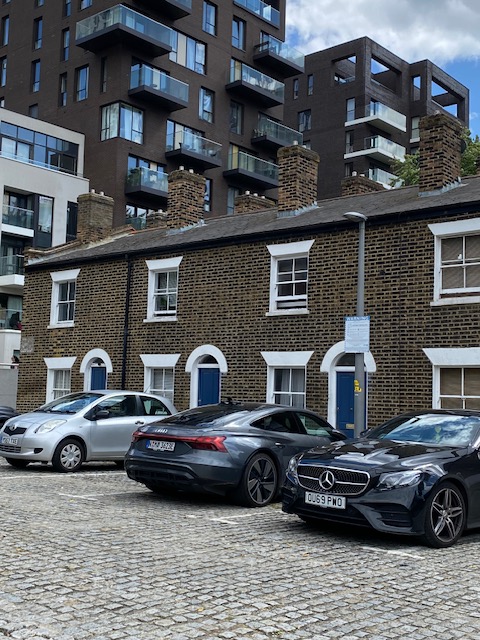
Next to the pub is a row of eight cottages that were constructed for workers at the adjacent tidal mill and chemical works. They are “a rare survival of late Georgian artisan housing” and are grade II listed for their protection.
5. North Greenwich station bus stop
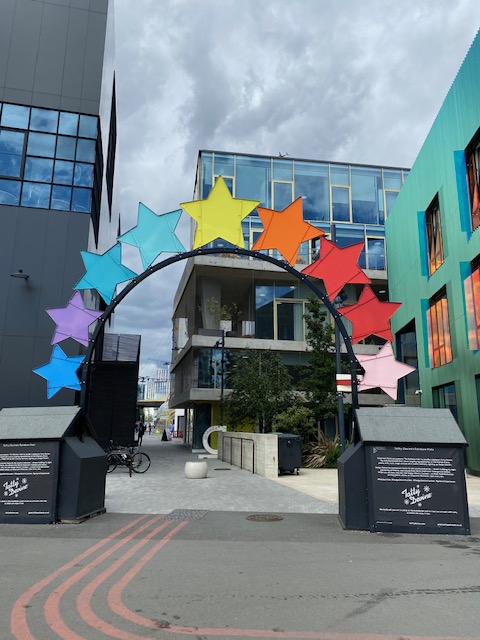
Another great place to stop. First of all you’ll find yourself at jeweller’s Tatty Devine’s Rainbow Halo. The illuminated stars in the form of a rainbow are representative of the themes of love, peace, unity, luck, magic and joy. In the same area is “33”, a three-storey decorative folly, a house-shaped pavilion designed by Studio Weave. It’s a mix of historical architectural styles in an abstract way: Edwardian, Victorian and Georgian. It’s possible to climb up to the upper levels and take a good look at the surrounding area.
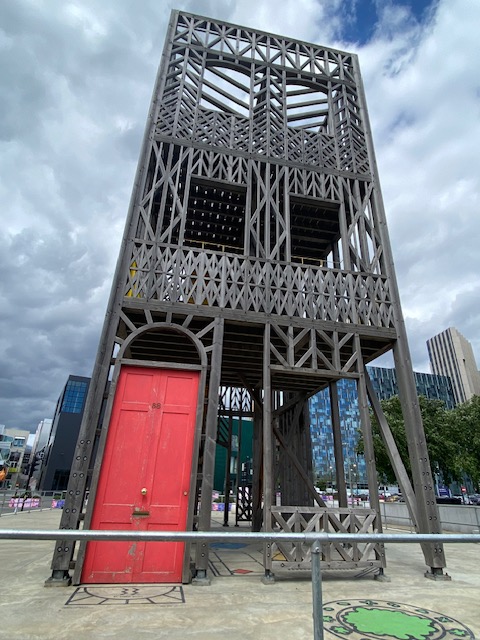
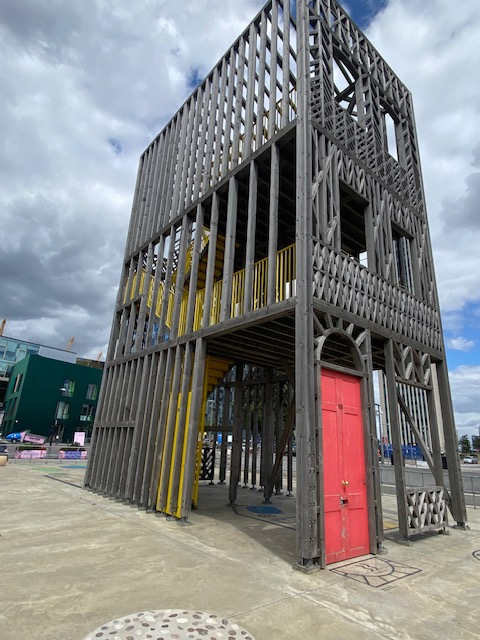
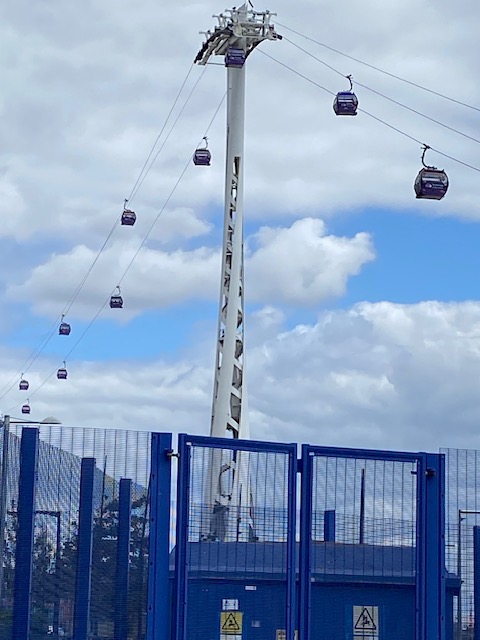
While you’re here, you can look up and see the cable car that takes passengers from North Greenwich to Royal Docks. They were introduced to London in time for the 2012 Olympic Games. The cars arrive frequently, around every 30 seconds and they can hold up to 10 people.
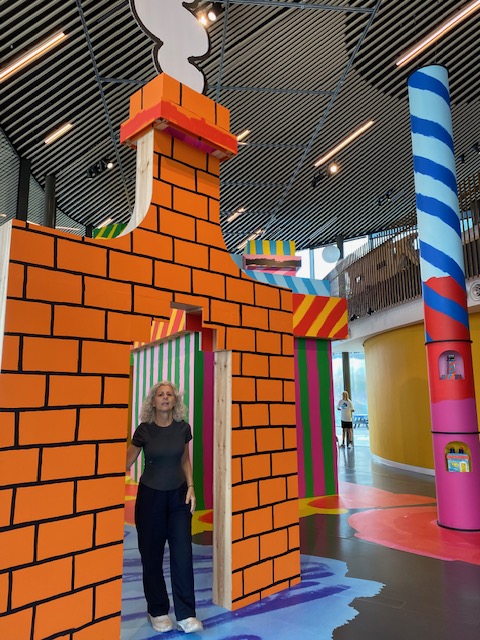
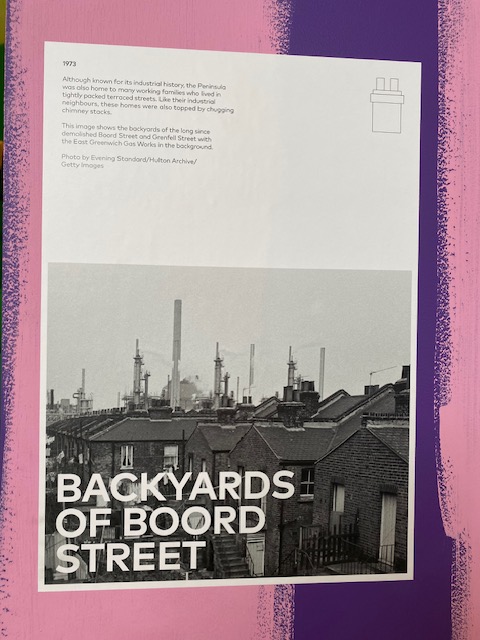
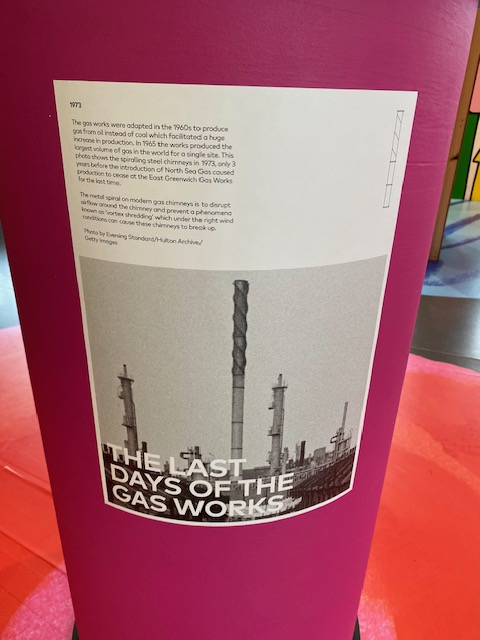
Visit NOW gallery which is a free exhibition space for contemporary art, fashion, photography and design. The current exhibition is Up In Smoke by the designer-architect duo John Booth and Mat Barnes. The installation tells the story of Greenwich Peninsula through its iconic chimneys, showing its transformation from a historic former marshland to the vibrant cultural hub it is today. The five re-imagined chimneys represent the diverse history of the area, from the Powder magazine used to store gunpowder in the 1700s to the more recent slender tubes of the modern gasworks as well as the chugging stacks of the terrace housing formerly found on Boord Street.
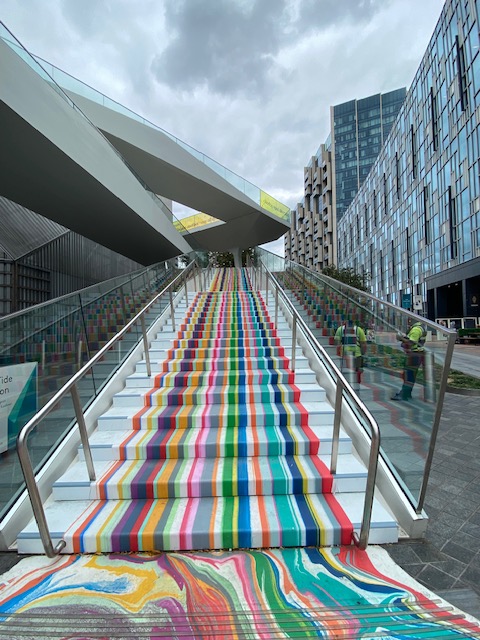
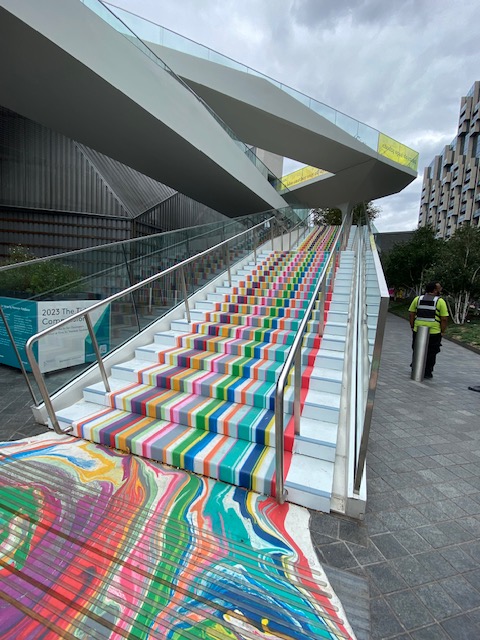
Outside the NOW gallery, is the Poured Staircase by Turner Prize nominee, Ian Davenport. He has created an immersive river of colour that cascades down The Tide staircase in parallel candy-coloured stripes. Davenport uses the force of the elements such as gravity as important themes in his artwork. In recent years, his work has consisted of carefully poured lines of acrylic paint down a surface, which puddle and pool at the bottom. You can’t help but smile when you gaze at the staircase and watch everyone’s reaction as they walk up and down. I managed to get a photo of the staircase while no-one was on it.
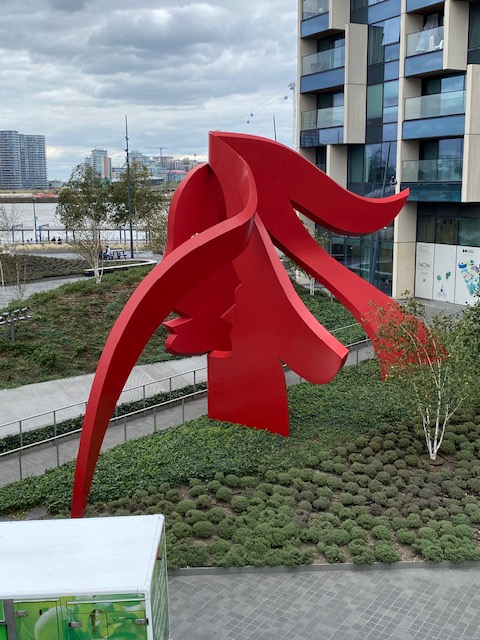
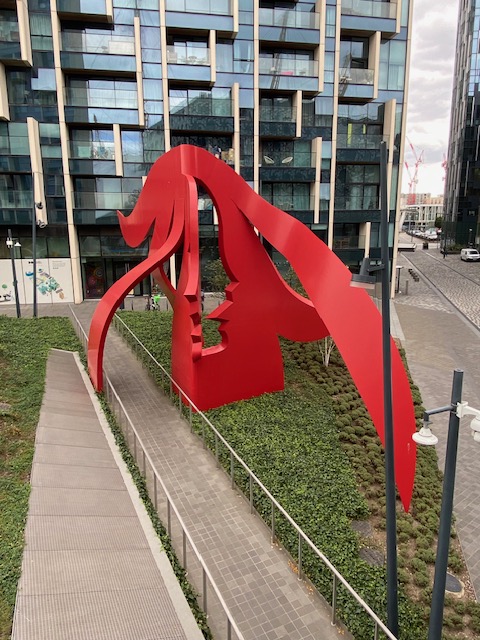
Yet more things to see – there’s a sculpture entitled Head in the Wind by British artist, Allen Jones, designed to be viewed from above and below as well as being interactive. It’s a vibrant, painted-steel piece that was commissioned for and inspired by The Tide.
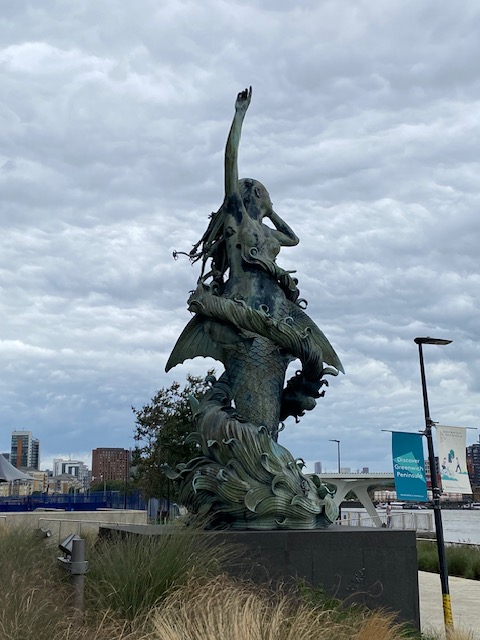
And you’re not done yet. Just past the Wind sculpture, is Damien Hirst’s Mermaid, which was part of his Treasures from the Wreck of the Unbelievable, first exhibited at the 2017 Biennale in Venice. In ancient times, water was seen as divinely powerful and inspirational and it’s thought that this sculpture is about the myths surrounding Alexander the Great after his death. They included the story of a mermaid who stops ships at sea to ask the question ‘Does King Alexander live?’
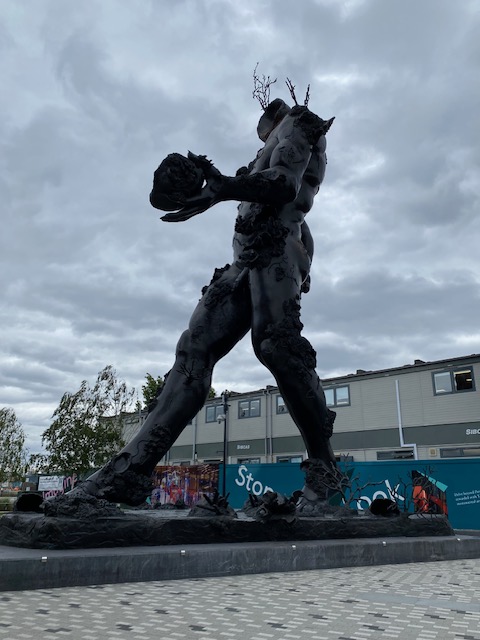
A second Hirst sculpture, also part of the Treasures from the Wreck of the Unbelievable series, can be found next to the entrance to the cable cars. Entitled The Demon with Bowl, it stands at just over eighteen metres, and is a copy of a smaller bronze recovered from the wreckage. The discovery of the body appeared to solve the mystery of a disembodied bronze head with saurian features excavated in the Tigris Valley in 1932.
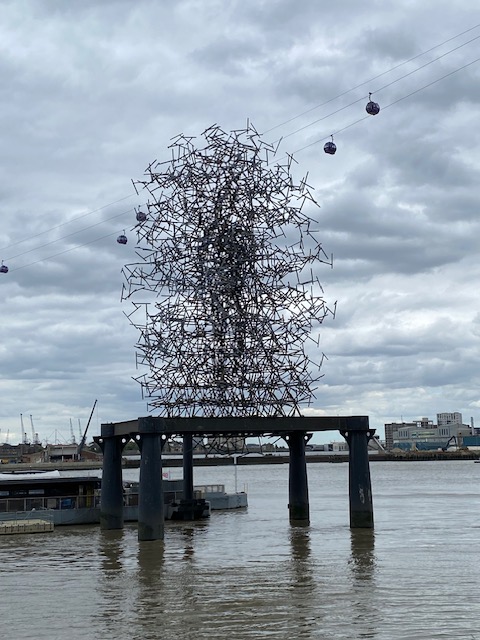
Finally here, there is Antony Gormley’s Quantum Cloud sculpture, made from galvanised steel. It was inspired by conversations between Gormley and quantum physicist Basil Hiley. According to the artist, it calls into question “the relationship of the self to the world and foregrounds the viewer’s influence on the viewed – a feature both of quantum physics and art”.
6. Chrisp Street Market bus stop
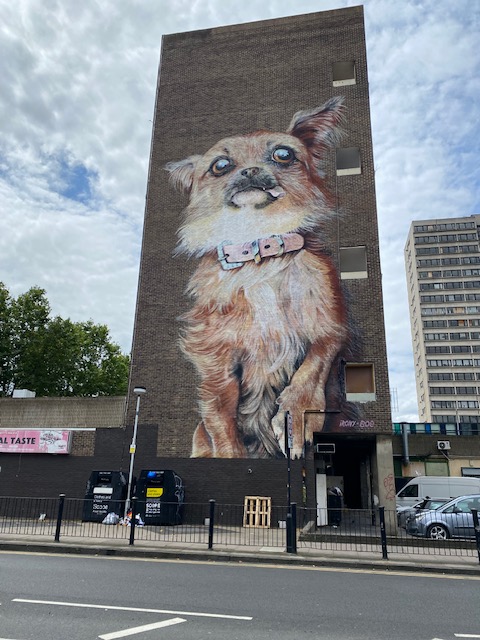
After spending a good amount of time at the Peninsula, hop back on the bus to this stop, where you will immediately see a very large mural of a chihuahua dog. It was painted by two local artists Irony and Boe, who have a penchant for animals. The choice of a small dog sitting on its hind legs with its tongue hanging out is interesting but it adds a rather dynamic addition to an otherwise dull building in this part of London (Poplar).
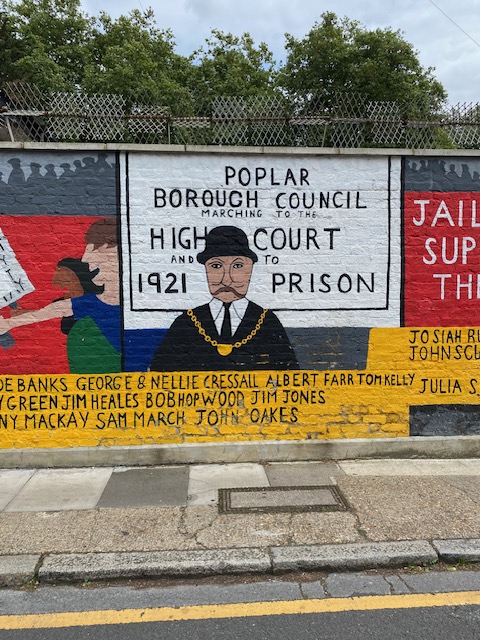
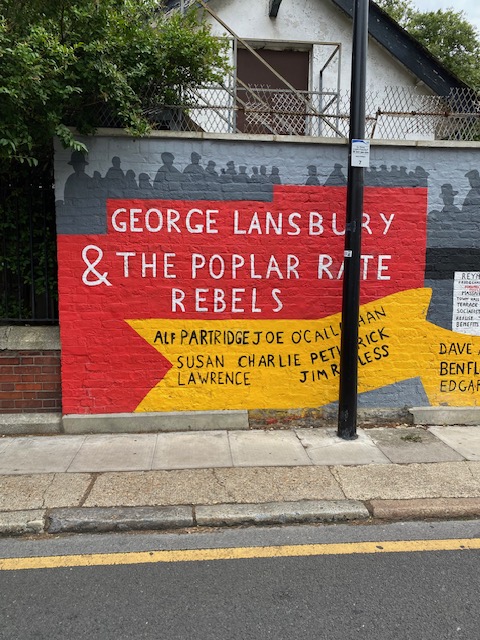
A few minutes’ walk from the chihuahua is a mural of a very different kind, called the Poplar Rates Rebellion mural. In 1921, faced with the prospect of a large increase in the rates, Poplar BC decided to hold them down by not collecting the precepts that should have been passed on to cross-London authorities, who responded by taking the matter to the High Court. The council’s response was to organise a procession of 2,000 supporters from Bow on 28 July 1921, led by Poplar’s official mace-bearer, accompanied by a band & a banner stating, “Poplar BC marching to the High Court & possibly to prison”.
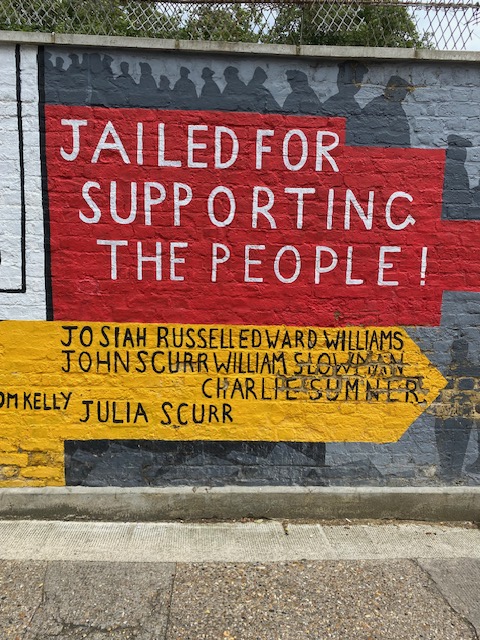
30 councillors, including 6 women, one of whom was pregnant, were sent to prison (men to Brixton, women to Holloway) indefinitely for contempt of court for refusing a court order to remit the monies. Mayor George Lansbury was hailed a hero; in the 1922 general election he won the parliamentary seat of Bow & Bromley with a large majority.
Spread over four panels, and painted in 1990, it includes an image of George Lansbury wearing his mayoral chain of office; placards reading “Can’t Pay Won’t Pay”‘, and a list of the names of the imprisoned councillors. The fourth panel draws a parallel with the contemporary campaign against the 1990s-era poll tax.
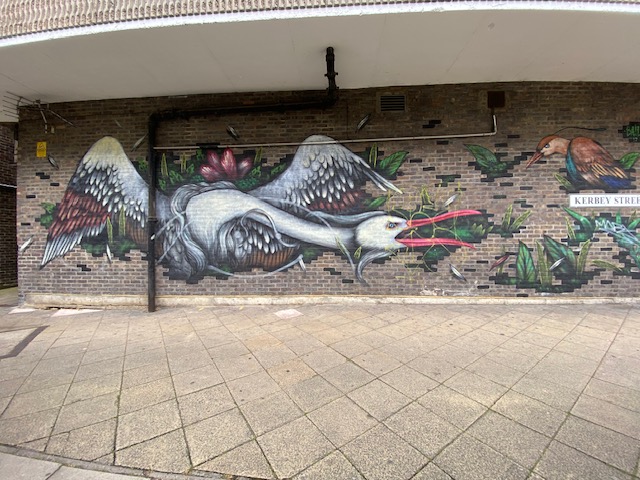
On the way back to the bus stop, in Kerbey Street, is another mural, by Brazilian street artist Bailon. Apparently he has a predilection to painting water birds and this is no exception as he has made excellent use of the brick canvas with his main bird set bursting out of the wall.
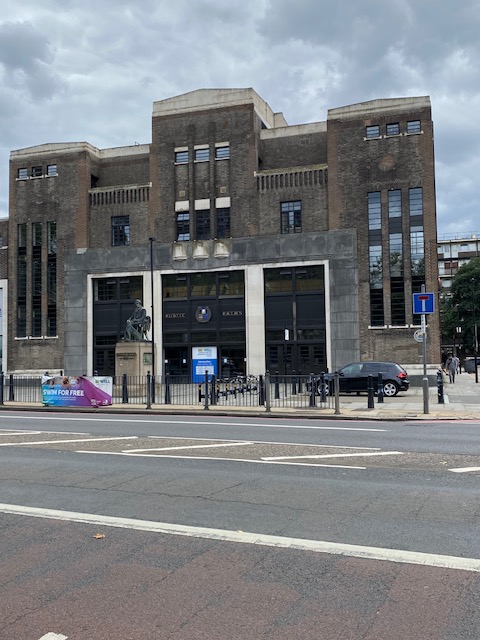
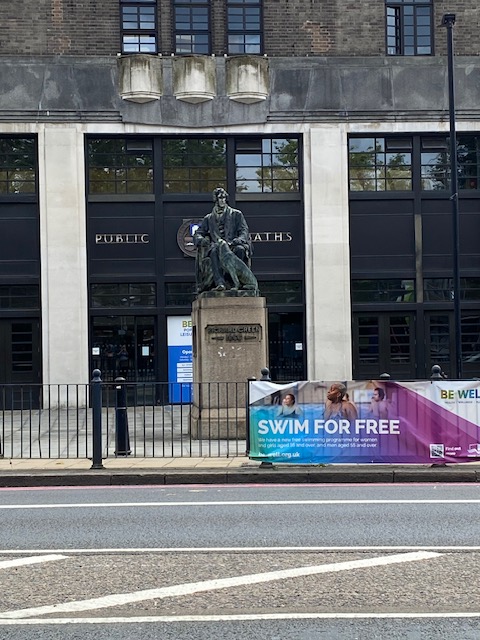
Along the main road, you’ll come across Poplar Public Baths. The original one opened in 1852, to provide public wash facilities for the East End’s poor as a result of the Baths and Washhouses Act 1846. The baths incorporated slipper and vapour baths as well as steam and shower baths. There was a public laundry containing 48 wooden washing tubs, drying equipment and ironing rooms. The Baths were rebuilt in 1933 and the larger pool was covered over to convert the building into a theatre with a seating capacity for 1,400 and incorporated a dance hall, cinema, exhibition room and sports hall for boxing and wrestling programmes.
The main bath hall sustained bomb damage during World War II and was forced to close. Poplar Baths reopened in 1947 and continued to be used as a swimming facility, attracting on average 225,700 bathers every year between 1954 and 1959, before the facility’s eventual closure and conversion to an industrial training centre in 1988. The Baths eventually became derelict and it was only in 2016 that they reopened as a leisure facility.
Outside the building is a statue of the local shipowner & philanthropist Richard Green with his faithful Newfoundland dog “Hector”. Green was the principal supporter of schools at Poplar, at which two thousand children were taught and partially clothed.
7. Marshgate Lane bus stop
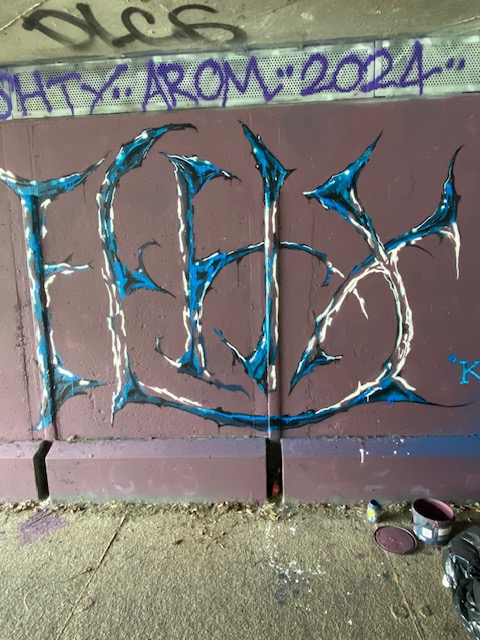
Final stop on this route is to see Bow Free Wharf. Walk along the canal walkway from the bus stop and you’ll come across a tunnel covered in graffiti or street art. On the day I was there, I was lucky enough to catch an artist at his work and although he didn’t want me to photograph him, he was happy for me to take a snapshot of his work.
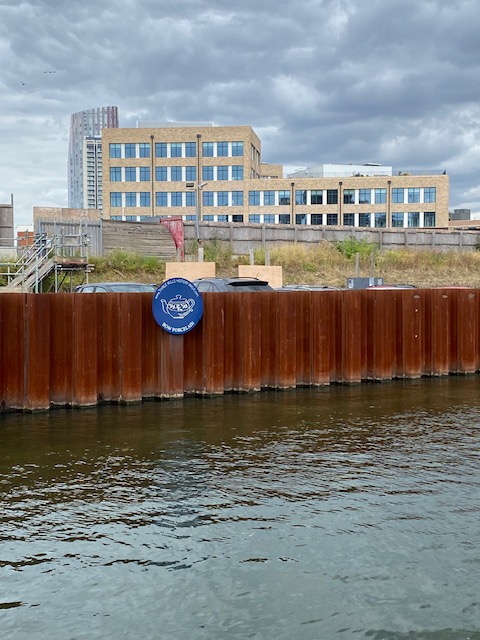
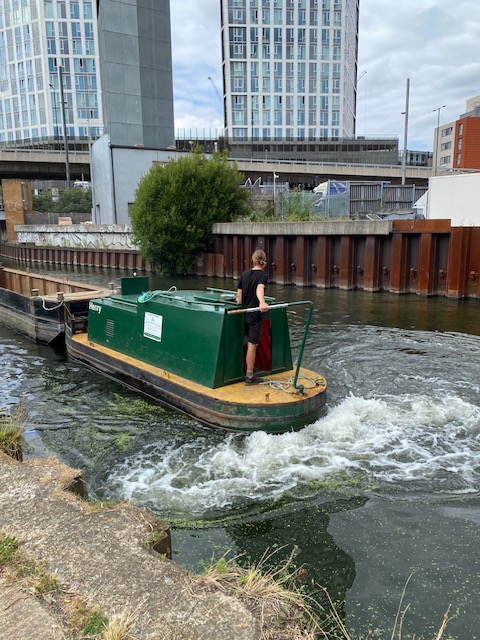
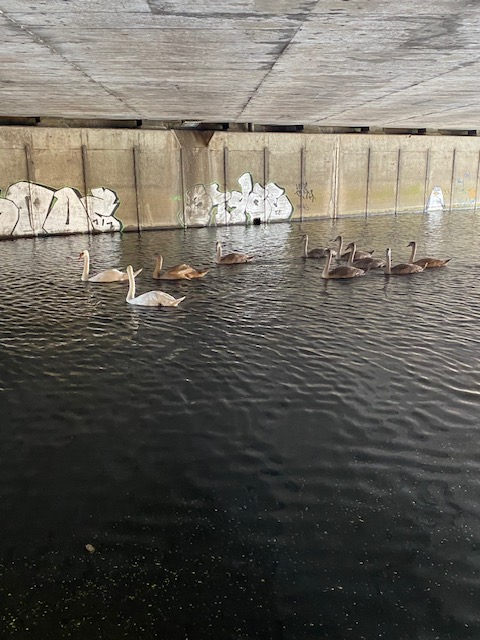
This part of the river forms a section of Three Mills History Walk, with one of the mills being Bow Porcelain. From 1747, this factory was sited in Bow before moving to the other side of the river Lee in Essex. Along the canal, boats wend their way – as well as a family of swans, while I was there.
That was the end of one of the best routes so far. I had been ambivalent about the 108, but I was bowled over by a lot of what I saw. From an ancient church and adjacent chapel in Lewisham to some architecturally delightful buildings in Blackheath and the fascinating Greenwich peninsula, there is no shortage of great things to discover on this route.
Toilets that are free and open to the public:
- Lewisham Shopping Centre
- Mycenae House
- NOW museum
- North Greenwich station
 london routemistress