
Edgware bus station to New Barnet
Highlights:
Schopwick Place
Whalebones Arch
Everyman Cinema
1. Edgware bus station bus stop and
2. Edgware Way bus stop
Although I had been at Edgware station on bus route 79, I revisited the nearby Railway Hotel, in the hope that it might have been renovated. It hasn’t and it’s such a shame because it really lends itself to having a new purpose.
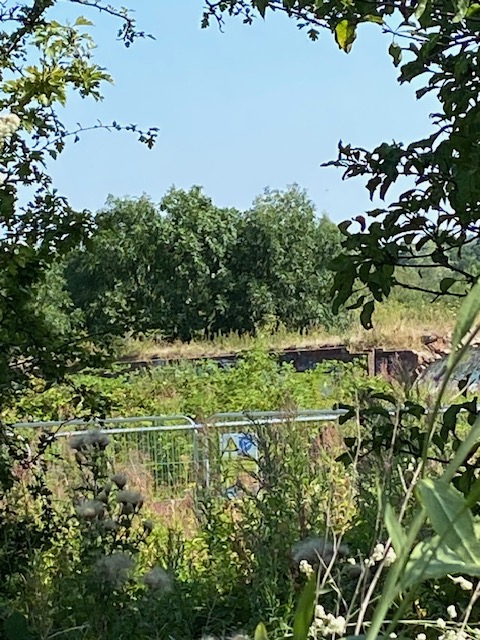
Start the journey at the bus station and alight at Edgware Way. It’s a bit of a treacherous walk over the A41 to get to the first place to see so don’t attempt it if you’re of a faint heart! The site of Brockley Hill tube station is bang in the middle of Edgware Way Grassland and is barely viewable from the access point. In fact, digging into the history of the site, I discovered that the station was due to be built to extend the Northern line tube from its present terminus at Edgware. Work never began due to the outbreak of WWII and plans had to be abandoned owing to the introduction of the Metropolitan Green Belt. So what I originally thought was part of the station, is in fact the remains of a viaduct for the station.


3. Pipers Green Lane bus stop
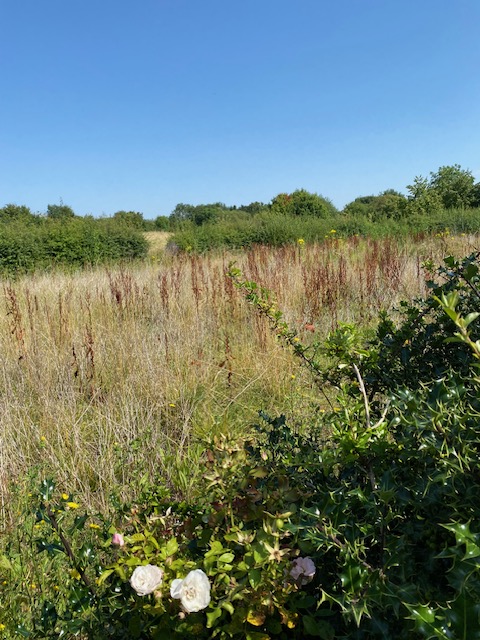
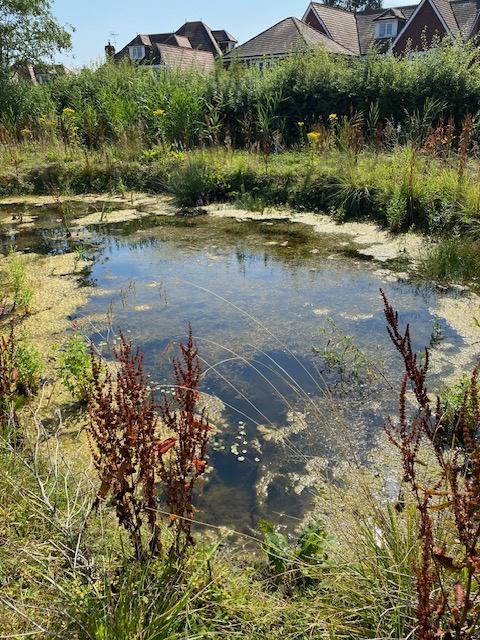
A short walk from the stop is Cleopatra’s Close Park, with its small pond inside. The park is connected to the much larger Stanmore Country Park and Wood Farm but is a really lovely space in its own right. There’s not much to see here other than the green space and pond, but it’s very quiet and peaceful if you’re looking for some “me” time.

4. Watling Court bus stop
There is rather a lot to see at this stop and they are in the area known as Elstree Village. Opposite the stop is the grade II St Nicholas church. A church has existed on the site since 1188 when the first building was founded by the monastery of St Albans. The church was rebuilt in 1360 by Abbot Delamere and became a separate parish independent of the Abbey. It was rebuilt in 1853 on foundations of a medieval church re-using some C15 stones.
Next door to the church is the Liberal Synagogue of Elstree, formerly the Old St. Nicholas CofE School, built 1882, and which is now a Grade II listed building. And next door again are the Elstree almshouses. These are a group of 3 houses although only two have access from the main road. They are all grade II listed and were built in the asymmetrical Arts and Crafts Style in 1883/4. The accommodation was initially intended for spinsters of the parish with limited means with the agreement that the almshouses would be financed by the parish. However, by 1897, there was a report that the residents were in a state of near starvation. A scheme was proposed to set up an endowment fund. The poor of the parish continued to live in the almshouses but by 2020, it was confirmed they were privately owned.
One more old and listed building in this street is The Holly pub. It’s a late-medieval timber-framed hall house and dates from the 15th century. It was centred on an open hall, which subsequently had two storeys; other modifications included a waggon way cut through the building. It’s now permanently closed though planning permission has been granted to convert it into residential use.


The other side of the church is Schopwick Place, another beautiful grade II listed building, that dates back to the early 18th Century and was home to Sir Percy Winn Everett, the first scoutmaster of the 1st Elstree Scout group. Built around 1710 on the site of a house that is noted in the archives as dating back to 1528, this symmetrical house had north and south wings and pavilions added in the late 18th Century. It has been a private residence, a doctor’s surgery and these days, it looks like it’s used for wedding venues and perhaps council offices. The gardens are also worth a visit – they are extensive and beautifully kept.


5. Knowl Way bus stop
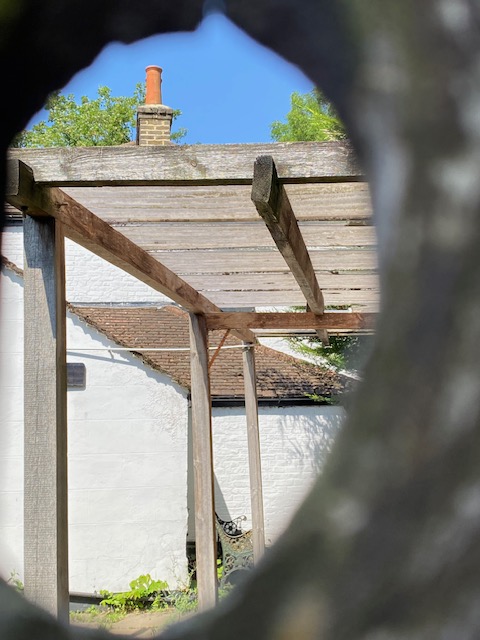
Walk round the corner to the site of Radnor Lodge, which is all that remains of Radnor Hall, which itself was originally known as Palmers. The Hall has been used in making films, such as The Danger Man, possibly due to its proximity to Elstree Studios. The Hall has since been demolished and it’s very difficult to see the lodge, but it’s worth a peek if you happen to be near.

6. Deacons Hill Road bus stop
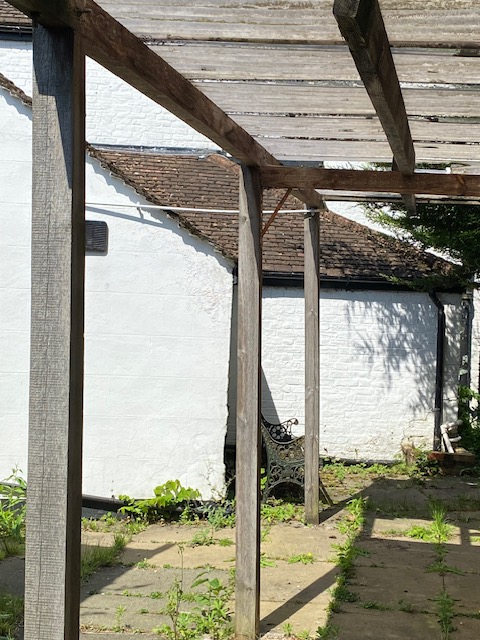
The bus stops right outside Allum House Hall and Manor, which is now an events venue. The Manor House was originally constructed in the 17th century, extended in the 18th century and later remodelled around 1880. Over the years it has been home to many Elstree families. When sold for £1,500 in 1830 it had been the birthplace of Euphrasia Haworth, an author, artist and friend of the poet Robert Browning and his wife Elizabeth. It then was the home of Charles Gordon (of gin fame) and his family. More families followed. It is believed that Baroness Orczy was living in the Manor House in the early 20th century when she wrote “The Scarlet Pimpernel”.
In 1951, Associated British Picture Corporation with the support of many actors including Richard Attenborough, Norman Wisdom and 21 year old Audrey Hepburn, as well as loans from local Rotarians, was able to purchase the Manor House for £6,500. It was in a poor state of repair but was ready to open 2 years later. Since then, the local council has approved the construction of Allum Hall and together with the House, they are a fitting venue for all sorts of celebrations.
Beside the manor, is a lovely cottage called Manor Lodge and it was here that workers at the Manor would live.


7. Furzehill Road bus stop
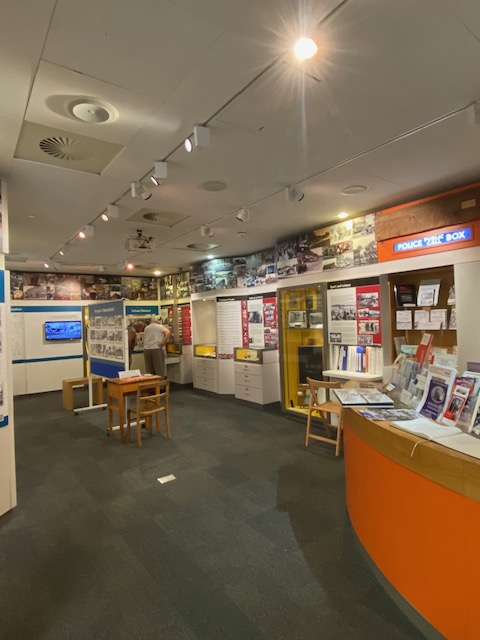
This is the stop for Borehamwood and Elstree Museum, which is located on the second floor inside the library. It’s a small museum and has themed exhibitions, the one at present (August 2024) being about local schools. The cabinets have examples of school uniforms, school reports and other paraphernalia, as well as old photos where you can try to identify yourself or anyone you might know who attended a local school over the years. There is also some information about Elstree during WWII, famous local residents and the growth of Elstree and Borehamwood. The museum is staffed by volunteers, one of whom is pictured in the poster about wartime Elstree.


8. Barnet Hospital/Queen’s Road bus stop
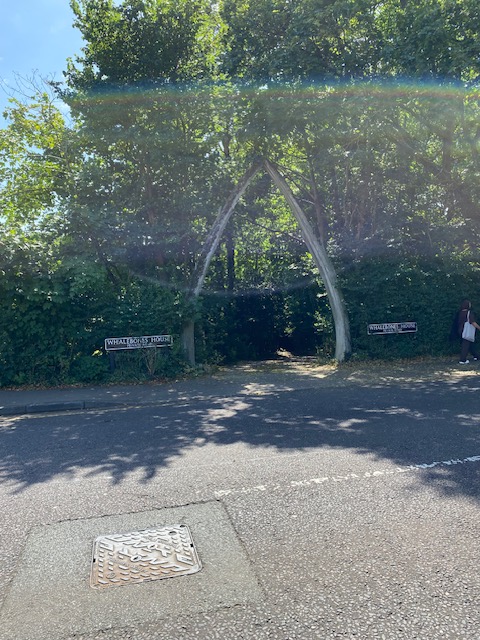
Over the road from the stop is the Whalebones Arch. 75 years ago local workmen were asked to complete an unusual task: to restore the unique appearance of one of Barnet’s oldest homes, Whalebones House. Two massive jaw bones from a 90-foot-long blue whale captured in the South Seas had been shipped from Norway to Hull to Barnet.
Each jaw bone was 24 feet long and weighed three-quarters of a ton. The task was to form an archway at the top of the drive leading to Whalebones, a 200-year-old house hidden in woods. They were a replacement for a set of jaw bones which had previously formed a gateway to the house since the 1860s. It took 6 men all day to manoeuvre these gigantic replacement jaw bones into place.
Each jaw bone had to be set in six feet of concrete and then the workmen used ladders, ropes, chains and pulleys to cajole them to form a perfectly symmetrical arch. Apparently, the stench of rotting flesh from the nerves, blood vessels and sinews was so bad that the many spectators who had gathered to watch, had to keep their distance!

9. Union Street bus stop
First take a look at the Barnet Almshouses that are along the main road. The sign above the entrance arch says Eleanor Palmer’s Charity, founded in 1558 and rebuilt in 1930. Eleanor Palmer was born Eleanor Cheeseman, whose father was an important man at Court being treasurer to both Henry VII and Henry V111. She was originally married to a London gentleman, Edward Taylor, who died in 1509 with whom she had three children. She married again, to John Palmer, and had five more children. John died in 1542 and she lived for another 16 years. The ‘Eleanor Palmer Trust’ charity was founded in 1558 to take care of the poor of Chipping Barnet and St Pancras.
Next to the almshouses is Ravenscroft Gardens, a very pleasant green space with a beautiful cedar tree taking centre stage. Opposite is another park, the Old Courthouse Recreation ground, which was originally a pasture with stables and a brewery. Barnet Urban DC purchased the buildings in 1912 and the county court was held there till the start of WW1. The remainder of the estate was bought in 1923 and opened to the public the following year.


Round the corner from here is The Bull. Records of an inn on this site go back to the 1400s. The present building dates from about 1750 although Tudor timbers were found in a chimney fire in 1987. The tiling on the front with the two porches and bull’s head drain spouts are Victorian, when it was known as The Old Bull. In 1975 the building was transformed into The Old Bull Arts Centre, a thriving and artistic cultural hub for local arts organisations. Now it’s the Susi Earnshaw Theatre School as well as being available to the wider community at evenings and weekends. Over the years, the playhouse has been a creative platform for upcoming theatre practitioners and emerging artists. People who have performed at the Bull Theatre include the late great Amy Winehouse, and Alexandra Burke.
Practically next door is Ye Olde Mitre Inne, being the oldest coaching inn still in existence in Barnet. Records show that an alcohol licence was issued for an establishment on the site as far back as 1553, though the building possibly pre-dates this. The inn originally had 12 beds and stabling for 26 horses. A mitre is a bishop’s hat and shows church allegiance – it became the Mitre in the early 1750s.


10. Everyman Cinema bus stop
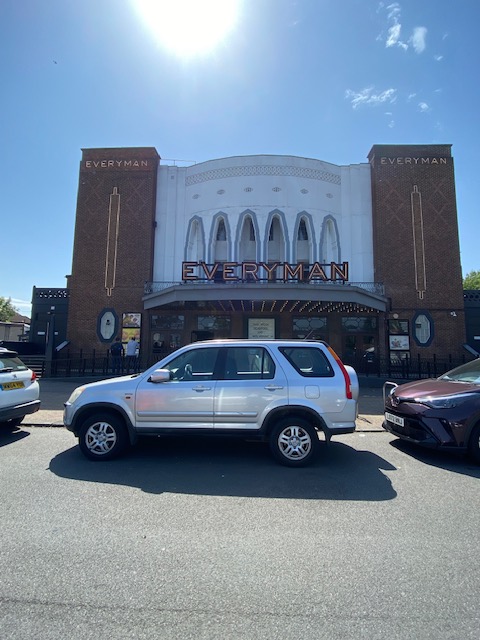
Final stop on this route is to visit the Everyman cinema, Barnet. It started out life as The Odeon Theatre, Barnet in May 1935 with Gene Raymond in “Transatlantic Merry-Go-Round” and Laurel & Hardy in “Them Thar’ Hills”. Seating was provided for 1,553 in the stalls and circle. It was converted into a triple screen cinema in 1974 and in 1989, the Odeon Barnet was given a Grade II Listed building status by English Heritage, for its “Moorish styling, art deco features and octagonal shape”. It became an Everyman cinema in 2015.
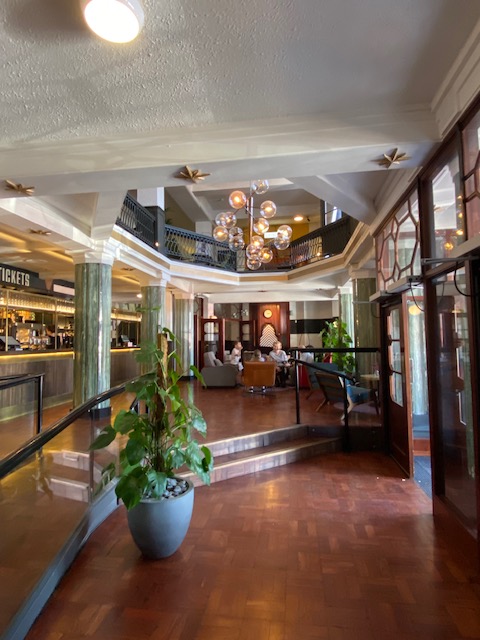


I got on and off the bus a lot on this route, mainly because there wasn’t too much to see at each stop. It was a mixed route, possibly because a lot of it was in the suburbs or places were unavailable to visit, such as Elstree Studios. It helped that the weather was good so I could spend time outdoors and explore parks and gardens.
Toilets that are open to the public and free:
- Broadwalk shopping centre, Edgware (start of route)
- Borehamwood Museum
- Everyman Barnet
 london routemistress
One response to “Bus route 107”
[…] from the bus station, and find St Margaret of Antioch church. This is also on routes 32, 79 and 107. Just inside the grounds is a grave for Frank Williams, who played the ineffectual vicar in […]
LikeLike