
Shadwell to St Paul’s
Charity bus ride on the number 100
To mark the milestone of reaching the number 100 TfL bus, I took a group of people on a charity bus ride to raise money for The Alzheimer’s Society. The bus route 100 is from Shadwell in East London to St Paul’s.
The idea was to show people some of the delights of a London that isn’t on the tourist trail, by getting on and off the bus at various places that I had previously researched and visited myself.
Each person who came on the bus ride had donated money to the justgiving page that I had set up specifically for this purpose. The reason I chose The Alzheimer’s Society as my preferred charity was because my brother-in-law has the disease and I see at first hand how devastating it is for the individual and his/her family.
1. Shadwell Station bus stop
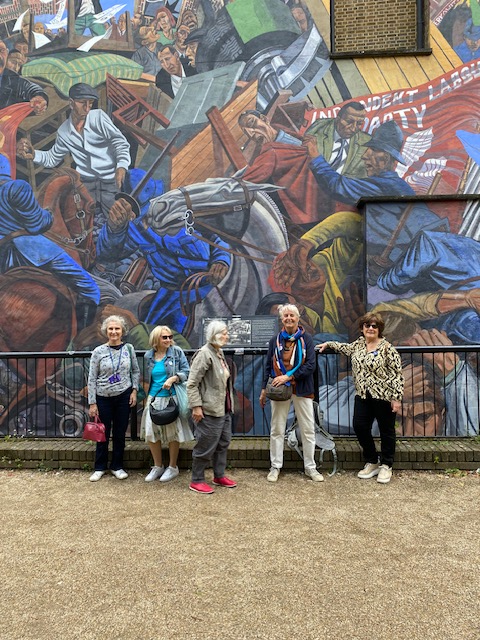
Before getting on the bus at Shadwell, we walked round to St George’s Gardens where there is a very large mural of the Battle of Cable Street. The Battle took place on the 4th October 1936. It happened because the British Union of Fascists, led by Oswald Moseley, was going to march through this area of East London. This was a direct provocation to the predominantly Jewish Community living in this area at the time. People from this community, along with communists, trade unions, Labour party members, dockers and labourers all joined forces to stop the march happening.
The opposition won the day, and the march was prevented from passing through. It was some years later, in the late 1970s, that the mural was commissioned to commemorate this event and it was eventually completed in March 1983. The artist David Bennington had been inspired by Spanish artist Diego Rivera. Unfortunately, the mural has been vandalised and David abandoned the project, which was then taken up by others, using their own skills and designs.


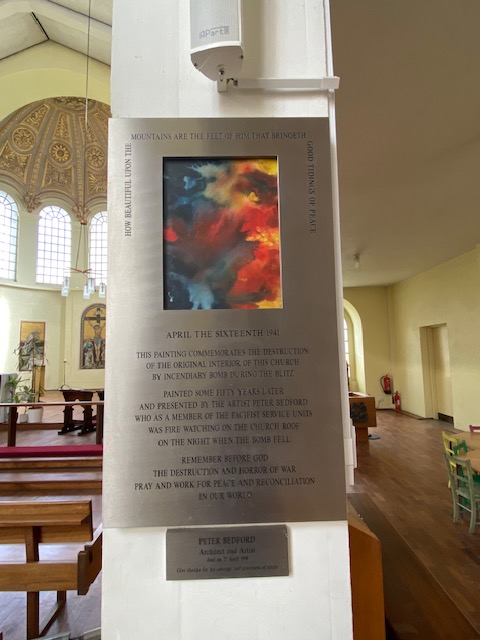
Round the corner is St George in the East Church, one of six Hawksmoor churches in London, which was built 1714-29. Hawksmoor was an architect who had worked with Sir Christopher Wren on St Paul’s Cathedral. The pepper-pot towers were built high in order to soar above the surrounding houses. During the Blitz in 1941, the church was hit by a bomb with most of the interior destroyed, though luckily the towers were left intact.


In the gardens of the churchyard is a derelict building, formerly a Nature Study Museum and even earlier than that, a Victorian mortuary. It was built in 1876 and it was here that on the 30th September 1888, the third victim of Jack the Ripper – Elizabeth Stride – was brought since it was the closest mortuary to the scene of the crime.
In 1904, it was converted to the nature museum where tanks of live fish and amphibians were on display, along with stuffed birds and mammals. At its peak, up to 1,000 people a day visited the museum, a large proportion of whom were schoolchildren. It was closed during World War 2 and has never reopened, hence its current state of disrepair.
Also in the gardens is a memorial to Henry Raine, an 18th century businessman and philanthropist. He built a charity school to provide education for 50 boys and 50 girls which he supported at his own expense.
After seeing all this, we then headed to the bus stop at the start of the number 100 bus route.


2. Wapping Wall bus stop
A short walk round the corner from the stop took us to the Prospect of Whitby pub, the oldest riverside pub in London. It dates from around 1520, in the reign of Henry VIII. There still remains the original stone floor as well as some 18th century panelling. At one time it was the meeting place for sailors, smugglers and cut-throats though later Samuel Pepys was a regular guest and later still, it was a favourite haunt of Princess Margaret and Prince Rainier III of Monaco. The artists Turner and Whistler both painted views from the tavern.
Outside the pub, riverside, is a haunting reminder of the demise of any pirates who got caught. There is a replica set of gallows that was typical of how pirates were hanged. Not only hanged but left until three tides had overflowed them.
There is plenty to see in the pub and as it was by now mid-morning, we rested awhile and had teas and coffees, as well as having time to look around and find some treasures and sit outside on the balcony overlooking the Thames. Then back to catch the bus to the next places of interest.


3. Duke’s Place bus stop
We visited the beautiful St Botolph without Aldgate church from this bus stop. St Botolph was an early East Anglian saint who built a monastery in the 7th century, probably in Suffolk. This survived until the Vikings invaded. His remains were dug up and were to be divided into 3 with the head to be taken to Ely, the torso to Thorney and the remainder to Westminster Abbey. The relics were brought to London through the four city gates at Aldersgate, Bishopsgate, Aldgate and Billingsgate. The churches at each of these gates were named after him and all still exist apart from Billingsgate. This church at Aldgate was connected to the Holy Trinity Priory, recently founded by Queen Mathilda, wife of Henry I.
The church survived the Great Fire in 1666 but by 1740, it was derelict. An act of Parliament enabled it to be pulled down and another erected in its place. This one here dates back to 1744.
The stucco ceiling of angels is worth taking time over as are the galleries with white balustrades. The organ was built in the early 18th century and has since been restored to its 1744 specification and is thus considered to be the oldest church organ in the country.


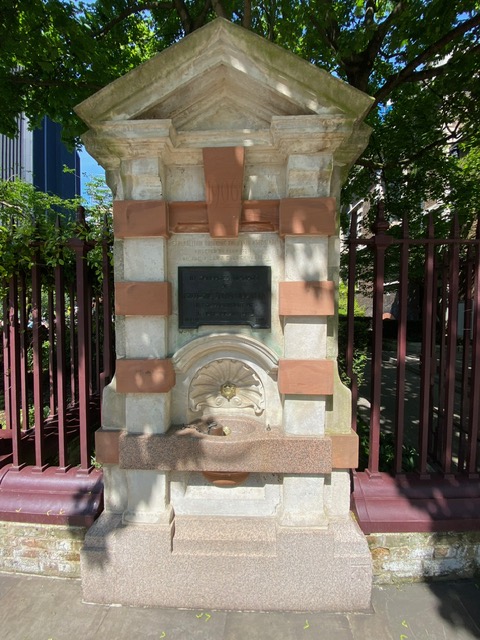
Outside the church is a drinking fountain with a dedication to Frederic Mocatta, a financier and philanthropist. These fountains were first erected in 1859 in London and by 1900, there were more than 500. They were placed to provide clean drinking water, especially for the working classes and the homeless as medical research had linked cholera epidemics to polluted water.
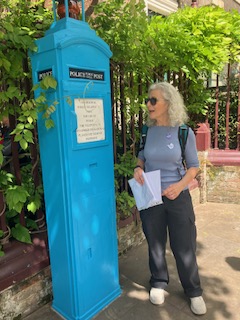
Next to the fountain is one of only eight remaining police call-posts in London. These were essential for the Met Police from the 1920s up to 1960s. They provided a means for the public to contact the police as an alternative to making a 999 call. The police stations were also able to contact bobbies on the beat.
Each had a red signal light that flashed if a PC was requested to call the station. There was an upper hatch for the telephone, a drop down door for a writing surface and a bottom door opening to a storage cupboard. At their peak in 1953, there were more than 600 of them scattered throughout the city but with the advent of radios and mobile phones, they were rendered obsolete.

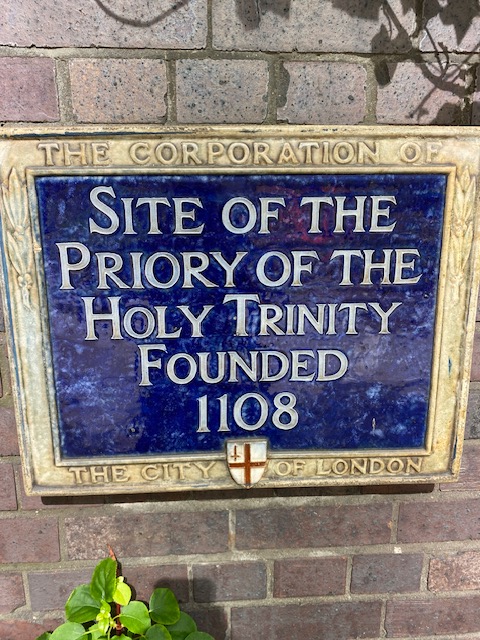
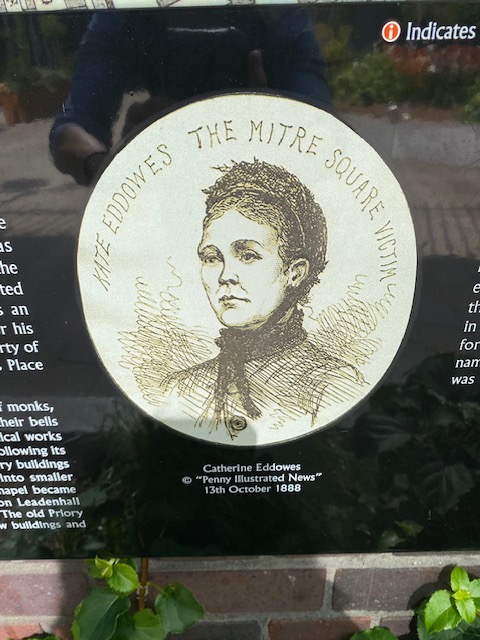
We then walked to the site of the Holy Trinity Priory, founded around 1108 as stated above, by Queen Mathilda. It was dissolved during the time of Henry VIII and came to be given to the Duke of Norfolk and henceforward known as Duke’s Place – now also the name of the bus stop. At the site of the Priory is a plaque to commemorate the fourth of Jack the Ripper’s victims, Catherine Eddowes as it was very near that she was found on the 30th of September 1888.

4. St Paul’s station bus stop
We got back on the number 100 and alighted at St Paul’s. We weren’t visiting the cathedral, as my mission is to visit places of interest that aren’t on the tourist trail and St Paul’s certainly is.
We first stopped at a Penfold post box, situated outside the old GPO building. John Penfold had designed a hexagonal shaped post box in 1866. It was the first standardised public post box in London and became commonly known as the Penfold Box. It was green with the VR cipher, standing for Victoria Regina (Queen Victoria). This replica was placed here to mark the 500th anniversary of the founding of the post office, when Henry VIII was on the throne.
We then walked round to Postman’s Park where we initially called into St Botolph’s without Aldersgate, another church dedicated to the saint. This church escaped the Great Fire of London with only minor damage but having become unsafe due to wear and tear, it was demolished and rebuilt in its present form in the 1780s. Inside the church is the only 18th century stained glass window in the City of London – a depiction of the Agony of the Garden. The organ dates back to 1788.


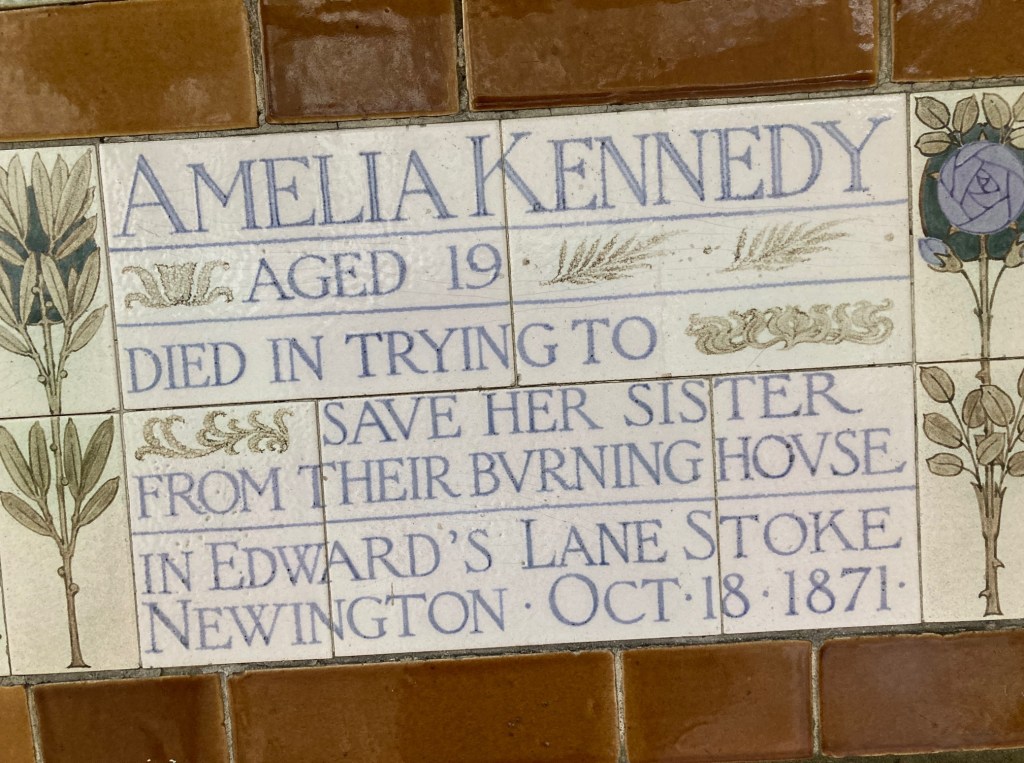
Almost at the end of the journey, we crossed the park to visit the George Watts’ Memorial to Heroic Self-Sacrifice. This is a memorial to ordinary people who died while saving the lives of others and who might otherwise be forgotten. It’s in the form of a loggia and long wall housing ceramic memorial tablets. By the time of Watts’ death in 1904, there were only 9 tablets but his wife oversaw a further 35 in the following four years with a small monument to her husband. In June 2009, the first new addition for more than 80 years, was erected.
Watts had decided it would be a fitting to commemorate Queen Victoria’s Diamond Jubilee with stories of everyday heroism. He first cited the case of Alice Ayres, a servant who, trapped in a burning house, gave up the chance to jump to safety and instead threw a mattress out of the window and three times ran into the house to fetch her employer’s children, and threw them onto the mattress. She herself never made it out alive.



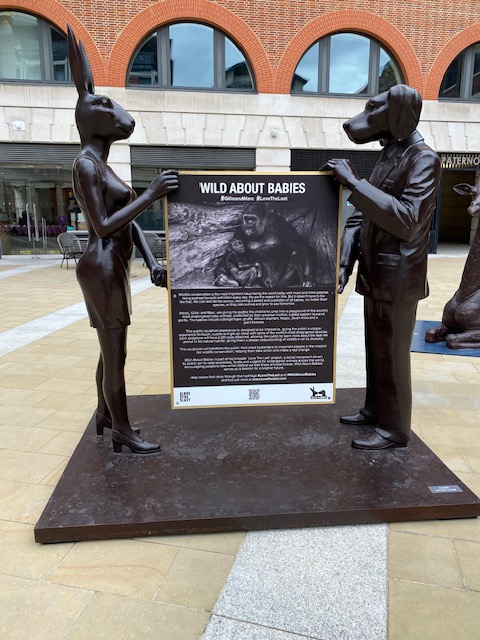
Our final place to visit was Paternoster Square where there are several large bronze sculptures of animals, created by artists Marc and Gillie. This display is a gathering of baby animals from endangered species and are in the form of interactive sculptures. We are actively encouraged to touch and get up close with some of the world’s most endangered species. Kids can even climb on their backs, though labels remind us this is “at your own risk”. It’s all part of a wider “LoveTheLast” initiative to bolster support and raise funds for the conservation of endangered animals.
Also in the square is a bronze sculpture by Elizabeth Frink, known as “Shepherd with his Flock”. The subject of the artwork reflects the former use of Paternoster Row as the site of Newgate Market for the sale of livestock and meat, and may also have theological overtones of the Good Shepherd, reflecting its position in the shadow of St Paul’s Cathedral.


It was at this point that the tour came to an end and we all made for a café for a well-earned drink and sandwich.
All the group gave very positive feedback and one has said about the morning ” So glad I could join your special tour on bus 100. What a wonderful day out! Such fascinating stuff to see and learn about. Hoping I get to do lots more.”


This charity ride took in only a handful of places of interest along the 100 bus route. There are a whole host of other fascinating places to see but we had to restrict the stops due to timing, as it was only a half day excursion.
I will be doing this journey again in July 2024 and it’s possible I may change the itinerary.
 london routemistress