
Wandsworth Plain to Aldwych
Highlights:
- The Padel Yard
- World Heart Beat
- Burghers of Calais sculpture
- National Police Memorial
1. Wandsworth Plain
The start of the route is near the river Wandle so it’s worth taking a look at a couple of places near the river, before getting on the bus. First is the Causeway which was the road from the village square at the end of Wandsworth Plain to Thameside warehouses and strip fields. There had been a tidal mill from medieval times until 1892.
Here, the main stream of the Wandle river diverts through a sluice and passes through Bell Lane Creek. At the time when the sluice was installed, it was painted gold and mounted on a stone arch carved with the words “Salmon Swan Otter Eel Heron”. Below the arch an old church bell was hung, with words “I am rung by the tides” inscribed on it.
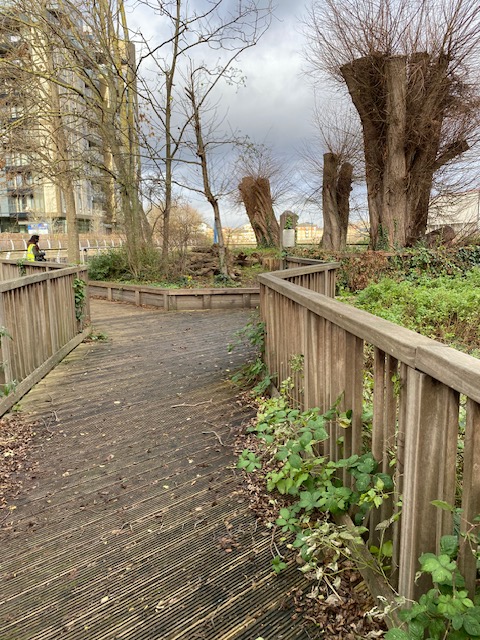
Adjacent to the Causeway is The Spit nature reserve. It’s accessible via a footbridge over the river and a wooden boardwalk with wetland terraces. It contains shrubs and some large willow trees, which were not in bloom in early January. Set within the boardwalk is a sculpture entitled Sail by Sophie Horton. It is in the shape of a dinghy sail with its convex side painted blue and has the design of a sail’s seams. The concave side is silver and has markings resembling the scales and tail of a fish.




2. Wandsworth Town Hall bus stop
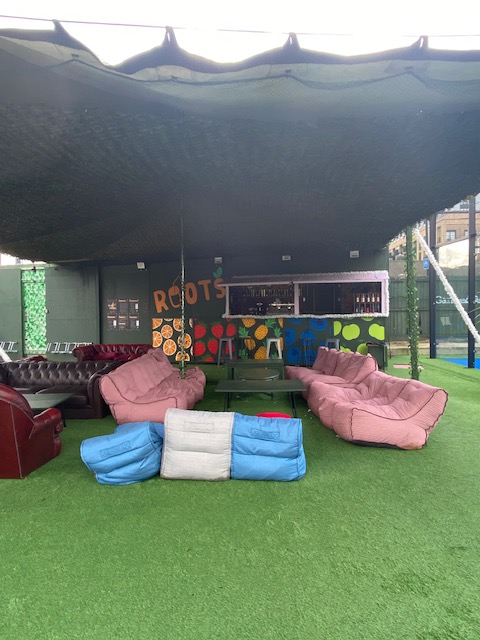
The town hall itself has been visited on a previous bus route (39) but there are other places to see near the stop. One is The Padel Yard, a sports club for lovers of both Padel and Pickleball, with a number of courts for each. The sport of Padel has become so popular that the Yard is expanding and building new courts, along with facilities for socialising such as bars and comfortable seating. Newcomers to the game have the rules explained to them and it’s possible to get monthly or annual membership. One of the owners, Vinnie, explained that the “paddle” is a cross between a tennis and squash racquet. It would be good to go at a time when games are being played.



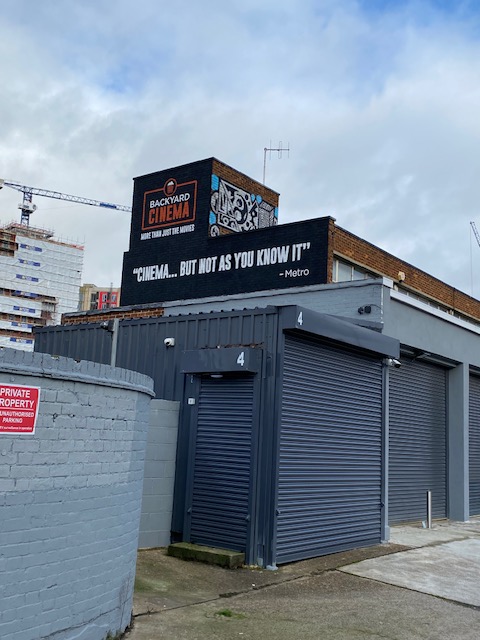
Almost next door to the Padel Yard is Backyard Cinema. It started as a passion project in the founders’ own back garden, and grew to be one of the leading alternative cinema experiences in the UK. It looks as if the venue has closed and are showing films at other places. It certainly looked locked up but it’s worth checking before visiting.
3. East Hill/Alma Road bus stop
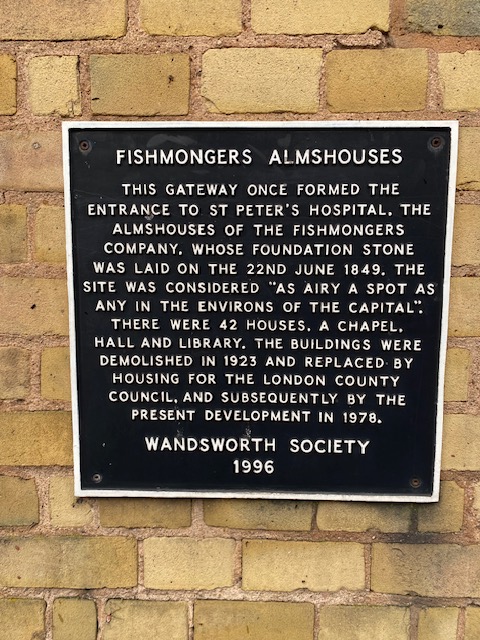
An unexpected stop was to see the gateway to the Fishmongers Almshouses in Wandsworth. This Victorian gateway was the entrance to St Peter’s Hospital, the almshouses of the Fishmongers Company. The foundation stone was laid on 22 June 1849 and the site was considered “As airy a spot as any in the environs of the capital”. There were 42 houses, a chapel, hall and library. The original Almshouses were bequeathed by Sir Thomas Hunt who, in his will of 1615, gave the Worshipful Company of Fishmongers £20 annually to establish almshouses. These days the site is home to residential properties.

4. Battersea Arts Centre bus stop
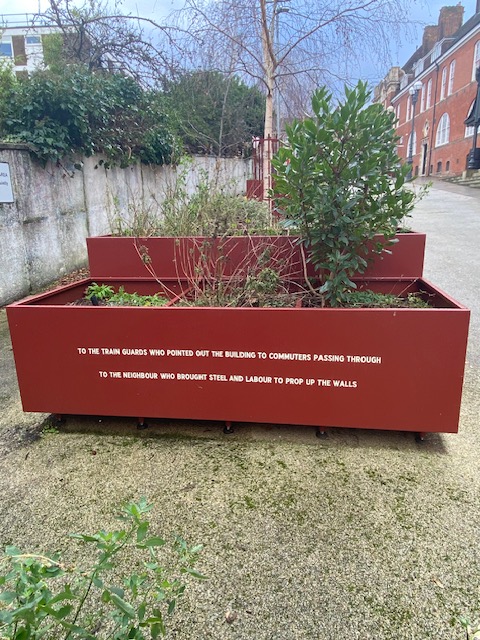
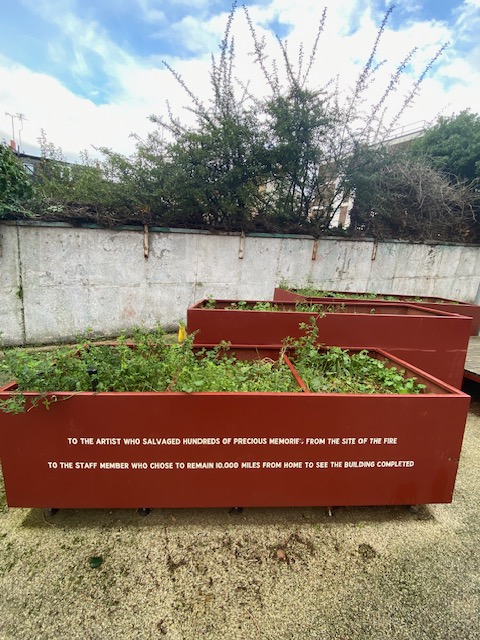
The Arts Centre is also on the number 77 route so walk round the corner to peek at the Community Garden. As part of a large-scale project, BAC installed a set of permanent artworks to celebrate the old town hall buildings 127 year history. Each installation represented a value such as courage, integrity and hope. Part way through the project in 2015, the Grand Hall was destroyed by fire. Such was the generosity of local individuals and large corporations, that the community garden was created to represent another value – that of generosity.

5. Nine Elms bus stop
There’s a lovely walkway from the bus stop, it’s called Merchants Way and it links the northern line station at Nine Elms with Arch 42, one of hundreds of Victorian arches sitting underneath the mainline railway between London Waterloo and Clapham Junction. This archway is a new pedestrian route with the tube station at one end and the river and US Embassy at the other end.
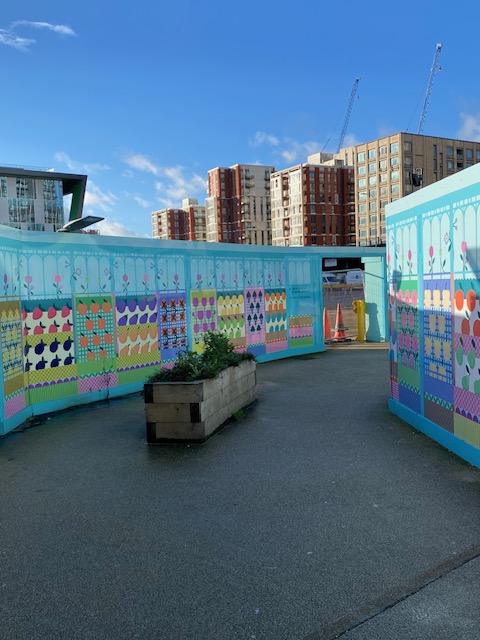


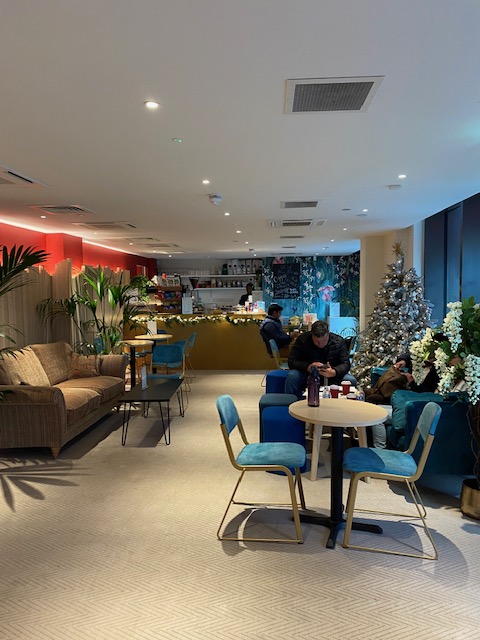
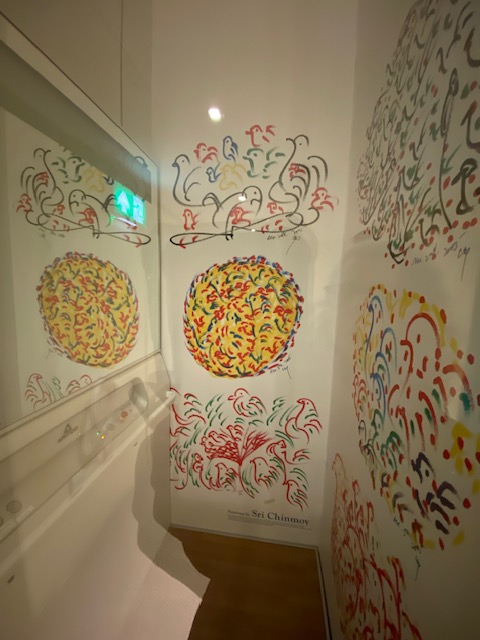
Having walked through Merchants Way with its fruit-laden walls, you come to World Heart Beat Music Academy. It was opened in 2012 in Wandsworth with the help of a Neighbourhood Excellence Initiative Award and support from local residents and businesses and in 2022, a second academy was opened here in Nine Elms. They provide access to instruments and free or subsidised music tuition to children and young people aged between 5 and 24 years, particularly those who come from challenging and disadvantaged backgrounds. All genres of music is taught including Asian, Celtic, Eastern European, Gypsy, Jazz and Reggae. There’s a café on the premises and the centre often puts on live music performances.

6. Horseferry Road bus stop
The stop is very near Victoria Tower Gardens, wherein is the Buxton Memorial Fountain It was erected in 1865 by Charles Buxton MP in commemoration of the Emancipation of Slaves in 1834. As William Wilberforce’s health failed, Sir Thomas Fowell Buxton took over in the Slave Trade abolition campaign and dedicated the memorial to his own father and Wilberforce, amongst others, all of whom were instrumental in bringing an end to the slave trade. The style of the Memorial is gothic and its elaborate tiles were restored to their former glory in 2007.
Before going further, look towards the river and the Houses of Parliament – you will have a magnificent view of the building.


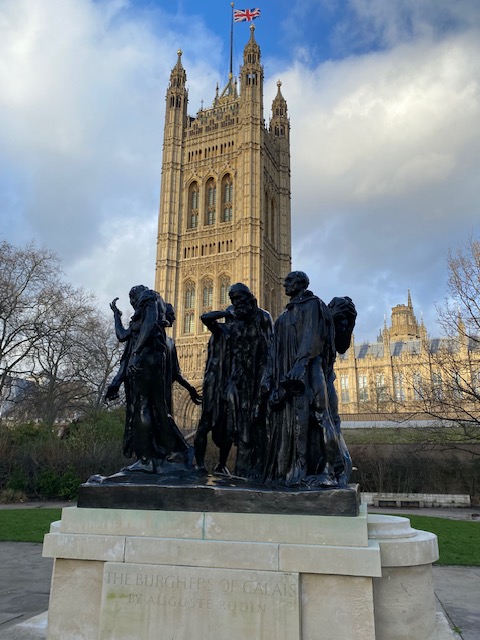
Also within the gardens are some sculptures worthy of note. One is by Auguste Rodin “The Burghers of Calais”, one of this French sculptor’s most famous pieces. It was completed in 1889 and serves as a monument to an occurrence in 1347 during the Hundred Years’ War, when Calais, an important French port on the English Channel, was under siege by the English for over a year. Calais commissioned Rodin to create the sculpture in 1884. Altogether, there are 12 casts. This one in Victoria Tower Gardens was cast in 1908, installed on this site in 1914 and unveiled 19 July 1915.


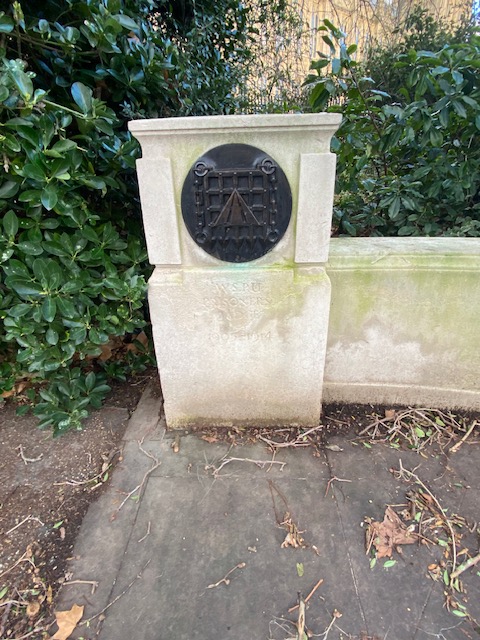
Still within the park is another sculpture – of Emmeline Pankhurst with separate memorials to her daughter Christabel and to the WSPU suffragette prisoners. Shortly after Emmeline Pankhurst’s death in 1928 a Pankhurst Memorial Fund was established, with her fellow suffragettes Rosamund Massey and Katherine “Kitty” Marshall as joint secretaries. Although the Chief Commissioner of Public Works, Sir Lionel Earle, was sympathetic to their cause, he believed that it would be impractical to place the statue in Westminster. After several locations were rejected, permission was granted to erect the statue in a corner of Victoria Tower Gardens near the Houses of Parliament. The statue was unveiled by the PM Stanley Baldwin, on 6 March 1930. In his speech he said: “I say with no fear of contradiction, that whatever view posterity may take, Mrs. Pankhurst has won for herself a niche in the Temple of Fame which will last for all time.”


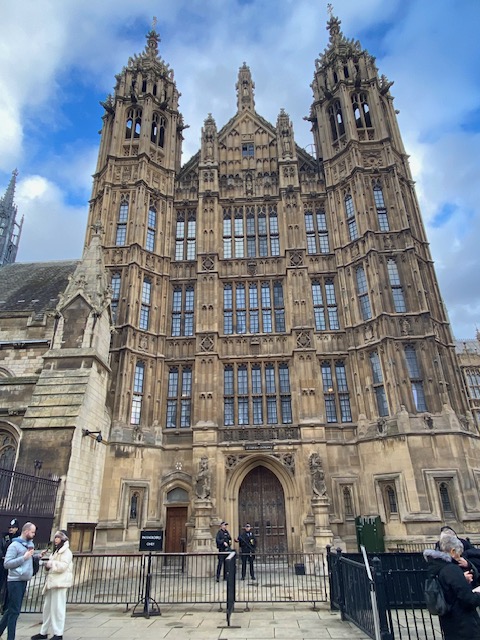
And so round the corner to Cromwell Green and the entrance to the Houses of Parliament. There is a magnificent bronze statue of Richard I (the Lionheart), astride a horse with the inscription “Richard I Coeur de Lion 1189 – 1199”. Also to be observed from the street is St Stephen’s Entrance – this leads into St Stephen’s Hall which is temporarily closed. The Hall stands on the site of the royal Chapel of St Stephen’s, where the House of Commons sat until the Chapel was destroyed by the fire of 1834.
During the second world war, the Commons Chamber was bombed and St Stephen’s Hall was used by the House of Commons on the first day of each session from 1945 to 1950, during the rebuilding of the Chamber. In 1960, the whole Hall was renovated and the war damage repaired.


7. Westminster station bus stop
It’s not far to walk from the previous places of interest to here but Westminster is the nearest bus stop. There is another impressive sculpture on Victoria Embankment – this one is Boadicea and her Daughters. Boadicea or Boudica, queen of the Celtic Iceni tribe, led an uprising in Roman Britain. The statue portrays Boudica accompanied by her two daughters, mounted on a scythed chariot drawn by two rearing horses. She stands upright, in a flowing gown, with a spear in her right hand and her left hand raised. Her daughters with bared breasts crouch in the chariot, one to either side of their mother. The statue was commissioned in the 1850s but owing to funding problems, it wasn’t actually erected in its present position until 1902, 17 years after the death of its creator, the sculptor Thomas Thornycroft.


8. Charing Cross/Trafalgar Square bus stop
Final stop for alighting on this route is near Trafalgar Square. Many other bus routes pass this way (15 and 24 are just two of them). Walk round to the Mall and there is the National Police Memorial which commemorates c4,000 police officers who have been killed in the course of their duties in the UK. In 1984, following the shooting of WPC Yvonne Fletcher, the film director Michael Winner founded the Police Memorial Trust. At first, the trust only erected small monuments at the spots where officers had died on duty but then lobbied for a single, larger scale memorial to commemorate all police officers who had died in the course of their duties.
Winner donated £500,000 of his own money to the campaign & the remaining funds were met by a public collection. Planning permission was eventually granted in Oct 2002 for the memorial to be placed at this site. In July 2004, a symbolic ceremony took place here, followed by an official unveiling by Queen Elizabeth II in April 2005. There are 2 elements to the memorial – a black rectangular enclosure inscribed with the police badge of office. And a glass column in a reflecting pool with the column internally lit with a faint blue light, symbolising the blue lamp which traditionally hangs outside police stations.
And so to the Trafalgar Theatre in Whitehall which sits as a mediator between two worlds – Downing Street and Shaftesbury Avenue, the Mother of Parliaments and Theatreland. Originally called the Whitehall Theatre, it opened its doors on September 29th 1930. It’s a grade II listed building and it was built in Art Deco style. During its history, it has staged many comedies and at one point was known for its Farces, with Brian Rix as the actor-manager. For a while in the 1990s, it became a studio for TV and radio and these days, it has reverted to a 630-seat theatre.


This is an interesting route, with lots to recommend it. However, one thing I learned was to be even more careful when researching beforehand where to go. Several of the places I’d identified prior to the start were closed (the Mall Galleries, Matt’s Galleries) or seemingly non-existent (The London Clockmaker and International Centre of Time). The website for both galleries had stated they were open so it might be worth calling before venturing out to see them.
Toilets that are free and available to the public:
- The Plough Pub near Plough Road bus stop
- World Heart Beat
- Battersea Arts Centre
 london routemistress