
Slough Bus station to Hounslow
Highlights:
- King John’s Palace
- The Island
- Village Lock-up
1. Slough bus station – bus stop
Before starting on the number 81, there are a few things worth seeing in and around Slough centre. First is Slough railway station. The original Brunel-era station buildings were made of timber and date back to 1838. The station was rebuilt in 1882 in a “Second Empire” style. The buildings have survived largely intact. It is a near-unique design on the Great Western Railway, with the most notable architectural details being the unusual scalloped roof tiles and the decorative ironwork around the top of the buildings.


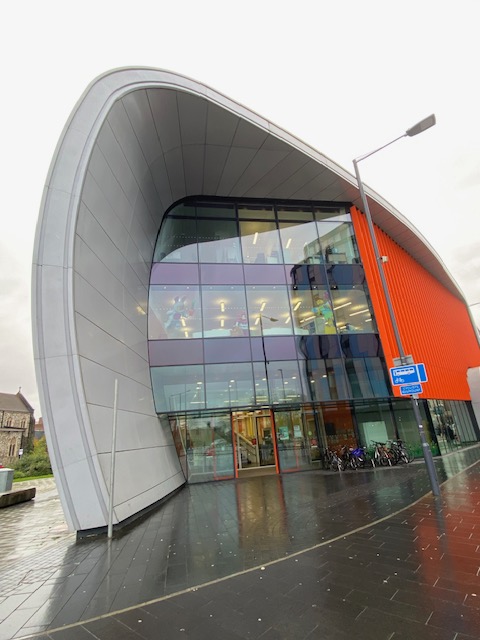
Over the road towards the town centre, is an impressive building called The Curve, so-named for obvious reasons. Slough’s iconic library and cultural centre houses a library, performance venue, gallery, a museum and plenty more. The unique three-dimensional curved building began construction in January 2014 and opened to the public in September 2016. Not surprisingly, it won Development of the Year at the Thames Valley Property Awards 2017.


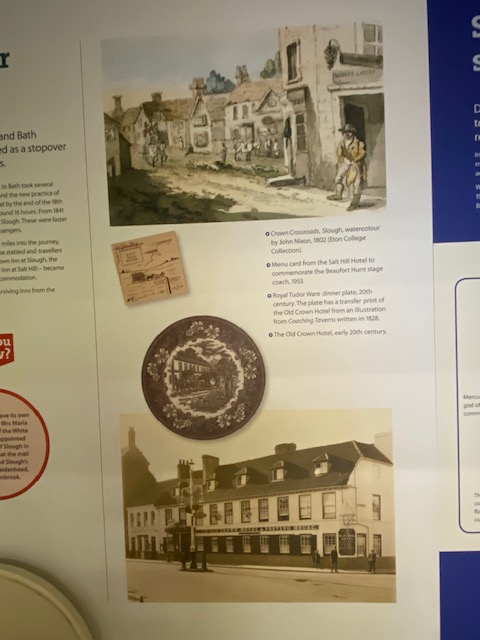
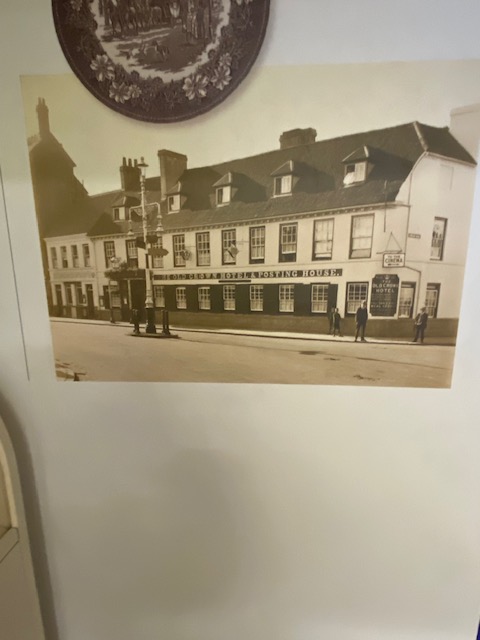
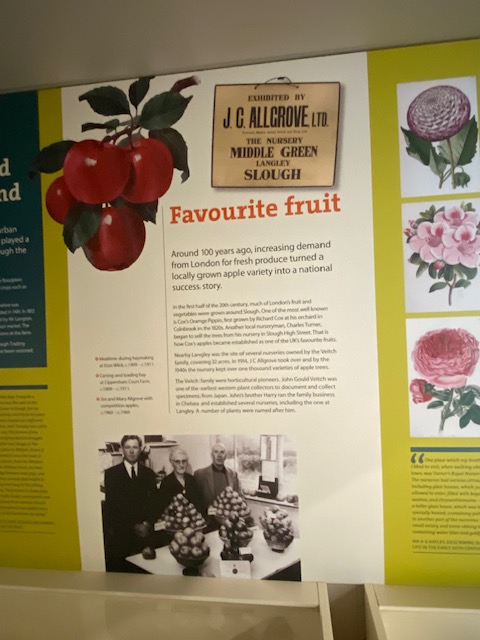
Inside the Curve is a museum with information about the history of Slough, showing pictures of places from the 19th and 20th centuries, as well as explaining that the original Cox’s Orange Pippin apple was first grown by Richard Cox at his orchard in Colnbrook in the 1820s.
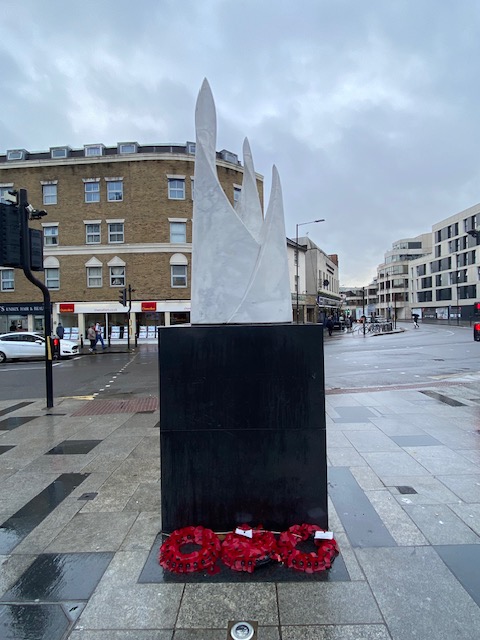
Back towards the High Street, there is a lovely memorial to those residents of Slough who had died during the two world wars, with the simple inscription “Slough’s Memorial to the Fallen“. This sculpture sits above someone’s average height so that everyone can see it down the high street.
The final place to visit before getting on the bus is St Ethelbert’s Church. It was built between 1908 and 1910 in the Gothic Revival style and is a Grade II listed building. The site of the church was bought in 1889 for £1,050. However, raising funds for the construction of the church proved difficult. In 1908, thanks to a donation from the superior of the Bernardine Cistercians of Esquermes, in memory of her parents, the foundation stone of the church was laid.


2. Cedar Way bus stop
The bus stops right outside Kedermister Park, which is a sizeable green open space, particularly geared up for sports and outdoor games. Today was particularly wet so the walk round the park was brief!
3. Ditton Park Road bus stop
A short walk from the bus stop is Ditton Park. Inside the park is Ditton Manor House but this is now privately owned and is used for weddings and conferences, so it was definitely closed today. Ditton Manor House and its courtyard walls, stables and observatory are Grade II listed. The original house was probably built around the early 1600s and was taken down as it was damaged by fire in 1812. The house was the English home of Charlotte Anne, the Duchess then Dowager Duchess of Duke of Buccleugh.
Nearby and set within the park is a pretty but dilapidated church. Apparently the interior is in disrepair though the walls and fabric of the building look solid enough. The small building was formerly a chantry, became a chapel by 1925 served by the vicar of Datchet, and has since been closed down.




4. Ye Olde George Inn bus stop
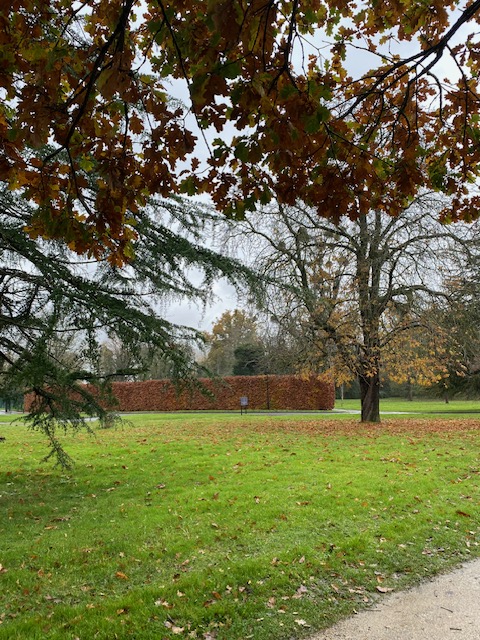
This bus stop has a wealth of fascinating places to see within a few minutes’ walk. The bus stops right outside Ye Olde George Inn, which probably dates to the 16th century and Princess Elizabeth, daughter of Henry VIII and later to become Queen Elizabeth, is reputed to have stayed there overnight in 1588. The façade dates from the mid 18th century when the owner, a John Jagger, more than doubled the size of the inn to include the buildings on either side. The timber frame is still visible in the older part of the building. Located in the original market place, the George Inn had a prime location in the days when this was a stopping place for stage coaches and mail coaches travelling between London and Bath.
Outside the inn is a village clock, named the Jubilee clock as it was unveiled to commemorate Queen Elizabeth II’s diamond jubilee in 2012.


A few minutes’ walk away from the inn is King John’s Palace. It lies on ground where King John is thought to have stayed on his way to sign the Magna Carta at nearby Runnymede in 1215. It was once a coaching inn that has now been converted into residential properties. The building dates to the 16th century and is Grade II listed with a painted rendered front and a tall central arched carriageway which would allow horses to be stabled at the back of the inn.


Opposite the entrance to King John’s Palace is the Ostrich Inn, reputed to be the third oldest inn in the UK. It’s situated on the High Street in Colnbrook, which was part of the old route of the Bath Road. The foundations of The Ostrich were laid in 1106, when Henry I was on the throne. It was originally named ‘The Hospice’ but over the centuries it has been corrupted to its current name; The Ostrich.
Final place of interest before getting back on the 81 is Colnbrook Baptist Chapel. The church itself was formed in 1708 by 13 men and women who were baptised on the 14th April in that year. Using different places to worship for many years, the foundation stone for this particular chapel was laid by Mr John Rayner on the 14th September 1871.


5. The Square bus stop
Behind the bus stop is an area known as “The Island”. It’s 4 acres of land surrounded by the river Colne and is in an area called Longford, which had belonged at one time to King Harold, the last Saxon king. It passed through various royal hands, including Henry VIII and in fact remained Crown property until 1874. There are many houses on the Island, one that stands out is Colne Cottage. It dates back to late Victorian, and has gables with bargeboards and a circular turret with Gothic style windows. The whole property is rendered and painted blue, giving it a striking appearance within its island setting. It is a building of character and interest.



6. Bolton’s Lane bus stop
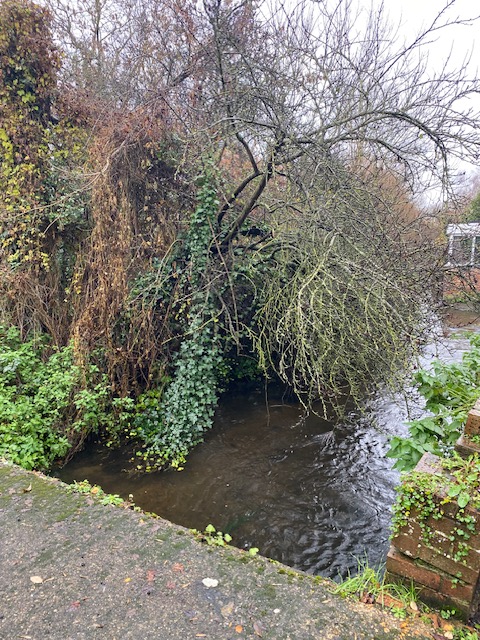
A large part of the 81 route goes around the perimeter of Heathrow airport so it seems a good thing to get out at this stop and find your way to the Viewing Stand. It’s a small stand but it’s covered and has seating so it’s possible to sit and watch planes taking off. And if you’re a plane spotter, this could be just the place to go!


7. Waye Avenue bus stop
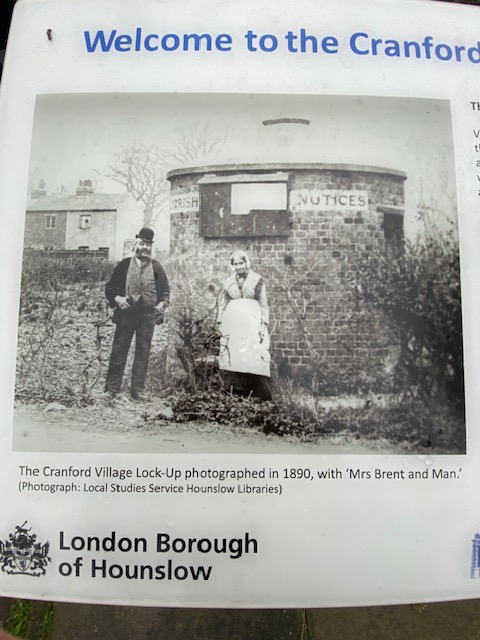
Final stop on this route – especially on a rainy day such as this was – is Waye Avenue to see a small building known as the Cranford Village Lock-Up. Until the 19th century Cranford was a small village on the Bath Road – the main route leading into London from the west. Robbers preyed on wealthy travellers going in and out of the city, and when they were caught, the local constable locked them up in this small, dark, cold ‘Highwayman’s Cage’. As police stations were built across London lock ups went out of use, and this was a lucky survival – very nearly removed when the land was developed in the 1930s. If you get up close to it, you’ll be shocked that anyone could last any time at all in such a small, claustrophobic space.


The weather today was really shocking and as many of the places of interest that I’d researched were outdoors, it meant I had to leave out some of those that were a little further away from bus stops. Certainly, they’ll be there for another bus journey.
Despite the rain and cold, it was a great route, with some fascinating places to see.
Toilets that are free and open to the public:
- Slough railway station
- The Curve library
 london routemistress