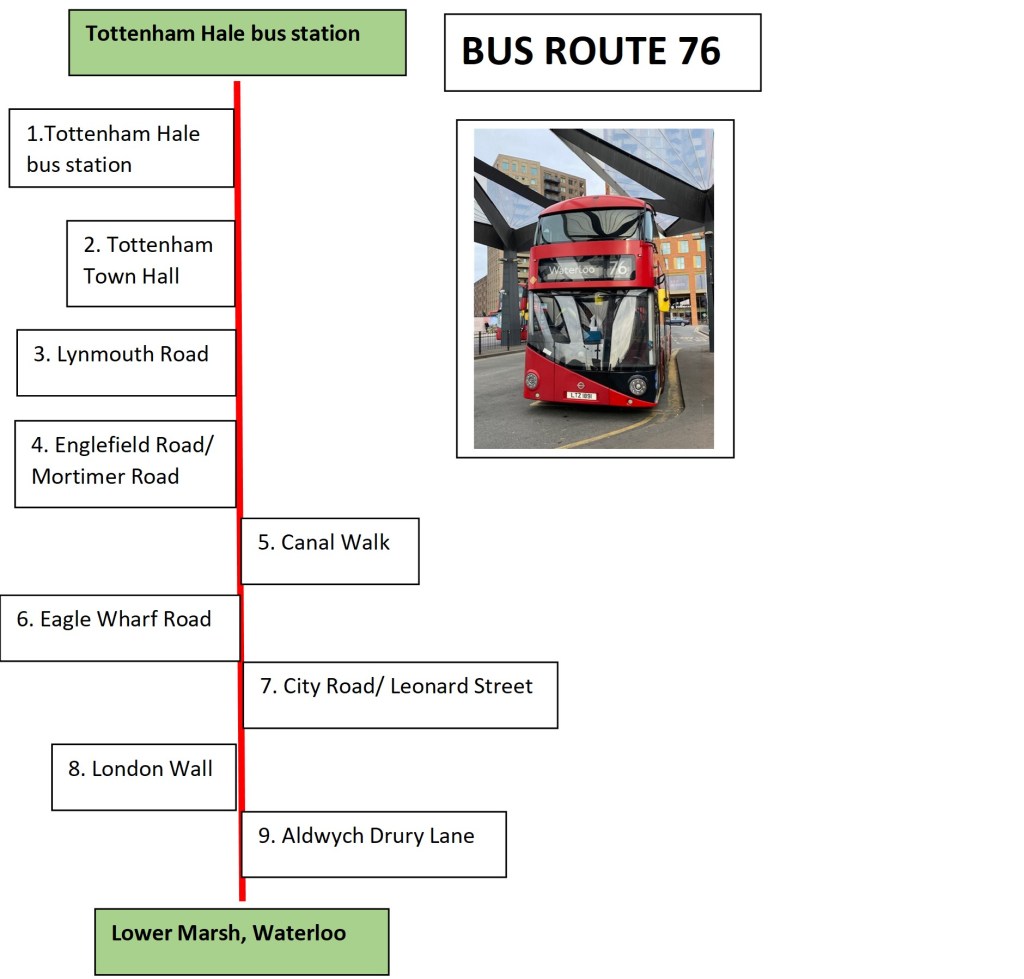
Tottenham Hale bus station to Waterloo, Lower Marsh
Highlights:
- The Engine Room and Walthamstow Wetlands
- Shoreditch Park and Hitchcock’s Reel
- Wesley’s Chapel
- Reflection Pool
1. Tottenham Hale bus station
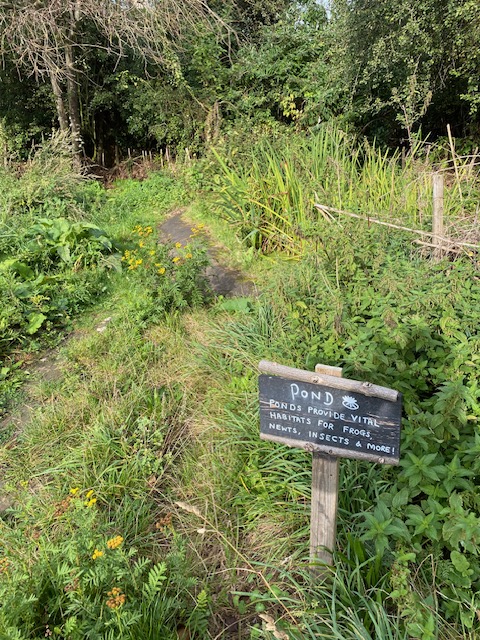
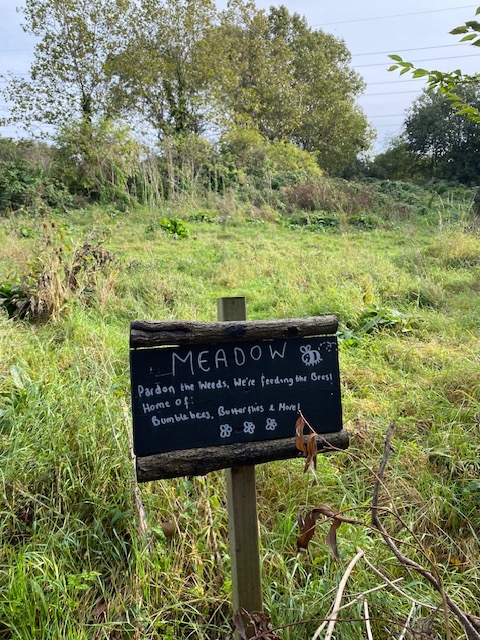
This is one of those routes that has plenty to see before getting on the bus at its beginning. Walk around the corner from the station and you’ll come to The Paddock, a community nature reserve. Until the 1850s, the Paddock formed part of common land that supplied grain to Tottenham Mill. After WW1, it was used as a sports ground and gradually became derelict, though it was occasionally used to graze horses and hence the name “The Paddock”. It’s now owned and managed by Haringey council in partnership with Friends of the Paddock (mainly volunteers) and they provide a valuable habitat for wildlife such as water birds and other aquatic animals and plants.


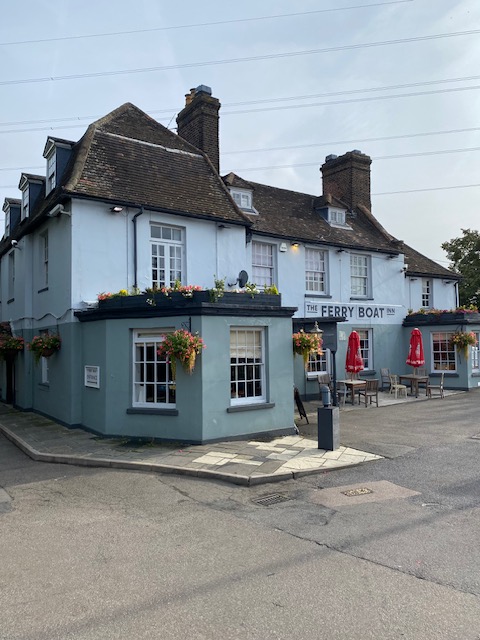
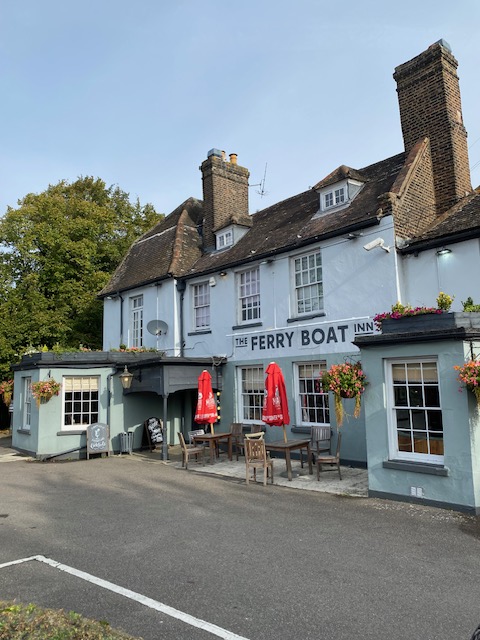
Not far up the road is the Ferry Boat Inn. A useful bridge was built over the river Lea in the late 16th century. A ferry beside the main bridge, mentioned in 1722, belonged to Walthamstow Tony manor. The ferry-house, which was probably rebuilt soon after 1738, became the Ferry Boat inn.
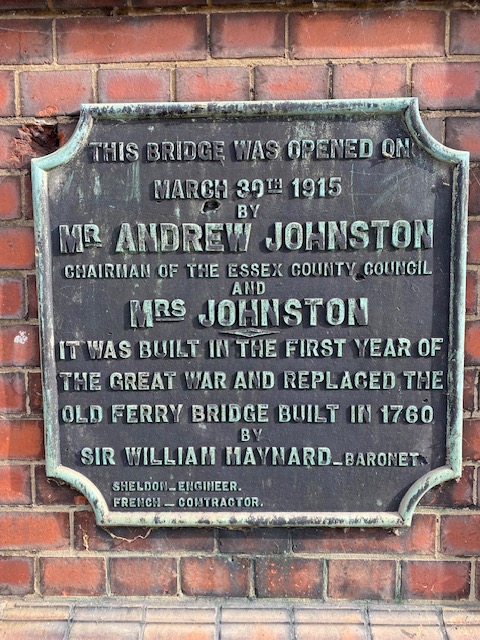
In 1760, Sir William Maynard rebuilt the bridge as a private toll-bridge for horses and carriages. It was called Ferry Bridge and was repaired in 1820 with iron trestles replacing the timber ones. The old bridge was demolished in 1915 when the present Ferry Lane bridge was built a little downstream. In 1986 the inn was added to the Statutory List of Buildings of Special Architectural or Historic Interest at Grade II, being described as an 18th century building with 19th century additions.

Opposite the Inn is an entrance to Walthamstow Wetlands, a huge site comprising ten reservoirs that provide drinking water for London and which are internationally recognised for their importance for migrating birds – particularly overwintering wildfowl. The Wetlands contains a range of habitats and experiences, and remains the largest fishery in London. It is part of the Lee Valley Special Protection Area, and site of metropolitan importance for Nature Conservation.
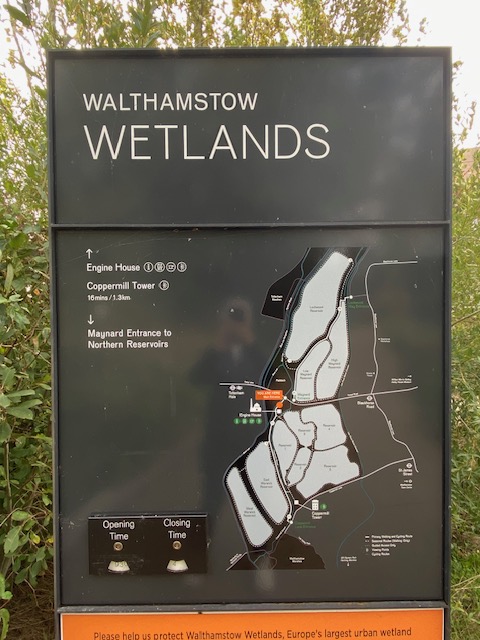


Set within the area of the wetlands is the Engine House. Built in 1894, it has been recently revamped to combine its original architectural features with modern amenities. It was known initially as Ferry Lane Pumping Station and remained in service until the 1980s. When the engineers starting building the Station in the 1890s, they discovered that underneath the building was a network of underground reservoirs, chambers and pipes that linked the reservoirs and reached as far as Stoke Newington.
The Engine House was originally built to provide London’s population with safe and reliable drinking water. The Wetlands continue to provide drinking water to over 3 million people in London. These days the Engine House is home to an extensive shop (the Boiler Room) and café (the Turbine Room) with a mezzanine from where you can see stunning views of the Wetlands. The venue is often used for weddings and other festivities.


2. Tottenham Town Hall bus stop
The Town Hall is an impressive looking, grade II listed building. The foundation stone was laid in 1904 and the municipal building was officially opened the following year. Designed in the Baroque style, it has a symmetrical frontage with the central section of five bays featuring a doorway flanked by Tuscan style pilasters. The rounded windows are flanked with Ionic columns and there is a cupola with a clock at roof level. A plaque on the front of the building commemorates Bernie Grant who had been a local MP and who held his surgeries within the town hall.


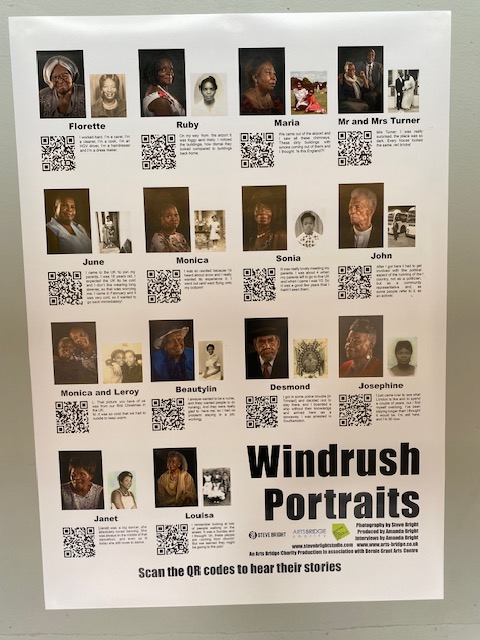
Just round the corner from here is the Bernie Grant Arts Centre (BGAC) a purpose-built multi-arts centre. Inside there is a 274-seat auditorium, studio/rehearsal space, café/bar, enterprise centre and open spaces. It is named in honour of Bernie Grant, MP, who represented the area. It was an initiative started before his death in 2000, through which he aspired to create “a unique showcase for international multicultural talent”. During October each year, BGAC is involved with Black Lives Matter Month and inside the reception area is a Windrush Elders Exhibition. You can see a series of images, taken by a local photographer, capturing striking portraits of those who have paved the way for the next generations in Britain.



3. Lynmouth Road bus stop
Make your way to the Campbell Works Art Gallery in Belfast Road. As it doesn’t open until 12.00, it wasn’t possible for me to visit inside on this occasion but it certainly looks worth a trip. The gallery was established through a collaboration of artists Neil Taylor & Harriet Murray. They run “an artist-led gallery space, initiating and curating art projects, and undertaking a wide range of public realm interventions.”


4. Englefield Road/Mortimer Road bus stop
A couple of minutes’ walk from the stop is De Beauvoir Square and Garden. The area was originally part of the Estate belonging to the de Beauvoir family and was broken up over time with the square starting to be built in 1838. Three sides of the square consist of pairs, mostly of two bays with high pitched roofs and two storeys over basements, with attics under shaped gable-ends. In the centre, is a classically laid out garden square and is protected under the London Squares Preservation Act of 1931. It consists of pretty rose beds and lawn areas . The park holds a Green Flag award, given to the best green spaces in the country.


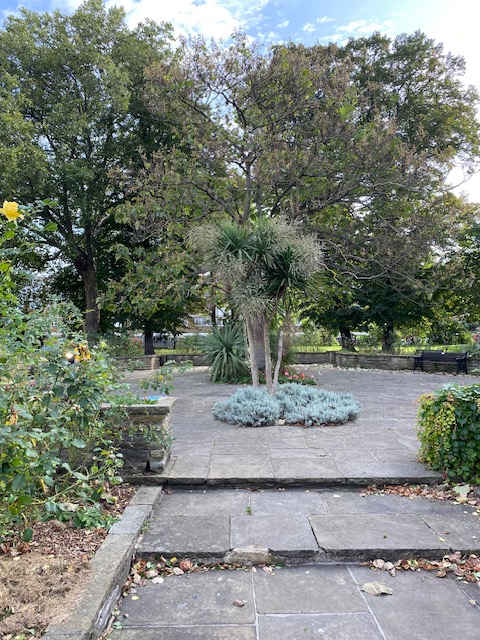
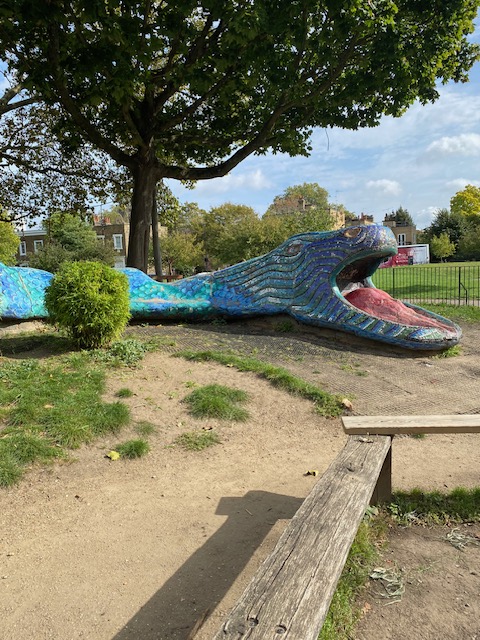
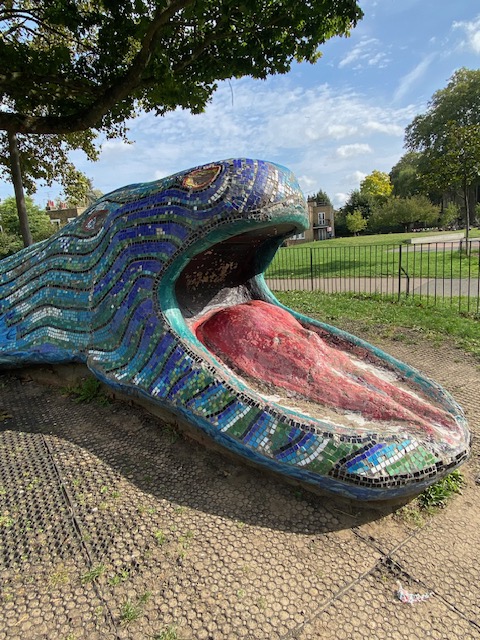
From here, walk round to Stonebridge Gardens where you will immediately be confronted with the Mosaic Snake. The gardens are small but popular and are home to the ever popular blue snake, a large mosaic play and art feature. The park was first opened in 1958 and was “neatly set out with flowering shrubs and borders to relieve the monotony of housing estates with over 30 newly planted trees and seats placed between rose beds.” These days it’s called the Snake Park as a result of the large mosaic snake.

5. Canal Walk bus stop
This is the stop for Haggerston Wharf but before you arrive there, you’ll find yourself opposite an iconic building with the words Thos Briggs (London) Ltd on the top. This Georgian factory was built in the 1700s. Throughout the two World Wars, the factory was a tent manufacturer for the Army. Later, it made heavy canvas goods. The factory relied heavily on the nearby canal, to import the industrial goods they needed. The factory closed down in the 1960s as it struggled for business, due to the canal not importing goods anymore and other factories and more contemporary buildings, were being constructed around it.
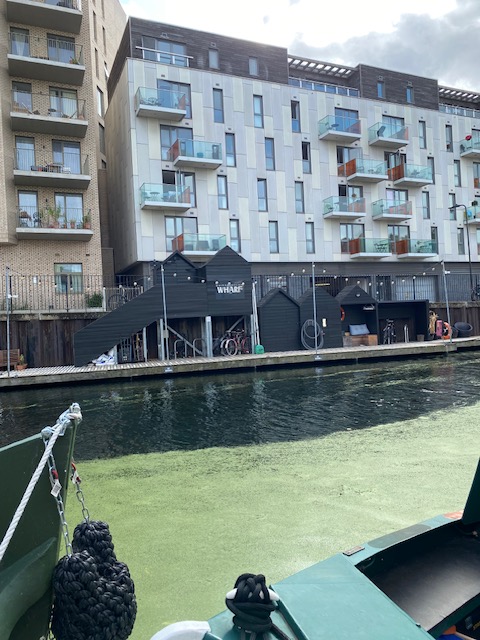
Haggerston Wharf was once an inaccessible section of the Regent’s Canal and has been transformed into a well-connected, tranquil and green setting. The wharf has twice been part of Open House London attracting hundreds of curious visitors who are able to get a glimpse of the gentle chugging of passing boats.


6. Eagle Wharf Road bus stop
Walk round to Shoreditch Park and you’ll immediately see Hitchcock’s Reel. This giant film reel commemorates the work of director Alfred Hitchcock, who shot 12 films at nearby Gainsborough Studios, including ‘The Lady Vanishes’ and ‘The 39 Steps’. Look behind the reel and you’ll see some letters writ large on the building behind. This is in fact the old Gainsborough Studios, now converted into 280 luxury apartments. In 1922 (aged only 23) Hitchcock had his first shot as a director at Gainsborough with “Number 13”, a silent movie. Interestingly, the production went bust and was never completed. Gainsborough Film Studios were named for the logo of Glennis Lorimer in Georgian costumes based on (the painter) Gainsborough’s portrait of Sarah Siddons.
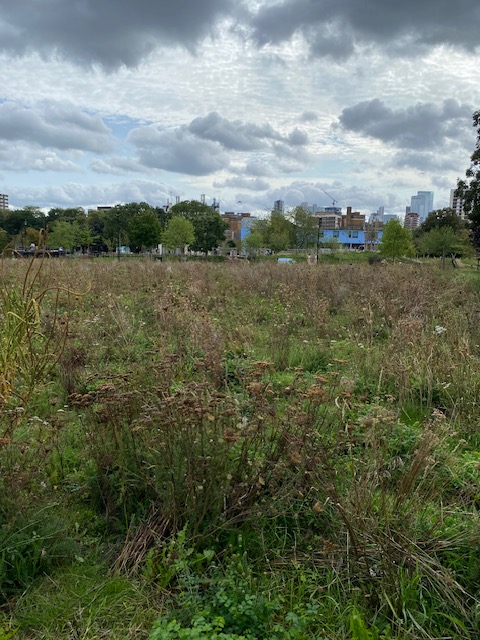
Also in the park is an 85-tonne granite boulder by the artist John Frankland. This boulder is one of a pair, the other being in Mabley Green. It’s a public-realm sculpture but it’s also available to rock-climbers. Frankland himself is a keen and experienced climber and considers physical contact with the rock as a way of energising the work, as well as a way of playfully debunking the notion of those sculptures in park settings, which are often fenced off or prominently labelled as ‘not to be touched’. Also of note in the park is an amphitheatre, which is used for theatre and cinema screenings, and a lovely wildflower meadow.


7. City Road/Leonard Street bus stop
Opposite the stop in City Road is Wesley’s Chapel and the museum of Methodism. There’s so much to see and explore here so prepare to spend some time looking around. Opened in 1778, it was built under the direction of John Wesley, the founder of the Methodist movement. It is a place of worship as well as a visitor attraction, which incorporates the Museum of Methodism in its crypt. The City Road Chapel was built to replace Wesley’s earlier London chapel, the Foundery, and the original pulpit from this chapel, can be seen in the museum.
The Georgian building is Grade I listed although it has been altered and improved since it was built. In 1864, the gallery was modernised, its front lowered and raked seating installed. The pillars supporting the gallery were originally ships’ masts donated by King George III, but these were replaced by French jasper pillars donated from Methodist churches overseas. Former Prime Minister Margaret Thatcher was married in the chapel in 1951.
Wesley died on 2 March 1791. His tomb is in the garden at the rear of the chapel along with the graves of six of his preachers, his sister Martha Hall and his doctor and biographer, Dr John Whitehead.


8. London Wall bus stop
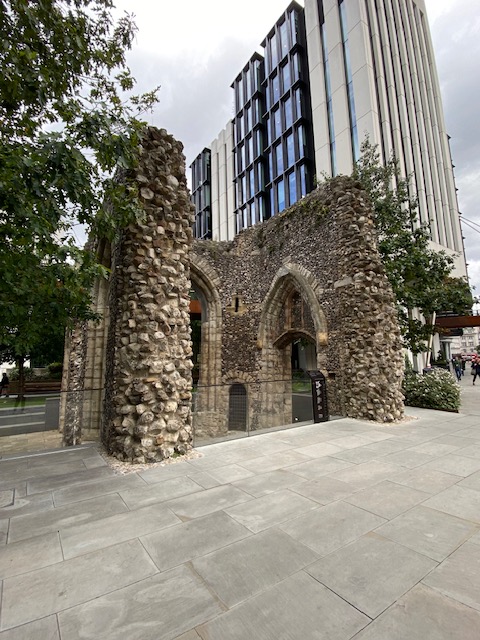
This stop is, predictably, for some of the surviving sections of London Wall. First you’ll come to The Tower of St Elsyng Spital, a hospital founded by William Elsyng in 1331, to provide care for London’s homeless blind people. It was likely to have been more like an almshouse than a modern hospital, providing a permanent home for poor people who couldn’t look after themselves. Round the corner from the Tower is a length of the wall that still exists, which was rediscovered after German bombing raids in 1940 had destroyed the area. Archaeologists were able to identify the site of the Roman fort for the first time.

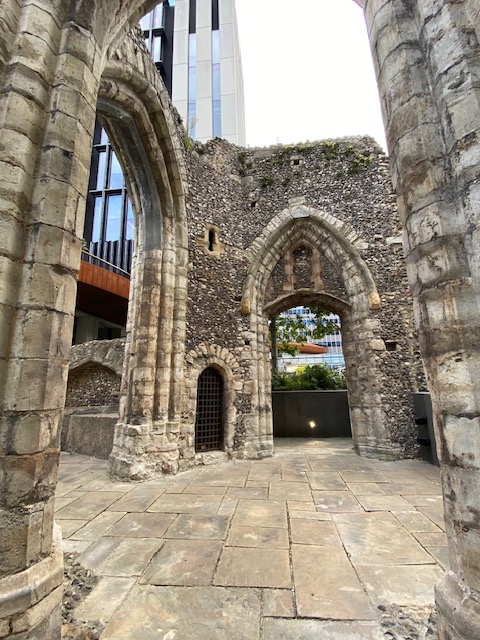

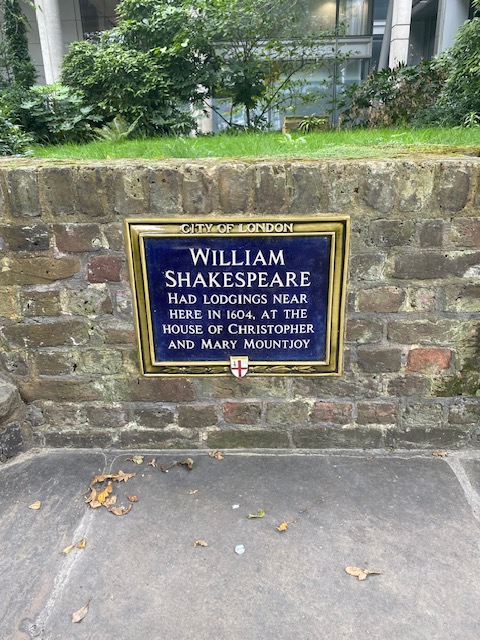
From here, head round to St Olave Silver Street and you’ll find a board explaining what had been on the site previously. The church of St Olave had been destroyed in the Great Fire of London in 1666. Also here is a plaque stating that William Shakespeare had lived near the site in 1604, at the house of Christopher and Mary Mountjoy.

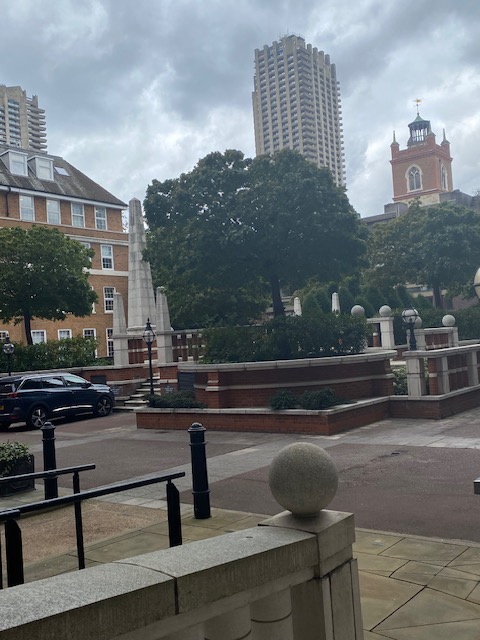
From here make your way to Monkwell Square, a garden square that’s part of the Barbican estate. Set around the square is the Barber-Surgeons’ Hall, which was established round the corner in the 14th century and was rebuilt here after the original building was destroyed in World War II. The Fellowship of Surgeons merged with the Barbers’ Company in 1540, forming the Company of Barbers and Surgeons, but it split in 1745, part of which formed what would become the Royal College of Surgeons. The company no longer retains an association with the hairdressing profession, and principally acts as a charitable institution for medical and surgical causes.


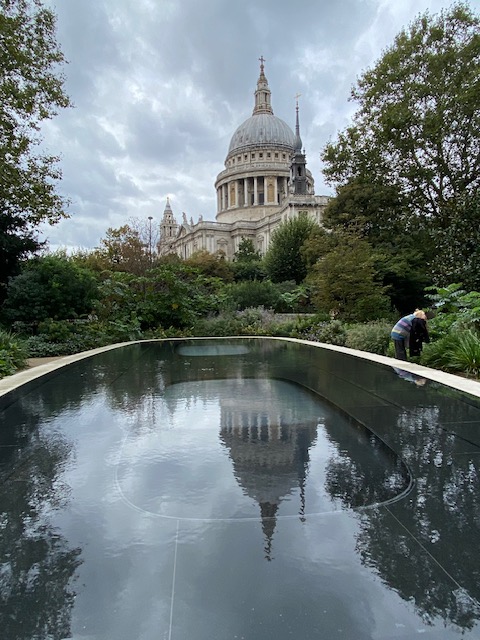
A short walk will take you to the Reflection Garden and Pool in the sight of St Paul’s Cathedral. The pool is set within the new Reflection Garden and creates a double view of St Paul’s dome as it is mirrored in the water. As you face the famous dome of St Paul’s, look at its reflection in the pool, and you’ll see it’s perfectly framed in an upside-down view of the dome. It’s a great alternative shot of the London landmark, and the garden itself provides a moment of quiet in the middle of the city.


Another park in the vicinity is Festival Gardens, which was created in 1951 by Sir Albert Richardson as part of the City of London Corporation’s contribution to the Festival of Britain. The immediate area surrounding St Paul’s was originally a confined network of streets which was subsequently redeveloped into the present layout. Set within the gardens is a bronze sculpture “The Young Lovers” by George Ehrlich, which was installed in 1973.


9. Aldwych/Drury Lane bus stop
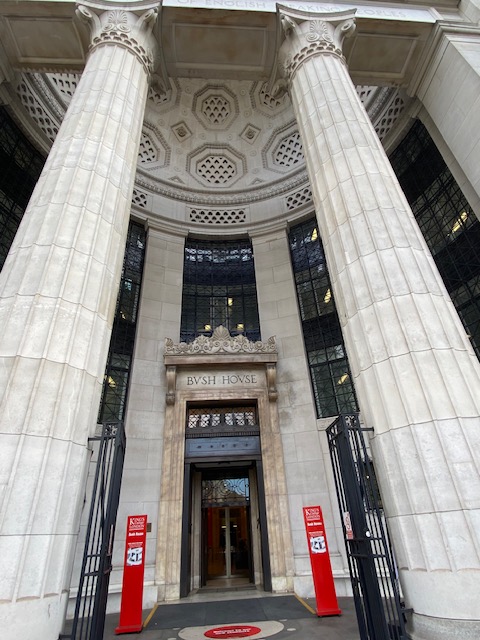
Final stop on this route is to see Bush House. It is a Grade II listed building and was conceived as a major new trade centre by American industrialist Irving T. Bush, and commissioned, designed, funded, and constructed under his direction. The design was approved in 1919, work began in 1925, and was completed in 1935. Erected in stages, by 1929 Bush House was already declared the “most expensive building in the world”.
The BBC European Service moved into Bush House after bombs damaged Broadcasting House in 1940 during The Blitz. The BBC Overseas Service followed in 1958, with the BBC World Service occupying four wings of the building. The BBC gradually relocated and the final broadcast from Bush House was on 12 July 2012. These days it’s home to King’s College London and King’s Business School.


There are a considerable number of historic places on this route, with some lovely outdoor spaces too. If you’re doing the full route, make sure you have enough time to do it justice.
Toilets that are free of charge and available on this route:
- The Engine House near Walthamstow Wetlands
- Bernie Grant Arts Centre
- Wesley’s Chapel and Museum
 london routemistress