Week 2 of the London Routemistress venture

Monday 22nd November 2021
Not having learned from last week, I took the tube to Brixton, rather than start at the beginning of route 2 at Marylebone. I came out of the station to go to Brixton Library. This is a grade II listed building which was built in the 1890s by the sugar magnate Sir Henry Tate. Because it’s Black History Month, the library was showing a Windrush exhibition, focusing on the Caribbean community in South London, specifically those who came to England during the two decades following the Second World War. The Windrush was a ship that brought the first migrants to Tilbury on June 21st 1948.
The exhibition showed in pictures and words how the migrants came here and in particular talked about the first 25 years.


From the library, I took the #2 bus outside St Matthew’s Church towards Norwood Bus Garage. I got off the bus at Vauxhall Pleasure Gardens and had a walk around. The Gardens were first laid out in 1661, reaching the height of their popularity in the early 1800s. The rich and famous wanted to see and be seen – such celebrities as Handel, Casanova, Pepys and Rossini. There was live music and other entertainment for Londoners and tourists alike.

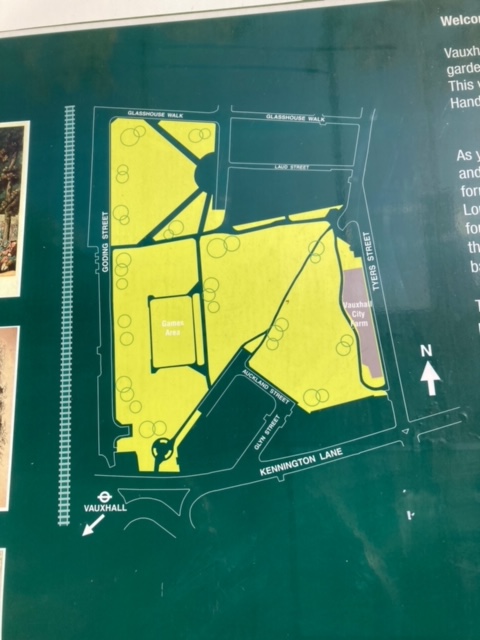

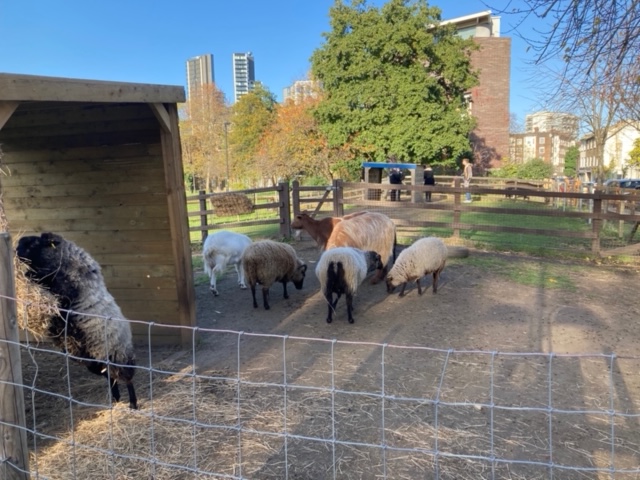
At one end of the Gardens is Vauxhall City Farm. Although it was closed today, being a Monday, I was still able to see some llama, sheep & goats. The farm is run as a charity and is a centre for Riding for the Disabled. Its history goes back to the 1970s when much of the area was being demolished, and the local residents were unhappy so protested and were given permission to convert the area into a farm where vegetables were grown and animals were kept.


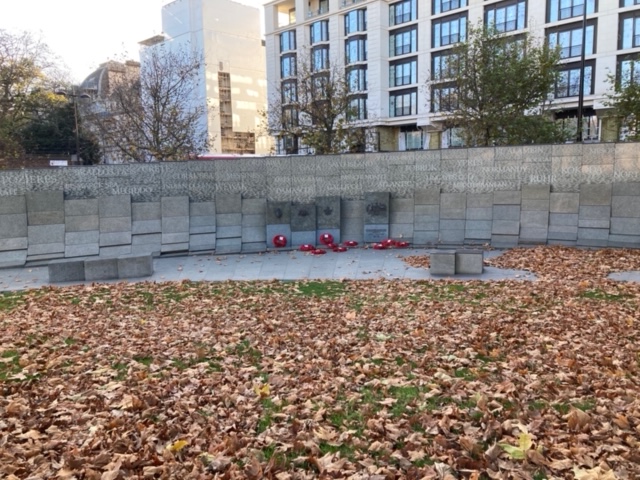
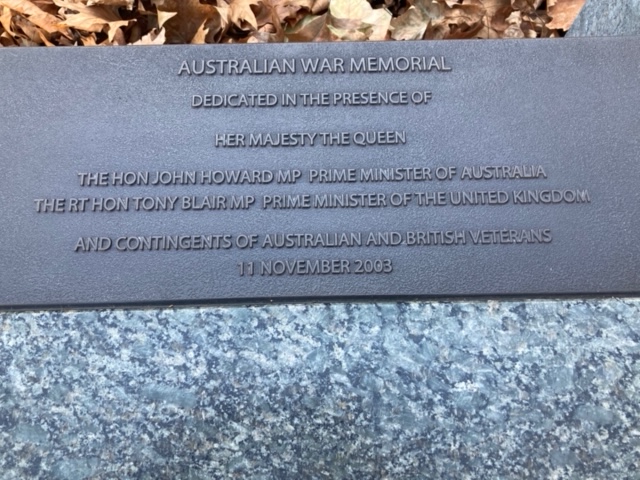
From here, I got back on the #2 and headed for Hyde Park Corner where I got off the bus. I made my way to the Australian War Memorial which was dedicated on 11th November 2003 in the presence of Queen Elizabeth II, John Howard – PM of Australia, and Tony Blair – PM of the UK. It’s dedicated to the 102,000 Australian dead of the First and Second World Wars.
The memorial comprises a semi-circular curved wall of grey-green granite slabs from Western Australia and cut before being shipped to London. The granite stones are inscribed with the names of 23,844 towns in which the Australian soldiers were born, in Australia, the UK and elsewhere.


Whilst I was so near, I went to see the Wellington Arch, which is a Grade I-listed triumphal arch by 19th century architect Decimus Burton. It originally supported a huge equestrian statue of the 1st Duke of Wellington by the sculptor Matthew Cotes Wyatt, as a result of which it has acquired the name “the Wellington Arch”.
Having had a pretty eventful few hours, I made for home.
Thoughts about the day: this was much more productive and interesting than the first bus journey. I had identified three places of interest to explore and I visited them all, so there was no disappointment today. However, I feel as if I’ve short-changed myself so I think from now on, I need to find the start of the route, no matter how far from home, and ride the bus to the end of the route, stopping off as many times as I want/need.
What I found invaluable was the research I’d done prior to setting out. Not just finding out the route but finding places to visit en route and where to get on and get off in order to see them. Three things to see are enough per bus route and of course it depends on how much time is taken at each place.
So far, I’ve been excited and stimulated by this new venture, not least because I’m visiting parts of London that I haven’t been to before.
 london routemistress